English


 Post by
Introduction: The Corrosion Challenge in Europe’s Solar Renaissance
As Europe accelerates its renewable energy transition to meet RepowerEU targets, utility-scale ground-mount solar installations are moving into increasingly demanding environments—from coastal zones in southern Spain to high-moisture agricultural and industrial soils in Germany.
Hot-Dip Galvanized (HDG) steel served as the industry standard for ground-mount PV structures. However, modern 25-to-30-year plant lifespans, combined with strict European quality and environmental directives, have exposed the limits of HDG.
Enter Zinc-Aluminum-Magnesium (Zn-Al-Mg / Magnelis® type) steel coatings. Delivering up to 3 to 10 times higher corrosion resistance than traditional HDG at reduced coating thicknesses, Zn-Al-Mg has rapidly become the preferred material choice for European EPCs and project developers.
Here is a technical deep dive into why Zn-Al-Mg coated steel is replacing HDG in ground-mount solar systems across Europe—and how it directly lowers the Levelized Cost of Electricity (LCOE).
1. Superior Corrosion Resistance in Coastal and Harsh Soils (C4 to C5-M Environments)
Under European atmospheric classification standards (ISO 12944-2), coastal solar farms in regions like Andalucia (Spain) or northern Germany often fall into C4 (High Corrosion) or C5-M (Very High Marine Corrosion) categories.
| Property | Traditional Hot-Dip Galvanized (HDG) | Zinc-Aluminum-Magnesium (Zn-Al-Mg) |
| Coating Composition | 99%+ Pure Zinc (Zn) | Zinc + 3.5% Aluminum + 3% Magnesium |
| Salt Spray Test Resistance | ~500 – 1,000 hours | Over 3,000 – 4,000+ hours |
| Coating Layer Thickness | 50 – 85 µm (Heavy) | 15 – 35 µm (Lightweight yet durable) |
| Corrosion Rate in C5 Environments | ~4.2 to 8.4 µm/year | < 0.8 µm/year |
How the Chemical Structure Works:
When exposed to air and moisture, the addition of Magnesium (Mg) and Aluminum (Al) forms a dense, stable protective layer of Simonkolleite. This protective film acts as a permanent barrier against aggressive chloride ions in coastal regions and sulfur dioxide in agricultural soils.
2. Revolutionary Self-Healing Cut Edges: Eliminating Post-Processing Bottlenecks
One of the biggest pain points with traditional HDG steel occurs during post-production machining. Punching holes, shearing, or cutting HDG beams exposes the raw carbon steel core to red rust unless manually recoated with zinc spray.
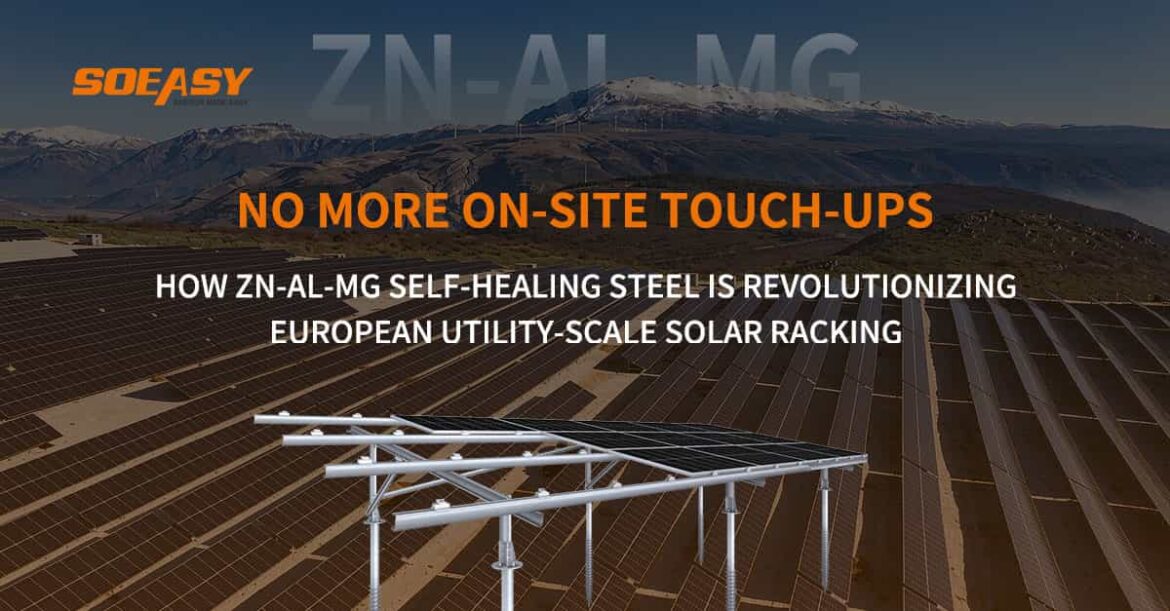
The Zn-Al-Mg Advantage:
Zn-Al-Mg coatings possess active self-healing properties. When a cut edge or punch hole is exposed to rain or ambient humidity:
- Zinc and magnesium ions dissolve from the surrounding coating layer.
- The dissolved ions migrate across the exposed raw steel edge.
- They form a compact, insoluble magnesium-based basic salt layer, sealing the cut edge naturally.
EPC Value: Eliminates the need for touch-up zinc spraying on-site, cutting job-site labor hours by up to 15% during structural assembly.
3. Structural Weight Reduction & Eurocode Compliance
Compliance with Eurocode 1 (Actions on structures – Wind/Snow loads) 及 Eurocode 3 (Design of steel structures) is mandatory for project approval and bankability in the EU market.
Because Zn-Al-Mg provides superior corrosion protection with a significantly thinner coating layer (e.g., ZM310 / ZM430 vs. heavy HDG batch coatings):
- Lower Dead Load: Thinner coating allows structural engineers to optimize profile geometries (such as high-tensile C/U/Z cold-formed profiles) without adding unnecessary weight.
- Higher Tensile Yield Strength: Pre-coated Zn-Al-Mg high-strength structural steel grades (such as S350GD, S420GD, or S550GD) allow longer spans between foundation posts.
- Fewer Piles Required: Reduced overall dead load directly reduces the number of ground screw/driven pile foundations needed per MW.
4. Sustainability & Environmental Advantage (RoHS & REACH Compliance)
Environmental considerations play a crucial role in European solar tenders:
- Lower Carbon Footprint: Pre-galvanized Zn-Al-Mg coil manufacturing consumes less energy compared to batch hot-dip galvanizing baths.
- Reduced Runoff Contamination: Zn-Al-Mg releases significantly less heavy zinc runoff into soil and groundwater during rainstorms, complying fully with strict EU soil protection regulations.
- 100% Recyclable: Entirely compatible with standard European steel recycling streams.
5. Total Cost of Ownership (TCO) & Bankability Analysis
While the raw material cost per ton of pre-coated Zn-Al-Mg steel coil can be slightly higher than raw black steel, it delivers substantial net savings across the project lifecycle:
Total Installed Cost Comparison:

HDG Steel Racking:
[ Base Steel ] + [ Freight to Galvanizer ] + [ Batch Galvanizing ] + [ Freight to Site ] + [ On-site Touch-up ]

Zn-Al-Mg Steel Racking:
[ Continuous Coil Zn-Al-Mg ] + [ Roll-Forming ] + [ Direct Freight to Site ]
Conclusion: Upgrade Your Ground-Mount Portfolio with SOEASY Zn-Al-Mg Solutions
For European EPCs and developers targeting long-term asset value in Spain, Germany, and beyond, switching from HDG to Zn-Al-Mg ground-mount structures is no longer just an alternative—it is the modern benchmark for quality, durability, and cost efficiency.
Why Choose SOEASY Ground Mounting Systems?
At SOEASY Solar, we manufacture engineered utility-scale ground-mount racking systems utilizing high-grade Zn-Al-Mg steel:
- Customized structural designs for complex slopes, high wind zones, and C5-M coastal environments.
- Factory pre-assembled components for fast field deployment.
Ready to Optimize Your Ground PV Project?
Request a Free Structural Calculation & Technical Quotation today.
Contact our engineering team to discover how our Zn-Al-Mg ground mounting solutions can cut your labor costs and boost your project’s IRR.
Contact Us:sales@soeasyrobot.com
Get to know our on the ground projects:Ground PV Projects – soeasypv.com