English


 Post by
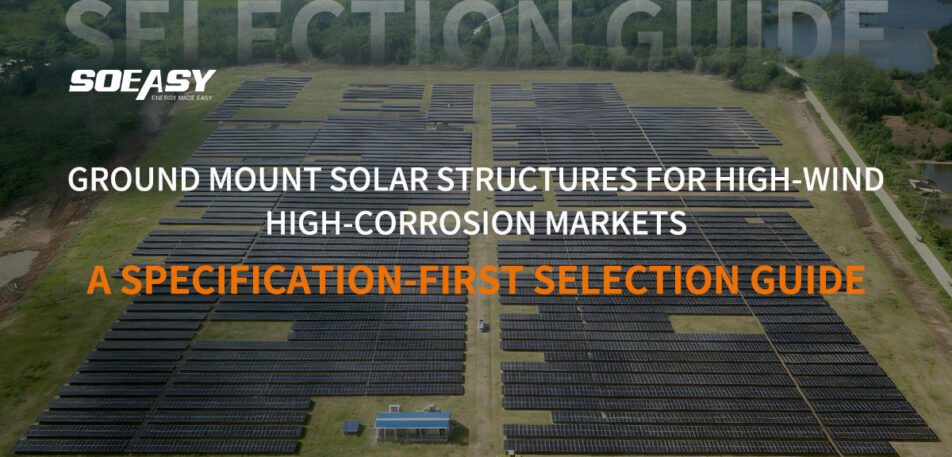
Why Ground-Mounted Systems Dominate Middle East Utility-Scale Solar
The Middle East is building some of the world’s largest ground-mounted solar plants. Saudi Arabia targets 58.7 GW of renewable capacity by 2030 under Vision 2030. NEOM alone plans 16–20 GW of solar PV. The UAE’s Al Ajban plant will deliver 1.5 GW AC, while Egypt’s Minya project adds 1.2 GW plus battery storage.
Ground-mounted mounting systems carry almost all of this capacity. Unlike rooftop arrays, they are not limited by building footprints. They allow optimal tilt angles, easy bifacial module placement, and full integration with single-axis trackers.
The result is a decisive advantage in a region where solar irradiance reaches about 2,177 kWh/m² per year, roughly 63% higher than the European average.
But the mounting structure determines whether that potential becomes stable, profitable production. This guide explains what to check when choosing a ground mount solar racking system in desert, high-wind, and corrosive environments.
Key Factors in Selecting a Ground Mount Solar Racking System
The right ground mount solar racking balances structural safety, site fit, corrosion resistance, and cost per watt. Five factors decide success on most Middle East projects.
1. Foundation type matched to soil conditions The foundation is the interface between the array and the earth. It transfers wind uplift, snow, and seismic loads while keeping rows level for 25+ years. The main options are concrete piers, ground screws (helical piles), and driven piles. Soil tests, not preferences, should drive the choice.
2. Wind load and sandstorm resilience Desert sites face extreme wind uplift. Shallow foundations may pull out of loose sand. Deeper driven piles and longer ground screws resist uplift through skin friction. Every system needs site-specific load calculations per local codes.
3. Corrosion protection Coastal Gulf air and saline soils attack steel fast. Hot-dip galvanizing and zinc-aluminum-magnesium (Zn-Al-Mg / ZAM) coatings provide the needed service life. Coating thickness and material spec are not optional details.
4. Compatibility with cleaning and tracking Dust and sandstorms lower yield. Automated cleaning robots and single-axis trackers add loads to the racking. The structure must integrate with both without conflict.
5. Installation speed and labor cost Remote desert sites make labor expensive. Pre-assembled systems cut on-site work and construction schedules.
Foundation Types: Ground Screw, Driven Pile, and Concrete Pier
Choosing the foundation is the single most important decision in a ground mount solar system. The table below compares the three main types.
| 基礎の種類 | インストール速度 | 耐荷重 | Best Soil | 主な制限事項 |
| Ground Screw (Helical Pile) | Fast (1–2 min each) | 中~高 | 軟土、砂、傾斜 | Rocky ground problematic |
| 打ち込み杭 | Fast (several per minute) | 高い | Soft / loose soil | 騒音、振動 |
| Concrete Pier / Pad | 硬化時間が長い | 非常に高い | すべての土壌タイプ | 高コスト、永続的 |
Ground screw (helical pile) is ideal for sandy desert sites. A hydraulic motor twists the screw into the ground, providing both bearing and pullout resistance. It needs no excavation and no concrete. Installation takes one to two minutes per screw. Ground screws are also removable and reusable, which suits leased land and phased projects.
Driven pile is best for large, open sites with uniform soft soil. Piles reach competent strata three meters or more deep. They offer high capacity but generate noise and vibration, which can be restricted near sensitive sites.
Concrete pier provides the strongest, most permanent solution for high-wind utility-scale projects.
The table below maps foundation suitability to common site conditions.
| 現場状況 | コンクリート製桟橋 | 地杭 | 打ち込み杭 |
| 平らでしっかりとした土壌 | 優良 | 良い | 良い |
| 柔らかい/湿った土壌 | Poor (dewatering) | 優良 | 優良 |
| 岩だらけの地面 | 良好(ドリル加工済み) | 貧しい | 貧しい |
| Desert sand | 良い | 優良 | 良い |
| 傾斜地 | 相当 | 優良 | 相当 |
Wind Load and Sandstorm Resilience in Desert Climates
Wind uplift is often the governing load for ground-mounted arrays. In the Gulf, summer storms and sandstorms expose structures to extreme forces. A tilted array creates lift that tries to pull foundations out of the ground.
Deep foundations resist uplift through friction along the shaft. Concrete piers resist it through mass. In loose desert sand, a short ground screw may pull out under extreme wind, while an adequately sized deep screw or concrete pier will not. This is why site-specific wind calculations matter more than a generic “wind rated” label.
For high-wind Middle East projects, engineers commonly specify deeper embedment, larger helix diameters, and higher-grade steel. Systems should be certified against local wind standards and design codes before procurement.
Corrosion Protection: Zn-Al-Mg and Hot-Dip Galvanizing
Corrosion is the silent killer of ground mount solar racking in the Gulf. Salty coastal air and saline soils attack steel far faster than in temperate climates. The industry standard is hot-dip galvanizing with a thick coating, often 80 μm or more.
A growing preference is zinc-aluminum-magnesium (Zn-Al-Mg / ZAM) alloy steel. with a typical coating of 70–100 μm. The alloy provides superior corrosion resistance and self-healing at cut edges. This matters on site, where drilled holes and cut ends expose raw steel.
| 材料 | Typical Coating | Key Benefit | Best Use |
| 溶融亜鉛めっき鋼 | 80 μm+ | Proven, cost-effective | Most desert sites |
| Zn-Al-Mg (ZAM) Steel | 70–100 μm | Self-healing cut edges | Coastal / saline / high-corrosion |
| Anodized Aluminum (6005-T6) | Anodized layer | Lightweight, salt-spray tested | Trackers, sensitive sites |
Aluminum systems, such as 6005-T6 anodized alloy, resist salt spray well and are lighter. Some systems are verified through 1,000-hour salt spray testing. The choice depends on load requirements, cost, and site corrosivity.
Fixed-Tilt vs. Single-Axis Tracker for Ground Mount Systems
Trackers add yield but add cost and complexity. The extra yield often justifies the premium in high-irradiance Gulf locations, but the mounting structure must be designed for tracking loads and automated cleaning.
The SOEASY Ground Mount Portfolio for Middle East Projects
SOEASY Solar builds ground mounted solar mounting systems engineered for desert, coastal, and uneven terrain. Our portfolio covers the full range of foundation and structure needs.
- Terra AL: A highly pre-assembled ground mount system for large-scale utility projects. Its 6005-T6 anodized aluminum structure is verified through 1,000-hour salt spray testing. Pre-assembly reduces on-site installation time by over 40%, cutting labor costs and schedule risk.
- Terra FLEX: An adaptive ground mount system for slopes and rough terrain. Its modular platform conforms to the land, eliminating expensive grading while maintaining performance.
- Foundation solutions: Certified ground screw (helical pile) systems with corrosion-resistant coatings (Zn-Al-Mg and hot-dip galvanized), driven pile solutions for utility-scale sites, concrete pier designs, and custom hybrid foundations for terrain-adaptive installations.
- ZAM material advantage: Next-generation zinc-aluminum-magnesium steel for superior corrosion resistance and environmental adaptability, backed by engineering calculations and installation support.
Every SOEASY system is backed by detailed structural calculations, installation guides, and technical support. This engineering depth helps EPCs and developers de-risk procurement and hit project timelines in the Middle East.
Frequently Asked Questions (FAQ)
What is the best foundation for ground mount solar in desert sand? Ground screws (helical piles) perform exceptionally well in sandy desert soils. They install fast without excavation or concrete. For very high wind sites, deeper screws or driven piles may be required.
Do ground mount solar systems need concrete? No. Ground screws drive into the soil and hold without any pour. Ballasted frames hold themselves down with weight. Concrete piers remain the strongest option but are the slowest.
A ground mounted solar mounting system is the backbone of every utility-scale PV plant in the Middle East. Matching the foundation to the soil, engineering for wind uplift, and specifying the right corrosion protection determine whether a plant stays stable and productive for 25 years.
SOEASY Solar’s Terra AL and Terra FLEX ground mount systems, backed by certified foundations and ZAM material technology, are engineered for these conditions. Contact the SOEASY engineering team for site assessment, soil analysis support, and foundation recommendations tailored to your project.