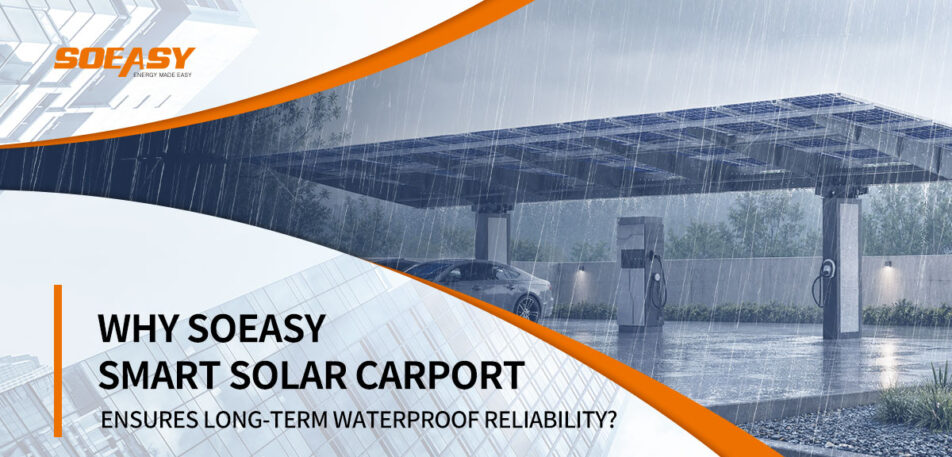
在光伏项目的落地过程中,光伏车棚(Solar Carport)凭借“上面发电、下面停车”的双重价值,已成为工厂、园区、商超及写字楼实现绿电替代与降低碳排放的核心载体。

然而,经过 1 到 2 年的运营,项目业主和 EPC 承包商经常面临一个令人头疼的技术问题——持续的屋顶漏水。

对于负责项目交付和长期运营维护的结构工程师而言,太阳能车棚不仅仅是一个光伏发电站。更具体地说,它是一个功能性的建筑设施,旨在为车辆遮风挡雨。一旦太阳能车棚的防水系统出现故障,就会引发客户频繁投诉,并严重影响项目的投资回报率。

本文从结构工程和现场运维的角度,深入分析了太阳能车棚防水的力学原理。我们探讨了传统密封方案失效的原因,并阐述了科学的机械防水技术如何实现25年免维护的使用寿命。

为什么防水对光伏车棚至关重要?

传统停车棚主要承担遮阳、避雨功能,而光伏车棚在此基础上增加了光伏组件、电气设备以及能源管理系统,其应用要求更加复杂。在光伏车棚场景下,漏水所引发的链式反应将直接影响多方利益:

1. 车辆损坏及潜在责任索赔

雨水从太阳能组件缝隙渗出绝非干净的水。相反,它是混杂着表面灰尘、油渍和酸性大气化合物的污水。当这种酸性泥浆滴到车漆上时,很容易造成漆面腐蚀、顽固水渍和车窗玻璃损坏。对于高档写字楼或商业中心而言,这往往会导致车主索赔和管理纠纷。

2. 停放体验打折与用户投诉

光伏车棚的核心商业卖点之一是为客户或员工提供良好的停车体验。如果雨天车棚内“大雨大漏、小雨小漏”,车主在上下车、搬运行李或充电时被雨水淋湿,车棚的建设初衷将大打折扣,直接导致物业服务满意度断崖式下跌。

3. 运维成本激增与结构安全隐患

频繁的渗漏迫使运维团队反复派遣技术人员进行高空作业,查找渗漏点并重新涂抹密封剂。高空作业不仅安全风险高,而且人工成本也十分昂贵。此外,长期渗水还会腐蚀下部的钢制连接接头、导管和电气设备,加速结构锈蚀并增加电气短路的风险。

为什么传统的“密封胶/打胶”防水必然失效?

为了密封光伏组件之间的缝隙,许多早期低成本的车棚项目都采用了传统的密封解决方案。具体来说,安装人员会在组件接缝处涂抹硅酮密封胶或铺设标准橡胶条。然而,在实际运行环境中,这种化学和物理密封方法几乎总会在 12 到 24 个月内失效。

结构力学和材料科学表明,传统密封剂失效是不可逆转的、不可避免的结果:

失效维度传统打胶/密封条方案的致败原因
热胀冷缩与剪切应力PV modules (glass and aluminum frames) and steel/aluminum mounting structures have vastly different thermal expansion coefficients. Temperature swings between day and night cause micro-level movement that tears the sealant, leading to cracking and debonding.
紫外线(UV)与老化The top surface of a solar carport experiences constant, direct exposure to intense ultraviolet radiation. Regular chemical sealants and low-grade rubber harden, turn yellow, embrittle, and lose elasticity rapidly under UV rays.
积水与水压下渗Traditional sealant methods represent passive blockages. When a carport uses a low tilt angle (such as a 5° tilt), flat rubber strips create micro-water traps. Under continuous water immersion and gravity pressure, moisture penetrates tiny gaps easily.
后期运维不可逆Once sealants crack, technicians must completely scrape away old material and clean gaps before reapplying glue. Field conditions rarely match dust-free factory environments, so newly applied sealant usually peels off again within weeks.

How to Scientifically Evaluate Solar Carport Waterproofing Systems

To avoid falling into an expensive “repair every year, leak every year” O&M trap, EPC contractors and project owners should establish strict evaluation standards across five key dimensions when reviewing structural solutions:

  1. Waterproofing Principle (Passive Seal vs. Structural Drainage): Does the design rely on chemical sealants for passive blocking, or does it use physical metal channels for active drainage?
  2. Drainage Flow Management: Does the system feature a complete drainage network with main gutters, sub-gutters, and downspouts? Can it handle heavy rainstorms exceeding 50 mm/h?
  3. Connection Joint Reliability: Do the fastening methods between drainage channels, main structures, and module clamps damage the waterproof layer? Do mounting bolts feature self-sealing and anti-loosening designs?
  4. Material Durability: Do component materials—such as thick AL6005-T6 aluminum alloy or hot-dip galvanized steel—meet strict standards for UV resistance, thermal endurance, and a 25-year service life?
  5. Maintenance Convenience: Does the drainage structure feature self-cleaning properties? Can gutters be cleared easily when leaves and debris accumulate?

SOEASY Smart Mechanical Waterproofing: The Sealant-Free Solution

Addressing the pain points of traditional sealant failure, the SOEASY Smart Solar Carport completely eliminates chemical sealants by incorporating a patented BIPV Mechanical Waterproofing System.

Following the structural engineering philosophy of “guiding water rather than blocking it,” this system manages water flow paths through precise mechanical forming, achieving reliable solar carport waterproofing in all weather conditions. The natural drainage path within the SOEASY system operates across four distinct stages:

  • Stage 1: Surface Collection: Rainwater landing on PV module surfaces flows smoothly into module gaps via natural gravity slope.
  • Stage 2: Longitudinal Main Gutter Interception: Longitudinal main gutters immediately intercept and collect all rainwater dropping through vertical gaps.
  • Stage 3: Transverse Sub-Gutter Tributary Flow: Water from main gutters routes into transverse sub-gutters, creating a complete, interlocking 3D drainage network.
  • Stage 4: Centralized Discharge: Collected water discharges into downspouts concealed inside columns, flowing cleanly into underground drainage systems.

1. Dual-Layer Independent Gutter System

SOEASY places custom-extruded AL6005-T6 high-strength aluminum alloy or hot-dip galvanized steel gutters under both longitudinal and transverse module seams:

  • Longitudinal Main Gutters: Positioned directly beneath vertical module frames, these gutters serve as the first line of defense to catch rainwater falling through vertical gaps.
  • Transverse Sub-Gutters: Installed under horizontal gaps, these sub-gutters overlap seamlessly with main channels, guiding horizontal runoff into primary drainage lines to form a complete 3D network.

2. Scientific Flow Management and Anti-Splash Design

The system utilizes the carport’s built-in 5° optimal tilt angle to direct water toward edge collection troughs via gravity. Water then drains through internal or external column downspouts directly into ground ditches. Therefore, even during sudden heavy rainstorms, large-capacity gutter cross-sections prevent water ponding and overflow.

3. Zero Welding and Sealant-Free Fast Bolt Fixing

SOEASY mechanical waterproofing components feature standardized modular designs. Drainage channels fix directly to the main PV mounting frame using specialized guide clamps, achieving 100% sealant-free, weld-free, and cut-free field assembly. As a result, on-site installation efficiency increases by over 50% while eliminating leakage risks caused by inconsistent manual gluing.

4. 25-Year Industrial-Grade Corrosion Protection

All drainage channels and connection hardware utilize industrial-grade anodized AL6005-T6 aluminum alloy or hot-dip galvanized steel. Thus, the system withstands salt spray and intense UV exposure, matching the 25-year service life of PV modules to deliver a true “install once, maintain never” solution.

Upgrade to Superior Mechanical Waterproofing

Effective solar carport waterproofing is never a simple matter of filling module gaps with glue. Instead, it is a systematic discipline combining material science, structural mechanics, and fluid dynamics. Abandoning aging chemical sealants in favor of durable, sealant-free mechanical waterproofing is the clear industry trend for delivering high-quality C&I solar carports.

The SOEASY Smart Solar Carport centers on patented BIPV mechanical waterproofing, combined with a 45 m/s wind resistance and 1.0 kN/m² snow load rating. We empower EPC contractors and project developers worldwide to build safe, attractive, and high-ROI solar infrastructure.

Don’t let seam leaks and constant O&M costs pull down your project ROI and brand reputation. Contact the SOEASY expert team today to secure a 100% leak-free, full-lifecycle waterproofing solution for your next solar carport project!