English


 Post by
噪声控制已成为日本电池储能系统(BESS)、变电站及工业厂房设计中不可妥协的要素。Transformer和PCS设备产生混合的低中频噪声。噪声屏障的顶部轮廓直接改变声学衍射、结构风荷载预算和许可审查。许多EPC团队想知道:他们应该为他们的场地选择直顶还是拱顶隔音屏?本文详细介绍了为日本建筑规范、风力和雪量要求量身定制的性能、限制和决策规则。
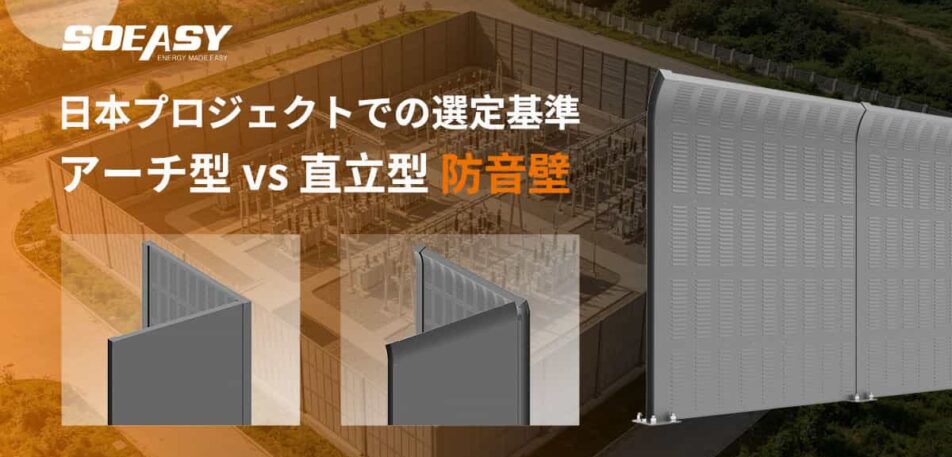
Core difference: how top geometry changes noise diffraction
Noise reduction of a noise barrier relies heavily on blocking sound line-of-sight and suppressing sound diffraction over the wall top.
- Straight-top noise barrier: Flat horizontal top. Sound waves diffract uniformly over the entire top edge. Simple acoustic calculation, widely adopted for standard industrial fencing. Its attenuation performance is predictable and easy for Japanese acoustic consultants to model in noise simulation reports.
- Arched-top noise barrier: Curved crown design. The curved surface redirects diffracted sound upward and away from sensitive receiving points. Under the same physical wall height, arched-top delivers extra noise attenuation, especially useful for mid-frequency noise from transformers and cooling fans.
Key takeaway: Arched top improves effective acoustic height without raising the full barrier elevation. But this gain only works when the curvature radius, panel absorption and site noise angle are properly modelled.
Straight‑top noise barrier: strengths, limits & suitable Japanese project scenarios
Main advantages
- Lower engineering cost: Standard flat panels and simple posts, fewer custom moulds, shorter lead time.
- Simpler structural calculation: Wind load calculation follows standard Japan civil engineering formulas. Foundation design and seismic check are straightforward for EPC and local building approval.
- Flexible modular installation: Easy to extend, cut, adapt to uneven ground, corners and segmented layouts common for BESS sites. Maintenance and panel replacement are fast.
- Good fire performance: Soeasy composite multi-layer panels retain consistent fire rating with straight-top configuration.
局限性:
Acoustic attenuation is fully dependent on physical height. If the noise source and receiver sit at similar elevation, you must increase wall height to hit target noise limits. Tall straight-top walls bring higher wind moment, larger foundation and higher total cost.
Best-fit Japanese sites for straight-top noise walls
- BESS / substations with sufficient land footprint and no strict height restriction
- Industrial zones with noise receivers far from site boundary
- Phased construction, where noise barrier sections will be added or modified later
- Sites with tight budget and standard noise requirements
- Areas with heavy snowfall: flat top design simplifies snow load assessment and snow clearance planning
Arched‑top noise barrier: strengths, limits & suitable Japanese project scenarios
Main advantages
- Higher noise attenuation at same wall height: Curved top disrupts sound diffraction. Ideal when you cannot build an extremely tall barrier due to local height ordinances, visual landscape constraints or overhead clearance limits.
- Optimised visual impact: Smooth curved profile reduces the “hard wall” appearance, helpful for projects near residential zones where local residents review site aesthetics.
- Compact footprint benefit: Saves foundation and material cost compared with building a taller straight-top wall to reach identical noise targets.
局限性:
- Higher manufacturing cost: Custom curved top sections, special moulding and stricter tolerance control.
- Restrictions in high-wind zones: Arched profile changes wind turbulence; must complete site-specific wind load calculation per Japanese standards. Curved parts also require more careful anti-corrosion protection for coastal salt-spray regions.
Best-fit Japanese sites for arched-top noise walls
- BESS / substation projects adjacent to residential areas with strict noise boundary limits
- Sites with height caps or landscape review requirements
- Mid-frequency transformer / PCS noise, where diffraction is the main noise leakage path
- Limited land area; cannot expand barrier base or increase wall height freely
Side-by-side comparison table (optimized for featured snippet)
| 对比项目 | Straight-top Noise Barrier | Arched-top Noise Barrier |
|---|---|---|
| Acoustic performance | Baseline attenuation, predictable simulation | Extra reduction on diffracted sound; same height = better noise blocking |
| Structural & wind calculation | Simple, standard civil code model | Requires custom wind/snow simulation |
| Material & project cost | Lower, standard modular panels | Higher due to custom curved top components |
| インストール速度 | Fast, modular pre-assembly | Slightly longer; curved top section alignment |
| Ideal Japan site condition | Open industrial / BESS, budget focus, heavy snow | Near residential boundary, height-limited land, noise-sensitive neighbours |
Japan-specific decision checklist for EPC & acoustic engineers
Use these 5 questions to select the correct barrier top for your Japanese energy site:
- What is the target noise limit at the property boundary? (Japan environmental noise ordinance)
- Is there a maximum permitted wall height from local municipal planning?
- What is dominant noise frequency: low-frequency transformer hum or mid-frequency fan noise?
- Site wind zone, snow load, coastal salt corrosion risk?
- Budget and construction schedule constraints?
Decision rule of thumb:
- If height restriction + residential noise complaint risk → arched-top noise barrier
- Standard BESS site, loose height limits, cost priority, heavy snow region → straight-top noise barrier
Combine top profile with Soeasy multi-layer composite noise barrier
Top shape is only one design variable. The actual noise reduction also relies on barrier panel construction. Soeasy Solar engineering-grade noise barrier uses three-layer composite structure: outer louver layer, glass wool absorption layer and solid isolation layer. Both straight-top and arched-top versions adopt this same acoustic panel core. You can freely select top geometry while keeping consistent fire rating, corrosion resistance and modular installation for BESS and substation projects across Japan.
常见问题
Q1: Can arched-top noise barrier replace taller straight-top wall for Japanese BESS?
A: It can reduce required physical height, but you still need acoustic simulation. It cannot solve low-frequency ground-borne vibration or noise leakage through gaps, gates and foundation openings.
Q2: Does arched-top always have worse wind resistance in Japan typhoon zones?
A: Not inherently worse. The curved shape changes wind flow; qualified structural calculation and reinforced posts can meet Japan wind code requirements.
Final recommendation
For most Japanese utility-scale BESS and substation projects:
- Straight-top noise barrier = default standard solution for cost, schedule and code simplicity.
- Arched-top noise barrier = targeted upgrade for noise-sensitive boundaries and height-restricted parcels.
Contact Soeasy Solar to receive acoustic simulation support and noise barrier proposal for your Japan energy storage or industrial site.
电子邮件:
Learn about our products:Soundproof Fence – soeasypv.com