English

 Post by
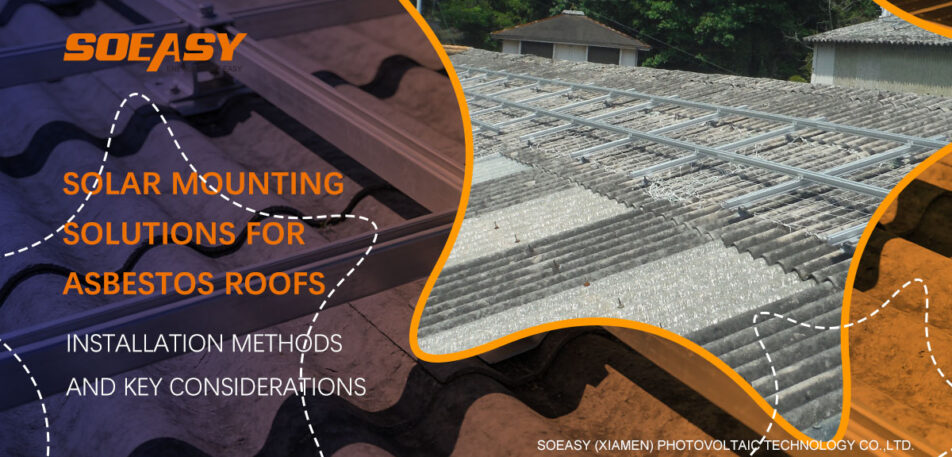
 Corrugated asbestos roofs are widely used yet technically challenging for solar installations. From rural homes in Southeast Asia and warehouses in Africa to aging industrial buildings, this roofing type remains common due to its historical cost advantages and lightweight structure.
As a result, selecting the right solar mounting system for asbestos roof applications has become a critical factor in ensuring both safety and long-term performance. Unlike conventional rooftops, these structures require specialized mounting solutions that can adapt to the corrugated profile, distribute loads effectively, and minimize the risk of cracking or leakage. Understanding these requirements is essential for designing a reliable and cost-efficient solar installation.
Corrugated asbestos roofs offer several natural advantages for solar installations:
- Extensive application base – ideal for cost-effective distributed PV projects
- Flexible installation layout – large spans and minimal shading allow flexible module arrangement
However, their physical properties also present critical challenges:
- High brittleness – especially after aging, panels become fragile
- Corrugated surface – uneven installation plane leads to stress concentration
- Limited load capacity – cannot support conventional mounting systems
This guide explains the structural characteristics, engineering challenges, and optimized mounting solutions for safe and durable installations.
Structural Characteristics of Corrugated Asbestos Roofs
Roof Composition
Corrugated asbestos roofs are non-load-bearing structures. The load is supported entirely by the substructure:
- Wood structure roofs – common in residential buildings, lower holding strength
- Steel structure roofs – used in industrial buildings, higher strength but prone to corrosion
Corrugated Profile Features
- Uneven surface prevents proper contact with flat brackets
- Stress concentration easily occurs at fixing points
- Direct installation can lead to cracking
Key design principle: Ensure load distribution and wave profile adaptation
负载能力
Typical load capacity is limited to 30–50 kg/m², depending on purlin spacing and material condition.
Main risks include:
- Local stress concentration causing cracks
- Reduced strength due to aging and weather exposure
Key Design Challenges and Solutions
1. Stress Concentration
Problem: Small contact areas create excessive pressure
Solution: Increase contact surface using specially designed components
2. Wave Profile Mismatch
Problem: Flat brackets cannot fit corrugated surfaces
Solution: Use profile-matched base structures
3. Limited Fixing Points
Problem: Fixing must align with purlins (800–1200 mm spacing)
Solution: Accurate site measurement and layout planning
4. Waterproofing
Problem: Roof penetrations create leakage risks
Solution: Use EPDM sealing + multi-layer waterproof design
Recommended Mounting Solutions
1. Wave Base System (Core Solution)
The wave base is the most effective solution for corrugated asbestos roofs.
Key Functions:
- Perfectly matches the roof profile
- Expands contact area (5–10× larger than standard washers)
- Converts point load into distributed load
- Provides a flat mounting surface
优点:
- Protects fragile roof sheets
- Improves system stability and wind resistance
Best for: All corrugated asbestos roof projects, especially aged roofs
2. L Foot + Wave Base Combination
A practical and widely used solution.
Structure:
- Wave base → distributes load
- L foot → connects rails and allows height adjustment
优点:
- Clear load path
- Flexible installation
- 性价比高
3. Hanger Bolt Solution
Used for high pull-out resistance requirements.
特征:
- Direct anchoring into purlins
- Strong wind uplift resistance
Must be used with a wave base to prevent roof damage
4. Mini Rail System
Designed for lightweight and fast installation.
优点:
- Reduced material usage
- Faster installation (up to 30% improvement)
- Lower overall cost
Best for:
- Lightweight roofs
- Standardized distributed projects
Engineering Considerations
Lightweight Design
Use Aluminum 6005-T5 for high strength and corrosion resistance
Load Distribution
Always use wave bases or equivalent components under fixing points
Fixing Optimization
- Align strictly with purlins
- Recommended spacing ≤ 1200 mm
耐腐蚀性
- Fasteners: SUS304 stainless steel
- Seals: EPDM rubber (25-year durability)
Installation Guide
1. Site Inspection
- Identify roof structure
- Check aging and corrosion
- Measure wave profile
2. Layout Marking
- Locate purlins accurately
- Mark fixing points
3. Installation of Fixings
- Drill with depth control
- Install wave base + sealing
- Fix L feet or hanger bolts with torque control
4. Rail or Mini Rail Installation
- Install rails and adjust level
- Ensure alignment
5. Module Installation
- Place modules carefully
- Fix with clamps according to specifications
6. Waterproofing
- Apply sealant to all joints and bolt heads
Safety Considerations
Roof Safety
- Never step directly on asbestos sheets
- Use walking boards
Health Protection
- Wear N95 masks during drilling
- Avoid asbestos dust inhalation
Working at Height
- Use safety harness
- Avoid bad weather conditions
常见问题
Q1: Can solar panels be installed on asbestos roofs?
Yes, if proper design and installation methods are followed.
Q2: Why is a wave base necessary?
Flat pads cannot distribute load properly and may cause cracking.
Q3: Is Mini Rail suitable?
Yes, it is ideal for lightweight and fragile roofs.
Q4: How to prevent roof damage?
- Do not step on panels
- Fix only on purlins
- Use wave base for load distribution
Why Choose SOEASY
At SOEASY, we focus on delivering practical and reliable solar mounting solutions tailored for complex roofing scenarios such as corrugated asbestos roofs.
- Complete System Solutions
From structural design and engineering support to product supply, we provide an integrated, one-stop service. - Comprehensive Wave Base Options
A full range of wave base designs compatible with large, medium, and small corrugated profiles, ensuring optimal fit and performance. - Efficient Installation & Cost Control
Thoughtfully engineered components enable faster installation while helping reduce overall project costs.