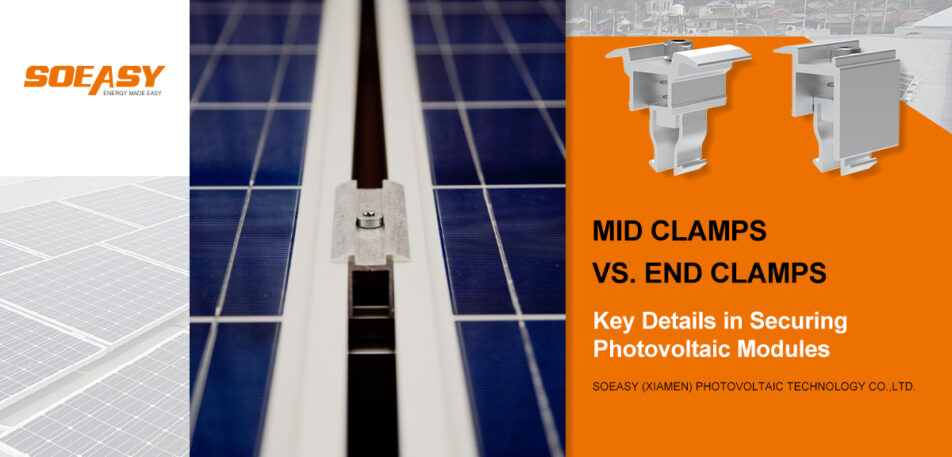
Clamps — The Core Component for Securing Solar Modules
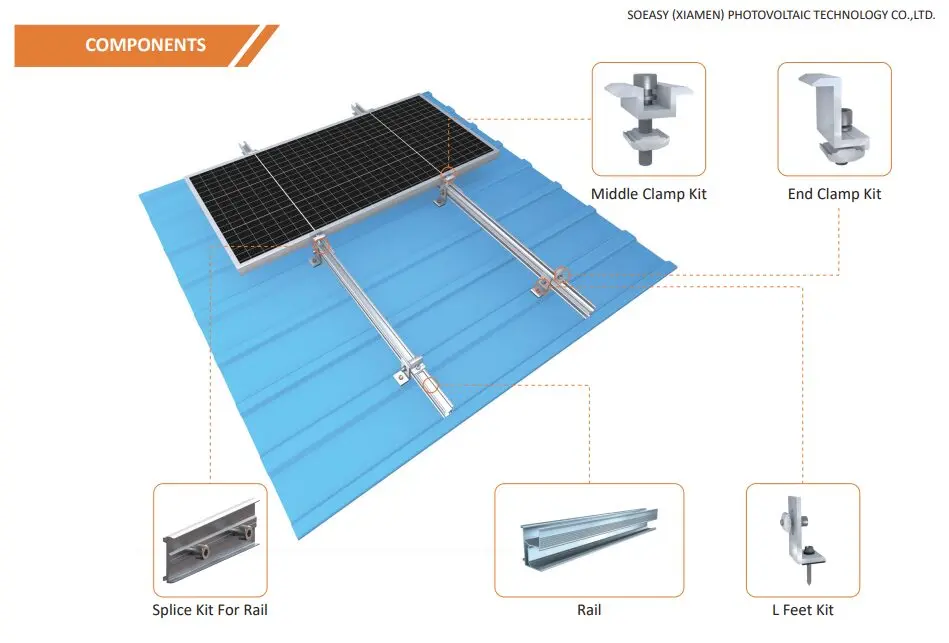
In photovoltaic mounting systems, clamps are the fundamental components that connect solar modules to the rails. Despite their small size, clamps play a critical role in securing each module firmly to the structure. A poor-quality or incorrectly chosen clamp can lead to module detachment in strong winds, frame deformation, micro-cracks, and even chain reactions causing system failure.
The selection of clamps directly impacts:
- System safety: The clamping force of the clamp determines module stability under extreme wind loads.
- Installation efficiency: Clamp design affects installation speed and labor costs.
- Long-term reliability: Material selection and anti-loosening design influence the 25-year service life.
Among the various types of clamps, mid clamps 及 end clamps are the most commonly used and fundamental. Though they may seem similar, they differ significantly in terms of function, force characteristics, and installation methods.
This article will systematically compare the mid clamps and end clamps, their definitions, functional differences, selection criteria, and installation points, helping you make the right clamp selection for your photovoltaic project.
What Are Mid Clamps and End Clamps?
1. Mid Clamps (Mid Clamps)
Definition:
Mid clamps are placed between two adjacent photovoltaic modules, clamping both the left and right sides (or top and bottom) of the modules’ frames and fixing them to the rails.
Typical Position:
- Located inside the array, between modules
- In the middle of each row of modules (not at the ends)
Core Functions:
- Fix adjacent modules and maintain consistent spacing
- Transfer the load from the modules to the rails
- Ensure neat arrangement and uniform gaps between modules
Common Features:
| Feature | Description |
|---|---|
| Double-sided clamping | Clamps both adjacent modules |
| Centered arrangement | Located between two modules, symmetrically loaded |
| Spacing control | Ensures consistent gaps between modules |
| Easy installation | Typically fixed to the rail with a single bolt |
2. End Clamps (End Clamps)
Definition:
End clamps are placed at the ends of the photovoltaic array, clamping the outer frame of the edge modules and fixing them to the rails to form the boundary constraint of the array.
Typical Position:
- At the start and end of each row of modules
- On the edge of the array
Core Functions:
- Fix the edge modules and prevent them from sliding out
- Provide mechanical constraint to the array’s boundaries
- Withstand higher wind loads at the edges of the array
Common Features:
| Feature | Description |
|---|---|
| Single-sided clamping | Clamps only the outer frame of one module |
| End arrangement | Positioned at both ends of the array, with asymmetric force |
| Boundary constraint | Prevents the modules from sliding outward |
| Edge-stop design | Some end clamps have an edge-stop, providing additional axial restraint |

Core Differences Between Mid Clamps and End Clamps
1. Function and Position
| Comparison Dimension | Mid Clamps | End Clamps |
|---|---|---|
| Installation position | Between modules | At the array ends |
| Clamping method | Double-sided | Single-sided |
| Main function | Maintain spacing, fix adjacent modules | Fix edge modules, prevent sliding |
| Load characteristics | Symmetrical loading | Asymmetrical loading |
| Quantity | Many (one less than the number of modules in a row) | Few (two per row) |
Conceptual Understanding:
- Mid clamps act as “connectors,” joining adjacent modules together.
- End clamps act as “anchor points,” locking the ends of the row.
2. Materials and Durability
| Comparison Dimension | Mid Clamps | End Clamps |
|---|---|---|
| Main material | Aluminum alloy 6063/6005 | Aluminum alloy 6063/6005 |
| Fasteners | Stainless steel 304/316 | Stainless steel 304/316 |
| Rubber pads | EPDM | EPDM |
| Strength requirements | Medium | Higher (due to greater wind loads at edges) |
| Corrosion resistance | Medium | Higher (more exposure to moisture at edges) |
Key Difference:
End clamps typically require higher structural strength and corrosion resistance because the edge modules experience higher wind loads and are more exposed to moisture.
3. Installation Process
| Comparison Dimension | Mid Clamps | End Clamps |
|---|---|---|
| Installation order | Install after end clamps | First to install |
| Alignment requirements | Align both adjacent modules | Align one module |
| Installation difficulty | Moderate | Lower |
| Time consumption | Moderate | Lower |
| 可调节性: | Low (limited by adjacent modules) | High (only one module aligned) |
Typical Installation Process:
- Install end clamps first to secure the first module.
- Place the second module and use mid clamps to secure it.
- Repeat until the row ends.
- Install the final end clamp on the opposite side.
- Selection Criteria for Mid Clamps and End Clamps
1. System Type
| System Type | Mid Clamp Selection | End Clamp Selection |
|---|---|---|
| Large ground stations | Standard mid clamp, cost-effective | Reinforced end clamp, strength-focused |
| Rooftop distributed | Lightweight mid clamp | Standard end clamp, waterproof design |
| Tracking systems | Reinforced mid clamp (for dynamic loads) | High-strength end clamp (to prevent loosening) |
| Agricultural PV | Standard mid clamp | Standard end clamp |
2. Module Size and Type
| 模块类型 | Mid Clamp Requirement | End Clamp Requirement |
|---|---|---|
| Framed (35mm thickness) | Standard clamp | Standard end clamp |
| Framed (40-50mm thickness) | Tall clamp | Tall end clamp |
| Unframed/Double-glass modules | Specialized unframed mid clamp (wide contact) | Specialized unframed end clamp |
| Large modules (>2.5m²) | Reinforced or increased quantity | Reinforced |
3. Environmental Conditions
| Environment | Mid Clamp Requirement | End Clamp Requirement |
|---|---|---|
| Coastal/High humidity | Stainless steel 316 fasteners | Stainless steel 316 fasteners |
| High wind zones | Standard or reinforced | Reinforced (higher wind load on edges) |
| Industrial pollution | Corrosion-resistant materials | Corrosion-resistant materials |
| High salt spray | Anodized + stainless steel 316 | Anodized + stainless steel 316 |
Important Note:
End clamps at the array edges bear the highest wind loads. In high-wind zones, reinforced end clamps or increased quantity of clamps are necessary.
4. System Design
| Design Factor | Mid Clamp Considerations | End Clamp Considerations |
|---|---|---|
| Module layout direction | Different number of clamps for horizontal vs vertical layout | One at each end of the row |
| Rail spacing | Determines mid clamp position | Determines end clamp position |
| Load requirements | Choose clamp strength based on load calculation | Edge zones require higher strength |
Core Benefits of Mid Clamps and End Clamps
Mid Clamps Benefits
- Ensure consistent module spacing, reducing alignment errors during installation.
- Connect adjacent modules into a unified array, enhancing overall stability and preventing module displacement during operation.
End Clamps Benefits
- Secure the array’s edges, preventing module displacement due to wind loads, especially in coastal or high-wind environments.
- Form a mechanical boundary for the array, crucial for structural integrity. Some end clamps with edge stops also prevent module movement along the rail.
Installation Tips
Mid Clamp Installation Tips
- Ensure the clamp height matches the module frame thickness.
- Use a torque wrench to tighten to the recommended torque (typically 15–20 N·m). Over-tightening can damage the module frame, while under-tightening results in insufficient clamping force.
- Maintain an even gap (typically 10–20mm) between adjacent modules. Ensure the rubber pad fully covers the frame contact area.
- Install from one end to the other.
End Clamp Installation Tips
- End clamps bear higher forces than mid clamps, so ensure proper torque application.
- Avoid over-tightening to prevent frame deformation or module micro-cracks.
- For clamps with edge stops, ensure they align with the module edges.
- For roof-mounted installations, ensure proper waterproofing and sealing at the penetration points.
General Installation Recommendations
- Always use a torque wrench—avoid tightening by “feel.”
- Regularly calibrate torque tools to maintain accuracy.
- Inspect rubber pads before installation; replace damaged or aged ones.
- In high-wind areas or tracking systems, use lock nuts or spring washers to prevent loosening over time.
Common Mistakes with Mid Clamps and End Clamps
Mistake 1: Misalignment During Installation
Symptoms:
Mid or end clamps are not aligned with the module frame center, causing skewed installation.
Consequences:
Uneven force distribution, frame deformation, and clamp loosening.
Solution:
Ensure clamps are aligned perpendicular to the module frame with full surface contact.
Mistake 2: Improper Material Selection
Symptoms:
Using standard stainless steel 304 fasteners in coastal projects (prone to pitting corrosion).
Consequences:
Corrosion, clamp loosening, and system failure.
Solution:
Use stainless steel 316 fasteners in coastal environments for better corrosion resistance.
Mistake 3: Over-tightening
Symptoms:
Excessive torque application causes deformation of the module frame.
Consequences:
Micro-cracks in the module, frame damage, and sealing failure.
Solution:
Use a torque wrench and follow the recommended torque (15–20 N·m).
Mistake 4: Mixing Clamp Types Improperly
Symptoms:
Using mid clamps at the ends or end clamps in the middle.
Consequences:
Edge modules not securely fixed, or internal modules cannot be installed.
Solution:
Use mid clamps only between modules and end clamps only at the edges.
Mistake 5: Ignoring the Need for Reinforced End Clamps
Symptoms:
Using standard end clamps in high-wind areas.
Consequences:
Modules at the edge of the array may be blown off in high winds.
Solution:
In high-wind zones, use reinforced end clamps or increase the number of end clamps.
Choosing the Right Clamp for Your System
Mid clamps and end clamps are indispensable components in photovoltaic mounting systems. While simple in structure, selecting the right clamp is critical for ensuring the safety and longevity of the system.
Key Takeaways:
| Comparison Dimension | Mid Clamps | End Clamps |
|---|---|---|
| Installation position | Between modules | At the array edges |
| Clamping method | Double-sided | Single-sided |
| Main function | Maintain spacing, fix adjacent modules | Fix edges, boundary constraint |
| Load characteristics | Symmetrical load | Asymmetrical load |
| Strength requirements | Standard | Higher (due to higher wind load) |
| Installation order | Installed later | Installed first |
Selection Principles:
- Position determines type: Mid clamps for internal modules, end clamps for edges.
- Environment determines material: Use stainless steel 316 in coastal/high-moisture environments.
- Load determines strength: Reinforced clamps for high wind or snow areas.
- Module determines size: Select the appropriate clamp based on module thickness and frame type.
SOEASY Complete Clamp Solutions
As a professional provider of solar photovoltaic mounting systems, SOEASY offers a full range of clamps for all types of applications:
- Mid Clamps Series: Standard, reinforced, adjustable types, for 22–50mm module thickness
- End Clamps Series: Standard, reinforced, edge-stop types, for edge fixation needs
- Specialized Clamps: Unframed module clamps, double-glass module clamps
- Material Assurance: Aluminum alloy body + stainless steel 304/316 fasteners + EPDM rubber pads
- Certification & Warranty: Strict testing, 10-year warranty
Whether your project is a large-scale ground-mounted system or a rooftop distributed system, SOEASY offers the most suitable mid and end clamp solutions for you.
FAQ
What is the difference between mid clamps and end clamps?
Mid clamps secure adjacent modules, while end clamps fix the edge modules and prevent sliding.
When should I use reinforced end clamps?
Reinforced end clamps are necessary in high-wind zones or for larger, edge modules.
How do I choose the right clamp for my project?
Consider module size, environmental conditions, wind/snow loads, and system design when selecting clamps.
English