English

 Post by
 In rooftop PV installations, solar accessories are often viewed as small, secondary components. However, they directly influence system safety, long-term stability, waterproofing performance, and overall installation quality. Because different roof structures vary in material strength, waterproofing layers, fastening methods, and load-bearing capacity, accessory selection must be tailored to each roof type.
Whether the project is built on a tile roof or metal roof, choosing the correct accessory greatly reduces roof damage, improves installation efficiency, and enhances system durability. As a specialist in rooftop solar mounting, this guide aims to help EPCs, installers, and system designers make informed decisions and select the most suitable accessories for each roof type.
Tile Roof Accessory Selection Guide
1. Common Tile Roof Types and Structural Characteristics
Tile roofs are widely used in residential PV systems and come in multiple materials and shapes. Each type has different levels of strength, brittleness, and curvature, which directly affect the choice of mounting accessories. Common roof tiles include:
- Spanish / Roman Tiles – Larger curvature, requiring hooks that closely match the contour.
- Flat Tiles – Uniform shape but vary in thickness and width across manufacturers.
- Cement Tiles – Heavier and stronger, requiring hooks with higher load-bearing capacity.
- Porcelain/Ceramic Tiles – Hard surface but brittle; improper drilling or cutting increases breakage risk.
These differences mean the hook’s height, adjustability, and installation method must match the tile type.
2. Recommended Accessories for Tile Roofs
(1) Roof Hooks
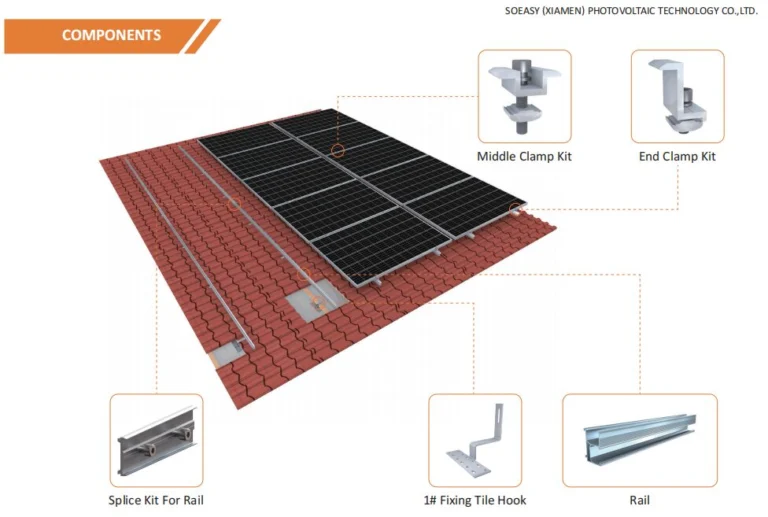
Roof hooks are the primary attachment method for tile roof solar systems. They connect the PV rails directly to the rafters underneath the tiles. Common types include:
- Fixed Hooks
High strength and ideal for uniform tile roofs with consistent height. - 可调节挂钩
Allow height and angle adjustments to fit varying tile thicknesses and uneven roof surfaces. - Non-cutting Hooks
Suitable for fragile or thin tiles; installed by lifting the tile without modifying it. - Tile-cutting Solutions
Used when tile height is inconsistent or hook clearance is insufficient. Precise cutting prevents tile lifting and ensures proper load transfer.
3. Key Selection Considerations
- 承载能力
Hooks must withstand long-term wind and snow loads without deformation. - Tile Curvature and Dimensional Compatibility
Poor hook-tile matching leads to tile cracking or improper rail alignment. - Minimizing Tile Damage
For porcelain or brittle tiles, adjustable or non-cutting hooks are strongly recommended. - Waterproofing and Installation Practices
Fixation points must be firmly anchored to rafters, and the waterproof layer must remain intact or be properly reinforced.
Metal Roof Accessory Selection Guide
1. Common Metal Roof Types
Metal roofs vary widely in shape and fastening structure. Common types include:
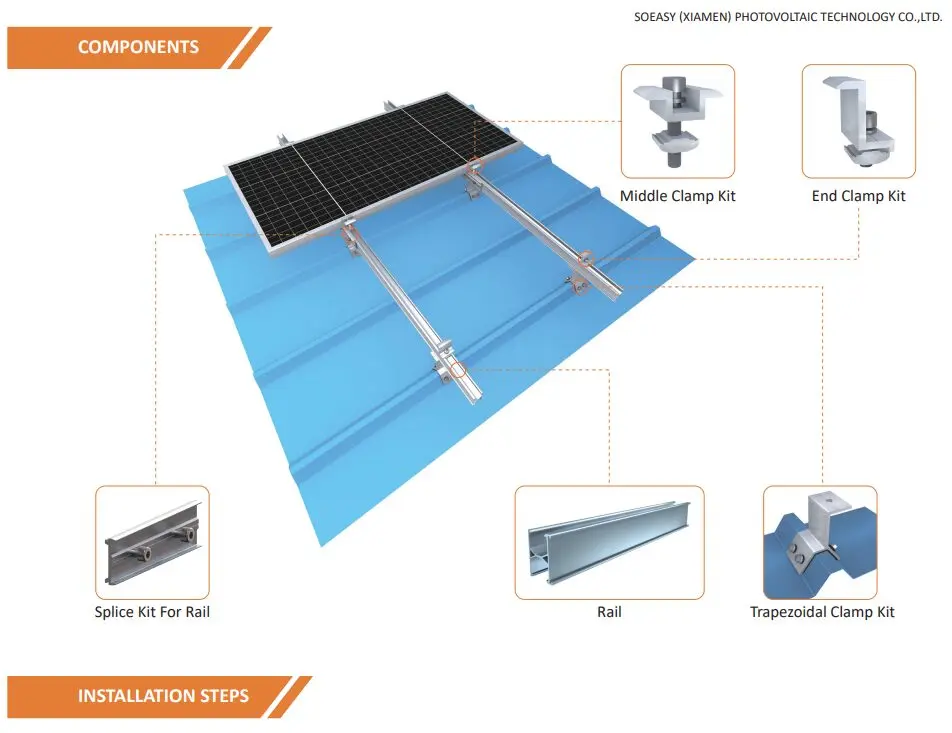
- Trapezoidal Metal Sheets
Frequently used in industrial buildings; typically requires a penetrating installation. - Standing Seam Roofs
Featuring raised seams that allow non-penetrating clamps. - Corrugated Metal Sheets
Curved wave shapes require specialized clamps for proper load transfer.
Understanding the roof profile is the first step in choosing suitable clamps or fastening systems.
2. Recommended Accessories and Installation Methods
Metal roofs generally use penetrating or non-penetrating solutions depending on the roof type.
(1) Penetrating Solutions (Mainly for Trapezoidal Metal Roofs)
- L-Feet combined with self-tapping screws
- EPDM sealing washers to ensure long-term waterproofing
This method provides strong structural performance but requires careful sealing.
(2) Non-penetrating Solutions (Standing Seam, Kliplok, Lysaght, etc.)
- Standing Seam Clamps
- Kliplok Clamps
- Lysaght-specific Clamps
These clamps secure directly onto the raised seam without drilling into the roof, effectively preserving the roof’s waterproofing layer and structural integrity.
3. Key Selection Considerations
- Avoid Damaging the Roof Surface
For standing seam roofs, non-penetrating clamps are the safest and most recommended option. - Waterproofing for Trapezoidal Roofs
EPDM washers, screw selection, and installation practices determine long-term leak prevention. - Material Compatibility with Roof Coatings
Avoid galvanic corrosion by matching clamp materials with the roof’s metal coating. - Enhanced Fixing for High Wind Regions
Coastal and typhoon-prone areas may require additional clamps or stronger fastening methods to improve uplift resistance.
Choosing the Right Accessories Ensures System Safety and Reliability
The long-term stability of a rooftop PV installation depends not only on modules and inverters but also on the correct selection of mounting accessories. Improper choices may lead to tile breakage, water leakage, clamp loosening, or even system failure—resulting in unnecessary maintenance or safety hazards.
Therefore, before finalizing the design, it is recommended to:
- Consult a professional mounting system supplier
- Conduct a detailed roof assessment
- Select materials and accessories that match actual site conditions
With extensive experience in global rooftop PV projects, SoEasy Solar provides customized mounting accessories and system solutions for all roof types—ensuring safe, efficient, and durable solar installations.
Learn more about our solutions: SOEASY Solar – Roof Accessory.com