English

 Post by
 Japan’s rapid expansion of battery energy storage (BESS), co‑located solar‑storage parks, substations and industrial energy facilities brings clear opportunities for renewable investors and EPC teams. Yet many project teams underestimate tangible business risks driven by site noise. Even well‑designed energy infrastructure can hit major roadblocks without early noise risk assessment.
For project developers, noise is not merely an environmental detail. Unmanaged acoustic issues may derail permitting, narrow available land options, trigger community push‑back and generate unexpected post‑construction costs. This article breaks down typical noise‑related risks for BESS and industrial energy sites operating under Japan’s strict local environmental rules.
Where does noise come from at Japanese BESS & industrial energy sites
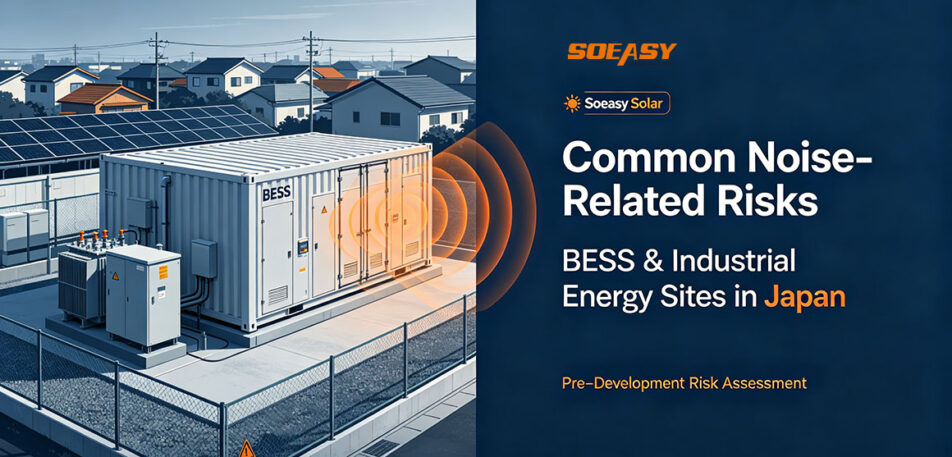
Battery racks themselves produce almost no operational noise. Most acoustic output originates from supporting hardware running 24/7: cooling fans, PCS power conversion units, transformers, ventilation systems and auxiliary industrial equipment.
- High‑and‑mid‑frequency airflow noise from banks of cooling fans
- Persistent low‑frequency hum generated by transformers and power electronics
- Mixed broadband sound reflected across site terrain and building surfaces
Many general‑purpose noise fences are originally engineered for highway traffic, not this special mixed‑frequency noise profile found at energy‑storage and industrial facilities. Using non‑purpose‑built hardware often delivers insufficient real‑world noise reduction for sites close to residential zones.
Real‑world Case 1: Pre‑construction permit delay due to incomplete noise‑mitigation planning A megawatt‑class solar‑co‑located BESS project in western Japan secured low‑cost land adjacent to a residential neighbourhood, yet the initial permit application was put on hold by municipal authorities. During environmental review, officials pointed out that the proposal only referenced standard highway‑type noise barriers, without sufficient assessment for mixed low‑and‑high‑frequency noise from PCS and cooling systems. The project team had to pause feasibility work for 3 months, conduct supplementary acoustic simulation, and revise noise‑control design before moving forward. This case illustrates the permit risk for BESS and industrial energy‑site developers: generic noise hardware cannot satisfy Japanese administrative review requirements for energy‑storage facilities.
Key business risks caused by unaddressed site noise
1. Construction‑permit delays or rejection due to noise regulation requirements
Under Japan’s Noise Regulation Act, industrial and energy infrastructure projects near residential zones must submit documented noise‑mitigation plans during environmental assessment and permit application.
If your proposal cannot demonstrate adequate noise control measures, local authorities may withhold construction approval or request major design revisions. This creates permit risk for BESS and industrial energy‑site developers, pushing back project timelines by months and raising financing uncertainty. Even facilities not formally classified as “specified facilities” still face administrative guidance from municipal environmental departments over neighbourhood noise impacts.
2. Resident complaints and community disputes near project boundaries
Land parcels suitable for utility‑scale renewable projects are increasingly scarce across Japan. Many viable plots sit within earshot of housing districts. Continuous fan and transformer noise can trigger resident grievances, public feedback and formal complaints after commissioning.
Community opposition creates reputational pressure for asset owners. In serious cases, local administrations may issue improvement recommendations or operational restrictions to lower site‑boundary noise levels.
Real‑world Case 2: Post‑commissioning retrofitting triggered by resident noise complaints One operational utility‑scale BESS facility in Japan entered commercial operation without dedicated engineering‑grade noise‑mitigation structures at site boundaries. Several nearby households submitted formal complaints regarding persistent 24‑hour hum and fan noise. Local government issued administrative guidance requiring noise improvement. The asset owner was forced to carry out retrofitting work on the live operational site. Extra costs included on‑site safety management, temporary protection for battery containers, material procurement and installation labour. Overall retrofitting expense was multiple times higher compared with integrating noise barriers during the initial civil‑construction phase.
3. Narrowed site‑selection pool for renewable & industrial projects
Site‑selection challenge for Japanese BESS project teams is closely tied to noise risks. Large areas of otherwise usable land get discarded in early feasibility reviews purely because of noise exposure risks to nearby homes. Effective noise‑mitigation solutions can unlock these land parcels that would otherwise be treated as high‑risk or non‑developable.
4. Costly post‑construction retrofitting and operational losses
Many teams treat noise mitigation as an after‑thought, completed only after complaints emerge or regulators raise concerns. Retrofitting acoustic barriers on an already‑operational energy site is far more expensive than integrating noise‑control hardware during initial civil works. Retrofitting requires site shutdown windows, extra logistics and engineering redesign, hurting project return‑on‑investment.
Why early‑stage noise mitigation planning matters
Noise risk cannot be fully resolved after equipment installation. Best‑practice workflows for Japanese BESS and industrial energy sites embed acoustic evaluation in the pre‑development phase: during land feasibility study, permit drafting and basic engineering.
When reviewing noise‑mitigation options, avoid relying solely on generic highway noise fences. Energy‑storage and industrial sites need engineering‑grade noise barrier systems built for broadband noise suppression, outdoor corrosion resistance and local wind‑load specifications.
Note: Laboratory noise‑reduction figures do not guarantee on‑site outcomes. Actual performance depends on noise‑source frequency, barrier height, installation distance, terrain and local meteorological conditions.
Noise‑related risks represent one of the most common hidden bottlenecks for Japan’s growing BESS and industrial energy‑site pipeline. Resident complaints, permit hold‑ups, limited site choices and expensive retrofits are preventable risks with correct early‑stage planning.
If you are evaluating noise‑mitigation for upcoming projects, you may review our related article introducing the upcoming engineering‑grade acoustic wall series by Soeasy Solar, purpose‑optimised for BESS, solar‑storage parks, substations and industrial sites across Japan. Request a technical preview for your project‑specific configuration assessment.
What’s Next In Our Series
In our next article, we will publish an in‑depth product breakdown: diving into its composite multi‑layer structure, vertical vs arched‑top configurations, field‑oriented installation logic and real‑world application scenarios for renewable and industrial projects. Stay tuned for our full new‑product analysis.