English

 Post by
 1. Flat Roof Applications in Commercial Solar Projects
With the rapid global growth of distributed photovoltaic systems, flat roof solar mounting systems have become one of the most common installation solutions for commercial and industrial solar projects. In urban centers as well as suburban industrial zones, flat roofs provide an ideal platform for photovoltaic installations.
Typical applications of flat roof solar mounting systems include:
- Commercial complexes – shopping malls, office towers, and hotels with large rooftop areas and stable electricity demand
- Office buildings – retrofitted buildings or new construction projects where solar power can offset part of the building’s electricity consumption
- Factories and warehouses – industrial buildings that often feature concrete flat roofs with strong load-bearing capacity
- Public buildings – schools, hospitals, and stadiums where solar projects can serve both practical and demonstration purposes
Compared with other roof types, flat roofs offer several important advantages. First, they provide a large usable area, which allows flexible solar panel layouts and higher system capacity. In addition, mounting structures make it possible to adjust panel tilt angles, thereby optimizing energy production.
Another advantage is maintenance accessibility. Technicians can easily reach solar panels for inspection and cleaning. As a result, system performance and long-term safety can be significantly improved.
However, not all flat roofs are identical. Therefore, installation methods must vary depending on roof structure and project conditions. In most commercial applications, flat roof solar mounting systems can be divided into two major categories:
- Ballast mounting systems, which rely on concrete blocks and avoid roof penetration
- Fixed mounting systems, which are mechanically anchored to the concrete roof structure
Each solution has unique technical characteristics. Consequently, understanding the differences between these flat roof solar mounting systems is essential for project developers and installers.
2. Types of Flat Roof Structures
Before installing a photovoltaic system, engineers must first identify the structural type of the roof. Although many buildings appear to have similar flat roofs, their internal layers can vary significantly. Therefore, roof structure plays a critical role in determining which flat roof solar mounting systems should be used.
2.1 Flat Roofs With Waterproof Layers
This structure is common in modern commercial and public buildings.
Typical roof layers include:
- Reinforced concrete structural layer
- Slope or leveling layer
- Insulation layer such as XPS or polyurethane boards
- Waterproof membrane such as SBS, PVC, or TPO
- Protective surface layer
These roofs have several important characteristics. First, the waterproof membrane is sensitive to penetration. Second, repairing leaks can be costly and time-consuming. Moreover, insulation layers often have limited load-bearing capacity.
For these reasons, ballast solutions are usually recommended. Specifically, ballast flat roof solar mounting systems avoid roof penetration and therefore reduce leakage risks.
2.2 Flat Roofs Without Waterproof Layers
Older industrial buildings often use this roof structure.
Typical structures include:
- Exposed concrete roofs
- Rigid waterproof concrete surfaces
- Structural slope roofs
Such roofs generally provide strong structural capacity. In addition, the absence of a separate waterproof membrane simplifies installation conditions.
Therefore, fixed flat roof solar mounting systems are commonly used in these situations. By anchoring the mounting base directly to the concrete structure, installers can create a stable mechanical connection.
3. Ballast Flat Roof Solar Mounting Systems
Ballast mounting systems are widely used in commercial photovoltaic projects, particularly on roofs with waterproof membranes.
3.1 Working Principle
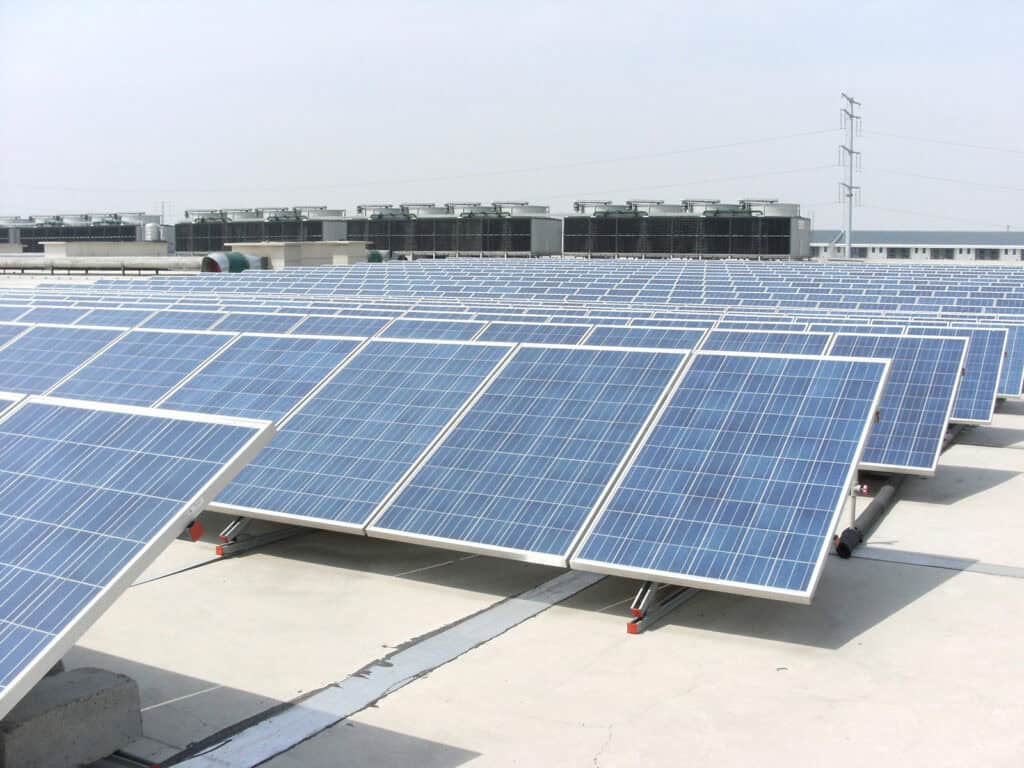
Ballast flat roof solar mounting systems rely on gravity to resist wind loads. Instead of drilling into the roof, installers place concrete ballast blocks on the mounting structure.
When wind uplift occurs, the system weight counteracts lifting forces. Meanwhile, horizontal wind pressure is resisted by friction between ballast blocks and the roof surface. As a result, the system can remain stable without penetrating the roof structure.
With proper engineering design, ballast systems can operate safely under a wide range of climate conditions.
3.2 Main Components
| Component | Function | SOEASY Advantages |
|---|---|---|
| Triangle Bracket | Supports rails and creates panel tilt | High-strength aluminum 6005-T5 |
| Aluminum Rail | Connects brackets and supports modules | Anodized corrosion-resistant surface |
| Ballast Block | Provides system weight | Precast or cast-in-place options |
| Rubber Pad | Protects roof surface and increases friction | Durable EPDM material |
| Mid & End Clamps | Secure solar panels | Compatible with 30–50mm modules |
3.3 Advantages of Ballast Systems
Ballast flat roof solar mounting systems offer several advantages.
- No roof penetration, which eliminates leakage risks
- Simplified installation without drilling or anchoring
- Compatibility with various flat roof structures
- Minimal impact on existing building structures
- Flexible design that allows system relocation if necessary
Because of these benefits, ballast systems are commonly used in commercial rooftop solar installations.
Another advantage is flexibility. If project conditions change, the system can be relocated or adjusted.
3.4 Key Design Considerations
Wind Load Calculation
Wind load analysis is one of the most important factors when designing ballast flat roof solar mounting systems.
Engineers must evaluate several parameters. For example, they analyze:
- Basic wind speed
- Building height
- Terrain conditions
These parameters determine the required ballast weight.
Roof Load Capacity
Ballast systems add additional weight to the roof. In many projects, the load can reach 50–100 kg/m². Therefore, structural evaluation is necessary before installation.
Ballast Distribution Optimization
Wind pressure is not uniform across a solar array. Typically, edge and corner areas experience higher wind pressure. Consequently, these areas require heavier ballast blocks.
Drainage Planning
Proper drainage design is also essential. Mounting structures should not block roof drainage channels. Instead, the system layout should allow rainwater to flow freely toward drainage outlets.
4. Fixed Flat Roof Solar Mounting Systems
Unlike ballast systems, fixed flat roof solar mounting systems are mechanically anchored to the concrete roof structure.
4.1 Working Principle
These systems rely on anchor bolts to resist wind loads. Expansion anchors or chemical anchors connect the mounting base directly to the concrete roof.
Because of this mechanical connection, fixed systems provide strong resistance against uplift and horizontal wind forces.
4.2 Main Components
| Component | Function | SOEASY Advantages |
|---|---|---|
| Triangle Bracket | Defines tilt angle | Optimized structural design |
| Mounting Base | Connects bracket to roof | Galvanized or stainless steel |
| Anchor Bolt System | Secures base to concrete | Mechanical or chemical anchors |
| Waterproof Components | Protect anchor points | EPDM pads and sealant |
| Aluminum Rails | Support PV modules | Compatible with ballast systems |
4.3 Advantages of Fixed Systems
Fixed flat roof solar mounting systems provide several important advantages.
First, they create strong mechanical connections. Therefore, structural stability is very high.
In addition, these systems offer excellent wind resistance. For this reason, they are often used in coastal or typhoon-prone regions.
Another benefit is lower roof load. Since heavy ballast blocks are not required, structural stress is reduced.
4.4 Waterproof Design
Because fixed systems require drilling, waterproof design becomes extremely important.
SOEASY solutions include multiple protection layers. For example, the system uses sealed anchor bolts, EPDM waterproof pads, and weather-resistant sealant.
In addition, protective waterproof caps provide extra protection. Consequently, the system can maintain reliable long-term waterproof performance.
5. Ballast vs Fixed Solar Mounting Systems
| Comparison Factor | Ballast System | Fixed System |
|---|---|---|
| Roof Protection | No penetration | Requires drilling |
| Structural Stability | Depends on ballast weight | Strong mechanical anchoring |
| 抗风: | Suitable for normal wind zones | Ideal for high-wind regions |
| Roof Load Requirement | Higher due to ballast weight | Lower structural load |
| Installation Complexity | Simple installation | Requires drilling and sealing |
| Installation Speed | Faster | Slower |
| Material Cost | Ballast transport cost | Lower material cost |
| Flexibility | Removable and relocatable | Permanent installation |
| Suitable Roof Type | Waterproof roofs | Concrete roofs without membranes |
6. Key Factors for Choosing Flat Roof Solar Mounting Systems
Selecting the most suitable flat roof solar mounting systems requires evaluating several project factors.
Roof Structure
- Waterproof roofs → ballast systems
- Exposed concrete roofs → fixed systems
Roof Load Capacity
Ballast systems require sufficient structural load capacity. In contrast, fixed systems add minimal additional weight.
Wind Conditions
High-wind areas often favor fixed flat roof solar mounting systems due to their strong mechanical anchoring.
Project Scale
Large commercial photovoltaic projects often prefer fixed systems because of their long-term structural stability.
Roof Warranty
When roof warranties prohibit penetration, ballast systems are usually the preferred choice.
SOEASY Flat Roof Solar Mounting Solutions
SOEASY Solar provides professional flat roof solar mounting systems for commercial and industrial photovoltaic projects worldwide.
SOEASY Ballast Mounting System
Key features:
- Modular design for fast installation
- High-strength aluminum triangle brackets
- Adjustable tilt angles (5°–15°)
- EPDM rubber protection pads
- Integrated drainage design
SOEASY Fixed Mounting System
Key features:
- Hot-dip galvanized or stainless steel bases
- High-strength anchor bolts
- Multi-layer waterproof protection
- Custom structural calculations for each project
Professional Engineering Support
SOEASY provides comprehensive project support, including:
- Roof structural assessment
- Custom wind load calculations
- Installation training
- Long-term technical support
FAQ About Flat Roof Solar Mounting Systems
Q1: Will ballast systems damage the roof?
If the roof structure has sufficient load capacity and ballast weight is properly distributed, ballast flat roof solar mounting systems will not damage the roof.
Q2: Will fixed systems cause roof leakage?
With professional waterproof design and proper installation, fixed flat roof solar mounting systems can achieve reliable sealing performance.
Q3: Which solution is better for commercial solar projects?
The best solution depends on roof type, wind conditions, structural capacity, and project requirements.
Q4: How is ballast weight determined?
Ballast weight is calculated through wind load analysis based on wind speed, building height, and array position.