English

 Post by
 Why Material Selection Matters in Ground-Mounted Solar Projects
Ground-mounted solar projects are typically characterized by large scale, high investment, and long service life (20–30 years). Within such systems, the mounting structure acts as the structural backbone, directly affecting:
- Structural safety: Ability to withstand wind, snow, and seismic loads
- Corrosion resistance: Long-term durability over 25+ years
- Operation & maintenance cost: Maintenance frequency and replacement needs
- Return on investment: Impact on both CAPEX and lifecycle cost
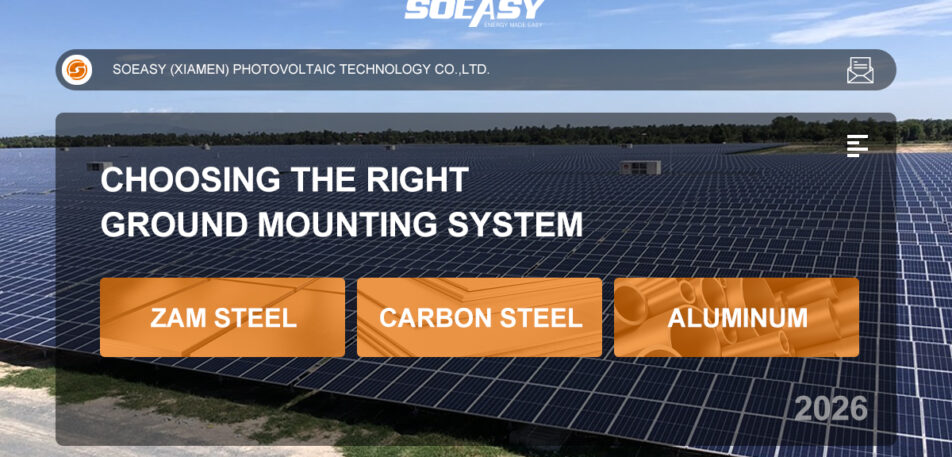
Among all available materials, ZAM steel (Zn-Al-Mg coated steel), hot-dip galvanized carbon steel, and aluminum alloy are the three dominant choices in today’s market.
This article provides a systematic comparison of corrosion resistance, mechanical properties, processing performance, environmental adaptability, and cost, helping you make an informed decision.
Overview of Common Ground Mount Materials
1. ZAM Steel (Zinc-Aluminum-Magnesium Coated Steel)
ZAM steel is an advanced coated steel widely adopted in the solar industry in recent years.
Technical features:
- Coating composition: Zn + ~6% Al + ~3% Mg
- Dense eutectic microstructure with higher hardness than zinc
- Base steel: High-strength grades (S350GD–S550GD)
Key advantages:
- 优异的耐腐蚀性
- Self-healing performance at cut edges and scratches
- High surface hardness and wear resistance
- Suitable for cold-forming processes
2. Carbon Steel (Hot-Dip Galvanized)
A traditional and widely used material with decades of engineering validation.
Technical features:
- Base material: Q235B, Q355B
- Coating thickness:
- Indoor: 65–85 μm
- Outdoor: 85–110 μm
- Fabrication: hot rolling or cold forming + post-galvanizing
Key advantages:
- High structural strength
- Mature supply chain
- Lower initial cost
3. Aluminum Alloy
Widely used in rooftop systems and increasingly adopted in ground-mounted applications.
Technical features:
- Common grades: 6005-T5, 6061-T6, 6063-T6
- Surface treatment: anodizing or powder coating
- Connection: primarily bolted (welding not recommended)
Key advantages:
- Lightweight (~1/3 of steel)
- Natural corrosion resistance
- Clean appearance and easy installation
Core Performance Comparison
1. Corrosion Resistance
| 材料 | Mechanism | Salt Spray (ASTM B117) | Cut Edge Protection | Long-Term Rating |
|---|---|---|---|---|
| ZAM Steel | Protective film + Mg self-healing | 1000–2000h | 优秀 | ★★★★★ |
| Carbon Steel (HDG) | Sacrificial zinc layer | 500–1000h | 一般 | ★★★★ |
| 铝合金 | Natural oxide film | 1000–2000h | Good (no self-healing) | ★★★★★ |
Insight:
ZAM steel stands out due to its self-healing capability, which protects exposed steel after cutting or drilling.
2. Mechanical Properties
| Property | ZAM Steel | Carbon Steel | 铝合金 |
|---|---|---|---|
| Yield Strength (MPa) | 350–550 | 235–355 | 200–260 |
| Tensile Strength (MPa) | 400–600 | 370–470 | 250–310 |
| Elastic Modulus (GPa) | 200 | 200 | 70 |
| Density (g/cm³) | 7.85 | 7.85 | 2.70 |
| 重量: | 标准 | 标准 | ~1/3 |
Insight:
- High-strength ZAM steel enables thinner sections with equal load capacity
- Aluminum requires structural compensation due to lower stiffness
3. Processing & Connection
| Process | ZAM Steel | Carbon Steel | Aluminum |
|---|---|---|---|
| Cold forming | 优秀 | 好 | 好 |
| Cutting | Self-healing | Needs coating | 好 |
| Welding | Possible (post-treatment needed) | 需要 | Not recommended |
| Bolting | 是的 | 是的 | Yes (with isolation) |
4. Cost Comparison
| 成本项目 | ZAM Steel | Carbon Steel | Aluminum |
|---|---|---|---|
| Material Cost | 中等 | 低 | 高 |
| Processing | 中等 | 中等 | 高 |
| Transport | 标准 | 标准 | 降低 |
| 安装 | 标准 | 标准 | 降低 |
| 初始成本 | 中等 | 低 | 高 |
| 生命周期成本 | 低 | Medium–High | Low–Medium |
Environmental Suitability
Inland (Low Corrosion)
- Recommended: Carbon Steel
- Alternative: ZAM Steel
Coastal (High Salt)
- Recommended: ZAM Steel / Aluminum
- Carbon steel requires heavy coating
Harsh Environments
- Recommended: Aluminum
- Alternative: Reinforced ZAM
Agricultural / Fishery Projects
- Recommended: Aluminum or ZAM Steel
应用场景
Utility-Scale Solar Farms
| 环境 | Primary Choice | Alternative |
|---|---|---|
| Inland | Carbon Steel | ZAM Steel |
| Mountain | ZAM Steel | Carbon Steel |
| Coastal | ZAM Steel | Aluminum |
Trend:
ZAM steel is increasingly replacing traditional galvanized steel.
Distributed Ground Projects
| 项目类型 | 推荐材料 |
|---|---|
| Commercial & Industrial | ZAM Steel |
| 住宅 | Aluminum |
| Agri-PV | Aluminum / ZAM |
Lifecycle Cost Analysis (LCCA)
Key Insight
Material selection should consider 25–30 years lifecycle cost, not just initial CAPEX.
| 环境 | Carbon Steel | ZAM Steel | Aluminum |
|---|---|---|---|
| Inland Low Corrosion | Best | +5–10% | +20–30% |
| Coastal | +30–50% | Best | +5–15% |
| Harsh | Not suitable | Best | Competitive |
设计考虑因素
- Match material strength with structural design
- Use appropriate anti-corrosion strategy
- Avoid galvanic corrosion (use insulation pads)
- Select compatible fasteners (SS304/316)
常见错误
- Choosing based on initial cost only
- Ignoring environmental corrosion class (ISO 9223)
- Mixing materials improperly
- Neglecting cut edge protection
Industry Trends
- Rapid adoption of ZAM steel
- Growing demand for lightweight structures
- Integration of material + structural design optimization
Conclusion: Choose Based on Project Conditions
There is no universal “best material”—only the most suitable one.
Selection Summary
| Scenario | 推荐材料 |
|---|---|
| Inland large-scale | Carbon Steel |
| Balanced performance | ZAM Steel |
| Coastal / harsh | Aluminum |
| Complex terrain | ZAM or Aluminum |
SOEASY 地面安装解决方案
SOEASY provides complete solutions across all material types:
- ZAM steel systems (S350–S550, C3–C5 protection)
- Hot-dip galvanized steel systems
- Aluminum mounting systems
- Full lifecycle engineering support
Contact us for a customized solution based on your project conditions. Explore our solar ground cases: SoEasy Solar Projects
常见问题
Which material is best for ground-mounted solar?
It depends on the environment. Carbon steel suits inland areas, while ZAM steel and aluminum perform better in corrosive environments.
Is ZAM steel better than galvanized steel?
Yes, especially in terms of corrosion resistance and cut-edge protection.
Why choose aluminum despite higher cost?
Its lightweight and corrosion resistance make it ideal for harsh environments and complex installations.