English

 Post by
 When discussing solar system safety, most attention is given to structural strength—whether the mounting system is robust, wind-resistant, and securely installed. While these factors are essential, a solar PV system is fundamentally an electrical system, where electrical safety is equally critical.
Each year, improper grounding design or installation leads to serious incidents, including:
- Lightning damage to equipment
- DC arc faults causing fires
- Electric shock risks from energized metal structures
Behind many of these issues lies a commonly overlooked factor: grounding continuity.
Among all grounding components, grounding clips 及 grounding plates are the smallest yet most critical elements. They ensure that all metallic parts of the solar mounting system are electrically connected into a single equipotential bonding network.
This article explains their working principles, functions, installation risks, and design considerations—highlighting why these small components are essential for system safety.
What Are Grounding Clips and Grounding Plates?
1. Grounding Clips
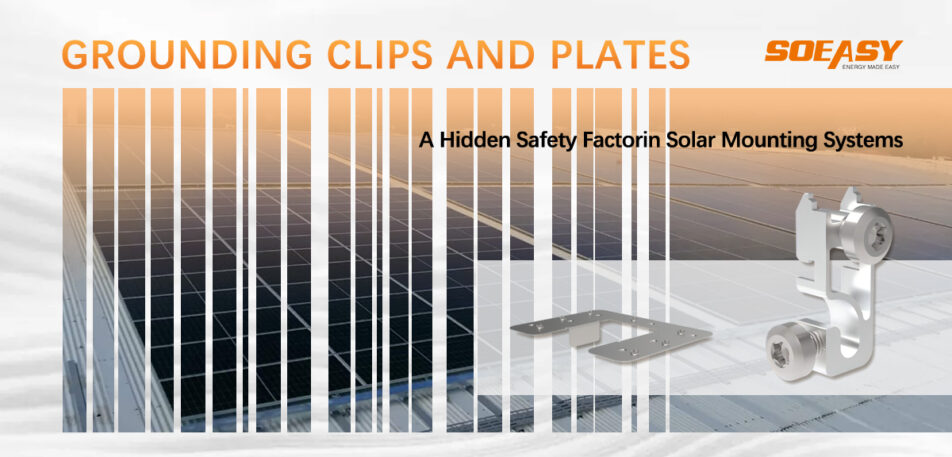
Grounding clips are metal components designed to establish an electrical connection between solar module frames and mounting rails.
主要优势
- Made of stainless steel or galvanized steel
- Equipped with serrated teeth or piercing points
- Installed between module frames and rails under clamping force
Working Principle
Both module frames and rails are typically made of anodized aluminum. The anodized layer (Al₂O₃) is electrically insulating.
Grounding clips pierce this oxide layer using their serrated teeth, creating direct metal-to-metal contact and ensuring electrical conductivity.
2. Grounding Plates
Grounding plates are used to connect separate conductive components, such as:
- Rail-to-rail connections
- Rail-to-structure connections
主要优势
- Flat metal plates with serrated contact surfaces
- Installed at rail splice points or structural joints
- Bridge electrical connections between components
Working Principle
When rails are joined using non-conductive connectors or oxidized surfaces, electrical continuity may be interrupted.
Grounding plates bridge these gaps and restore electrical continuity by piercing oxide layers at connection points.
3. Role in the System
Together, grounding clips and plates form a complete equipotential bonding network:
- Grounding clips → connect module frames to rails
- Grounding plates → connect rails to rails and structures
All metallic components are electrically bonded and connected to ground, forming a continuous grounding path.
Why Grounding Is Critical in Solar Mounting Systems
1. Lightning Protection
Solar systems are often installed in exposed locations. Without grounding:
- Lightning current may damage modules, inverters, or cables
With proper grounding:
Lightning current flows safely to earth through a low-resistance path
2. Fault Current Path
Possible fault conditions include:
- Insulation failure
- Inverter faults
- DC arc faults
A proper grounding system:
Provides a safe path for fault currents and triggers protection devices
3. Personnel Safety
Without grounding, metal parts may become energized.
Grounding ensures all components are at the same electrical potential, reducing electric shock risks.
How Grounding Clips and Plates Work
Mechanical Pressure + Oxide Penetration
Aluminum naturally forms an insulating oxide layer (5–20 μm thick). Despite its thinness, it prevents electrical conduction.
Grounding components solve this through:
- Serrated teeth design
- Mechanical pressure during installation
- Penetration of oxide layer
- Stable metal-to-metal contact
Continuous Grounding Path
A complete grounding path is formed as:
Module frame → Grounding clip → Rail → Grounding plate → Adjacent rail → Structure → Ground wire → Earth
This creates a low-resistance, continuous electrical path.
Common Installation Mistakes and Risks
1. Ignoring Grounding Components
- Assumption: metal contact is sufficient
- Reality: oxide layers prevent conduction
Risk: total grounding failure
2. Incorrect Installation Position
- Misaligned clips or plates
- Insufficient contact pressure
Risk: high resistance and unreliable grounding
3. Insufficient Tightening Torque
- Loose connections prevent oxide penetration
Risk: unstable electrical performance
4. Material Mismatch and Corrosion
- Using incompatible metals
- Poor corrosion resistance
Risk: degradation of conductivity over time
Design Considerations for Reliable Grounding
1. Material Selection
- SUS304 / SUS316 → best for corrosive environments
- Galvanized steel → cost-effective for standard conditions
Use materials compatible with aluminum structures
2. Surface Treatment
- Thicker anodized layers require stronger penetration
- Special grounding components may be needed
3. Standards and Compliance
- IEC 62548 – grounding design requirements
- NEC 690 – U.S. grounding regulations
- UL 2703 – bonding continuity (≤ 0.1Ω)
- GB 50057 – grounding resistance requirements
Typical requirements:
- Connection resistance ≤ 0.1 Ω
- Ground resistance ≤ 10 Ω (or local standards)
When to Use Grounding Clips vs Grounding Plates
| 应用场景 | Recommended Component |
|---|---|
| Module frame ↔ rail | Grounding clip |
| Rail ↔ rail | Grounding plate |
| Rail ↔ structure | Grounding plate |
| Structure ↔ ground | Grounding lug |
In most systems, both clips and plates are required together.
Benefits of Proper Grounding Design
- 系统安全性得到提升
- Reduced fire and failure risks
- Compliance with certification standards
- 更低的维护成本
- Longer system lifespan
Small Components, Critical Safety Impact
Although grounding clips and plates are small and low-cost, they define the electrical safety baseline of the entire system.
They ensure:
- Safe discharge of lightning current
- Protection against electrical faults
- Long-term system reliability over 25+ years
Grounding design should never be overlooked.
SOEASY Grounding Solutions
SOEASY provides complete and reliable grounding solutions for solar mounting systems:
- Full range of grounding accessories
Grounding clips, plates, and lugs - Tested electrical performance
Ensures compliance with resistance standards - Optimized material and design
Durable, corrosion-resistant, and reliable - System-level compatibility
Fully integrated with mounting system designs
Choose SOEASY for safe, compliant, and long-lasting solar mounting solutions.