English


 Post by
Why Agrivoltaics Is Reshaping Utility Solar Development
Agrivoltaic mounting systems elevate solar arrays 2.2 to 4.5+ meters above grade with wide post spacing, allowing Australian farmers and solar developers to combine utility-scale electricity generation with active sheep grazing, horticulture, or crop cultivation on the exact same hectare of land.
Across Australia’s designated Renewable Energy Zones in New South Wales, Victoria, and Queensland, competition over prime agricultural land has become one of the biggest hurdles to project permitting. State planning authorities and rural communities increasingly scrutinize traditional low-profile ground mounts that lock productive farmland out of agricultural use for 30 years.
Agrivoltaics (Agri-PV) turns land-use conflict into a win-win commercial model. By deploying elevated, wide-span agricultural solar mounting structures, project developers accelerate planning approvals, lower vegetation-management OPEX through livestock grazing, and unlock dual revenue streams—while improving PV module efficiency through natural crop transpiration cooling.
1. The Agronomic & Engineering Synergy: How Agri-PV Boosts Both Yields
Unlike conventional ground-mount solar farms built at 0.6m–0.8m ground clearance, engineered agrivoltaic structures create a regulated microclimate beneath the panels:
- Microclimate Cooling & Higher PV Efficiency: Crops and pasture beneath elevated panels release moisture through evapotranspiration, lowering ambient air temperatures around the modules by 2°C to 5°C during peak Australian summers—directly reducing thermal voltage drop and boosting kWh yield.
- Reduced Heat Stress & Water Evaporation: Partial shading protects heat-sensitive crops (such as berries, orchards, leafy greens, and vineyards) from harsh UV radiation and scorching afternoon heat, cutting irrigation water consumption by up to 20%–30%.
- Zero-Mowing Vegetation Management (Solar Grazing): Maintaining a minimum clearance height allows sheep and grazing livestock to move freely beneath the arrays, eliminating mechanical mowing costs and lowering bushfire fuel loads during dry seasons.
2. Four Critical Engineering Requirements for Agrivoltaic Racking
Designing an agricultural solar mounting system requires far more than simply stretching standard ground-mount legs. Elevated structures face higher wind overturning moments, machinery collision risks, and aggressive agricultural chemical environments:
1. Customizable Ground Clearance & Wide-Span Post Spacing
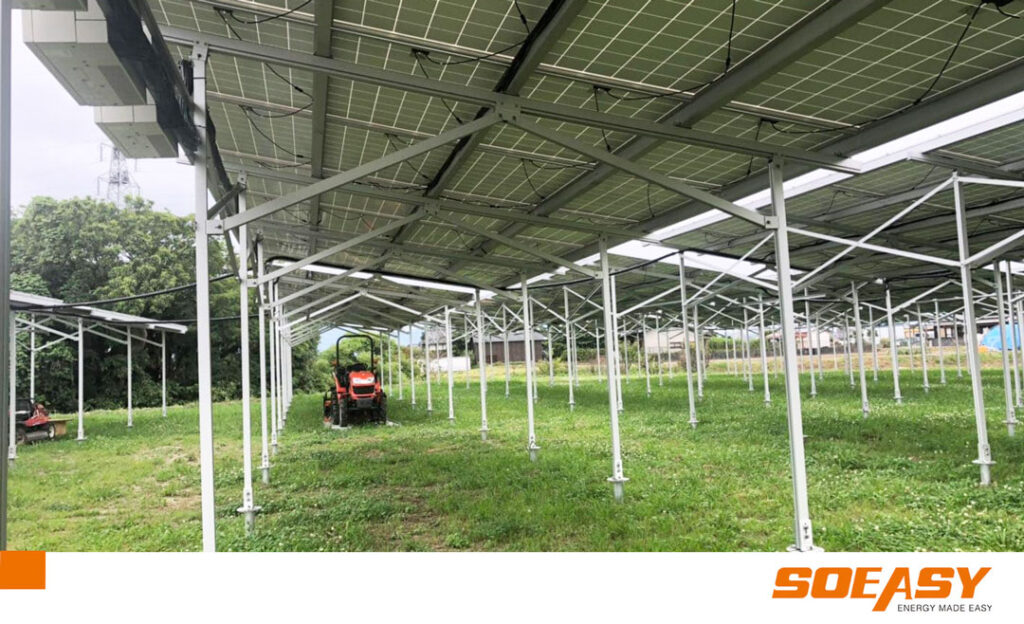
- Solar Grazing (Pasture / Sheep): Requires 1.2m to 1.8m leading-edge clearance and rounded edges/protected cable routing to prevent livestock injury or wire chewing.
- Horticulture & Row Crops: Requires 2.5m to 4.5m+ clearance 及 5m to 8m+ East-West column spans so tractors, harvesters, and irrigation booms can operate unobstructed beneath the canopy.
2. Light-Transmission Control (Semi-Transparent & Variable Pitch Layouts)
Different crops require specific Photosynthetically Active Radiation (PAR) levels. Agrivoltaic mounting frames must support customized row pitch, checkerboard module spacing, or frameless/semi-transparent bifacial glass modules to balance kWh generation per hectare with uniform sunlight distribution on the ground below.
3. Resistance to Fertilizers, Ammonia & Soil Acidity
Agricultural environments expose steel and aluminum racking to corrosive nitrogen fertilizers, livestock manure/ammonia vapors, and irrigated soils. Racking components require high-grade anodized aluminum (AL6005-T5 / AL6082-T6) or heavy-duty Zn-Al-Mg / hot-dip galvanized structural steel with isolated stainless-steel (SUS304/316) fasteners to prevent galvanic corrosion over a 25–30 year lifespan.
4. High Wind Uplift Resistance at Elevated Heights
Because wind speed increases with height above ground, a 3.5-meter elevated solar canopy experiences significantly greater uplift and lateral shear forces than a low-profile array. Structures must be engineered to AS/NZS 1170.2 (Australian Wind Actions) with reinforced knee-bracing and deep helical ground screws or driven piles.
3. Agrivoltaic System Configurations: Matching Structure to Farm Type
| Agricultural Application | Recommended Clearance | Post Span (E-W) | Optimal Racking Architecture | Primary Commercial Benefit |
| Solar Grazing (Sheep / Pasture) | 1.2m – 1.8m | 3.5m – 5.0m | Reinforced 1P/2P High-Clearance Ground Mount | Eliminates mechanical mowing OPEX; fastest REZ permitting. |
| Orchards, Vineyards & Berry Farms | 2.5m – 3.8m | 5.0m – 7.5m | Portal-Frame / Single-Column Canopy Structure | Protects high-value crops from hail, frost, and sunburn. |
| Mechanized Row Crops | 3.5m – 4.5m+ | 6.0m – 9.0m+ | Heavy-Duty Long-Span Agricultural Frame | Full clearance for farm tractors and spraying machinery. |
| Greenhouse & Controlled Agri-PV | 3.0m – 5.0m | Custom Grid | Waterproof / Semi-Transparent Structural Roof | Controlled microclimate for year-round specialty crops. |
4. Tailored Engineering: SOEASY Agricultural PV Mounting Systems
Recognizing that every farm crop, soil profile, and local wind zone demands bespoke geometry, SOEASY engineered its dedicated Agricultural PV Mounting Systems for full structural customization across global rural and utility projects:
- Fully Customized Elevation & Span Geometry: Engineered to your exact agricultural machinery dimensions and crop height requirements—from 1.5m pasture mounts to 4.5m+ high-clearance orchard canopies.
- Integrated Rainwater & Drip Management: Optional waterproof purlin channels and guttering guide rainwater runoff away from sensitive crops or channel water directly into farm irrigation reservoirs.
- High-Strength, Corrosion-Resistant Materials: Built using precision-extruded AL6005-T5 anodized aluminum or high-tensile Zn-Al-Mg / HDG steel, certified to international structural standards including AS/NZS 1170 及 Eurocode 1 & 3.
- Fast Field Assembly with Pre-Assembled Sub-Components: Factory pre-assembled brackets and modular beam connectors cut on-site installation labor, minimizing disruption to seasonal planting and harvesting schedules.
5. Field-Proven Experience: Global Agricultural & Rural Solar Deployments
With over 10GW of global solar mounting shipments, SOEASY has partnered with EPCs and agricultural developers across land-scarce markets—including Japan, Europe
- High-Clearance Farmland & Tea/Crop Co-Location Projects (Japan): In jurisdictions governed by strict Solar Sharing agricultural regulations, SOEASY delivered custom-elevated aluminum and steel mounting structures featuring wide column spacing and calibrated light-transmittance ratios, enabling local farmers to maintain continuous crop yields beneath active PV arrays.
- Rural Grazing & Distributed Ground-Mount Systems (Europe & APAC): Customized elevated ground structures designed for undulating rural pastures, providing safe livestock clearance, corrosion-resistant ground screw foundations, and rapid modular deployment.
Frequently Asked Questions (FAQ) — Agrivoltaic Mounting Systems
Q1: How much more does an agrivoltaic mounting structure cost compared to a standard ground mount?
Elevated agrivoltaic structures typically add 10% to 25% to racking material costs due to taller posts, thicker structural sections for wind resistance, and wider spans.
Q2: Can agrivoltaic systems be installed on sloping agricultural land?
Yes. By combining elevated post designs with adjustable post-to-beam connectors and helical ground screws, SOEASY agricultural mounting structures adapt to gently rolling pastures and hillsides without disturbing fertile topsoil.
Unlock Dual Revenue on Your Agricultural Land
Planning an agrivoltaic project in Australia or seeking a custom high-clearance solar mounting solution for farmland or grazing pastures? Send us your site location, target clearance height, machinery dimensions, and module datasheet—our structural engineers will deliver a custom layout, wind-load calculation, and factory-direct quotation within 48 hours.
👉 Explore SOEASY Agricultural PV Mounting Solutions & Request a Quote
電子メール: