English

 Post by
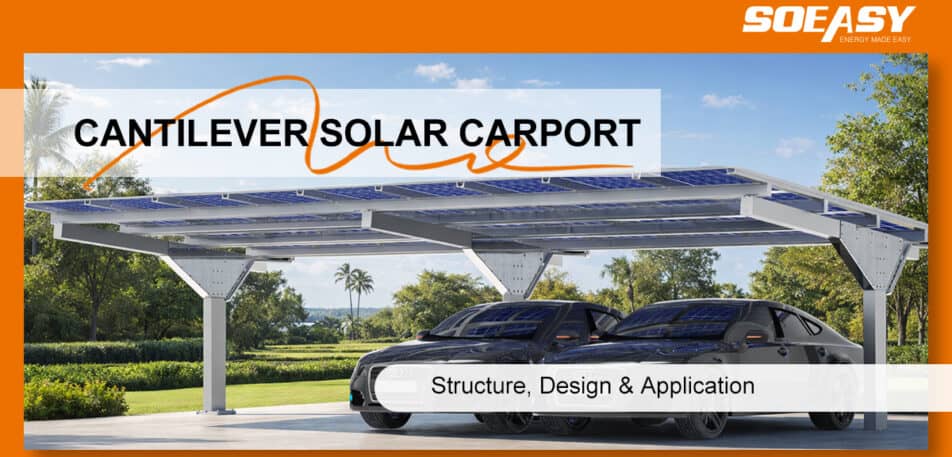
 A Cantilever Solar Carport is a photovoltaic structure that integrates solar power generation with vehicle shading and weather protection. In recent years, solar carports have been widely adopted in industrial parks, commercial facilities, and public parking areas. Among various carport structures, the cantilever solar carport stands out for its clean layout and efficient use of space.
Unlike conventional carports supported by columns on both sides, a cantilever solar carport uses columns on only one side. The PV canopy extends outward from the columns through cantilever beams, creating a column-free parking area. This design significantly improves spatial openness while enhancing both functionality and aesthetics.
Overview of Cantilever Solar Carports
In solar carport classification, cantilever structures are typically positioned as premium solutions that prioritize space efficiency, visual clarity, and user experience. Common configurations include single-span cantilever carports and multi-span continuous cantilever layouts, which can be flexibly adapted to different site conditions.
Cantilever solar carports are especially suitable for projects where unobstructed parking spaces, smooth traffic flow, and architectural integration are key considerations.
Typical Structural Configuration
Single-Sided Cantilever Structure
The defining feature of a cantilever solar carport is its single-row column support system. Columns are usually placed along one side of the parking area—such as adjacent lanes or green belts—allowing the parking spaces beneath the canopy to remain completely free of columns.
Main Structural Components
Columns
Columns serve as the primary vertical load-bearing elements. Typically made from square or circular steel tubes, they are rigidly connected to the foundation and transfer vertical loads as well as wind and snow loads.
Main Beam / Cantilever Beam
The cantilever beam is rigidly connected to the top of the column and extends horizontally over the parking area. It is the core structural member supporting the PV modules and external loads.
Purlins and Bracing System
Purlins are arranged perpendicular to the main beam to support the PV modules directly. Where necessary, diagonal braces or tie rods are added to improve torsional resistance and overall stability.
PV Module Installation Area
The canopy is usually designed as a single-slope or dual-slope roof. The tilt angle can be optimized according to local solar conditions to maximize energy yield.
Common Structural Materials
- Steel Structures
Hot-dip galvanized steel is the most widely used material due to its high strength and load-bearing capacity. It is well suited for large spans and heavy-load conditions. - 铝结构
Aluminum offers excellent corrosion resistance and a clean appearance. It is often used in coastal or high-corrosion environments, although the cost is relatively higher.
Load Transfer and Structural Safety Principles
Load Path of Cantilever Structures
Loads from PV modules, wind, and snow are transferred from the purlins to the cantilever beam, then through the rigid beam-to-column connection down to the column foundation. The maximum bending moment typically occurs at the root of the cantilever beam, which is the critical design section.
Base Moment and Anti-Overturning Design
Due to eccentric loading, the column base is subjected to significant bending moments. To ensure safety, designers typically adopt the following measures:
- Enlarging foundation dimensions or using pile foundations to resist overturning moments
- Connecting columns with tie beams or ground anchors to form a cooperative load-resisting system
风雪荷载考虑因素
Cantilever solar carports are particularly sensitive to wind uplift forces, especially at the canopy edge. Snow loads can also generate high bending moments near the cantilever root. Accurate load values must be determined according to local codes, including the effects of uneven snow accumulation.
Structural Design for Different Spans
- Small spans (≤ 6 m): Single cantilever beams are usually sufficient
- Medium spans (6–9 m): Triangular truss-type cantilever beams are commonly used to improve stiffness while reducing weight
- Large spans (> 9 m): Customized structural analysis is required, often involving space trusses or auxiliary tension systems with strict deflection control
Key Advantages of Cantilever Solar Carports
- Improved parking efficiency by eliminating internal columns
- Better driving visibility and safety, reducing the risk of vehicle damage
- Modern and streamlined appearance, enhancing the overall project image
- Dual functionality, combining clean energy generation with shading and rain protection
Critical Engineering Design Considerations
Foundation Design
Depending on geological conditions, independent footings, pile foundations, or micro-piles may be used. Compression, uplift, and overturning resistance must be verified under all load combinations.
Corrosion Protection and Durability
- Steel structures should be hot-dip galvanized with a zinc layer thickness of ≥ 85 μm
- Aluminum-to-steel connections must include electrical insulation to prevent galvanic corrosion
- Fasteners should be stainless steel or galvanized
PV Module Layout and Tilt Angle
Module orientation and tilt should balance energy yield, drainage performance, wind behavior, and installation efficiency. Typical tilt angles range from 5° to 15°.
Drainage and Waterproofing
Organized drainage systems should be integrated into beams or purlins, guiding rainwater into downpipes or drainage channels. Waterproof gaskets are recommended at module clamp interfaces.
Cable Management and Electrical Safety
Cables can be routed internally along beams or purlins for a clean appearance. Equipotential bonding and lightning protection systems must comply with electrical safety standards.
Typical Application Scenarios
- Industrial and commercial park parking areas
- Factory and logistics center parking facilities
- Shopping malls, hospitals, schools, and transport hubs
- Overseas projects with high requirements for space efficiency and visual openness
Comparison with Double-Post Solar Carports
| 方面 | Cantilever Carport | Double-Post Carport |
|---|---|---|
| Structural stability | Higher design precision required | Easier to ensure |
| Space experience | Column-free, open | Columns within parking area |
| Construction complexity | 更高 | 降低 |
| Cost | Typically 10–25% higher | 降低 |
| Suitable scenarios | High-end, space-limited projects | Standard parking lots |
Economic Performance and Long-Term Value
Initial Investment
Costs mainly include the mounting structure (including foundations), PV modules, inverters, electrical systems, and installation. Cantilever systems generally cost 10–25% more than standard double-post carports, depending on span and material selection.
Power Generation and Added Parking Value
A 1 MW solar carport system can generate approximately 1 million kWh annually, providing substantial electricity savings or feed-in revenue. Shading and rain protection also enhance property value and vehicle protection.
Operation and Service Life
The structural design life should match the PV module lifespan of at least 25 years. Maintenance requirements are minimal, focusing on periodic inspections of fasteners, coatings, and electrical connections.
Overall Commercial Benefits
With a typical payback period of 5–8 years, cantilever solar carports offer long-term stable returns, combined with environmental benefits and enhanced corporate sustainability image.
How to Select the Right Cantilever Solar Carport Solution
- Evaluate site conditions, parking layout, geological data, and climate loads
- Balance safety, cost efficiency, and architectural appearance
- Choose a supplier with proven structural design capabilities and project experience
A well-designed cantilever solar carport delivers not only clean energy but also long-term structural reliability and architectural value. In today’s transition toward sustainable infrastructure, working with an experienced mounting system provider is essential for achieving safe, durable, and visually refined solar parking solutions.
Learn more about our solar carport: SOEASY Solar Carports Solutions.Com