English

 Post by
 As the world accelerates its transition to clean energy, solar power stands out as one of the most promising renewable sources. Yet, while most people focus on generating green electricity, the foundation methods used in solar power plant construction often escape notice.
This leads to an important question: if solar structures still depend on concrete pouring and heavy excavation, can they truly be called “green structure”?
The answer lies beneath the surface — in the ground screw, a sustainable foundation that replaces traditional concrete bases.
What Are Ground Screws?
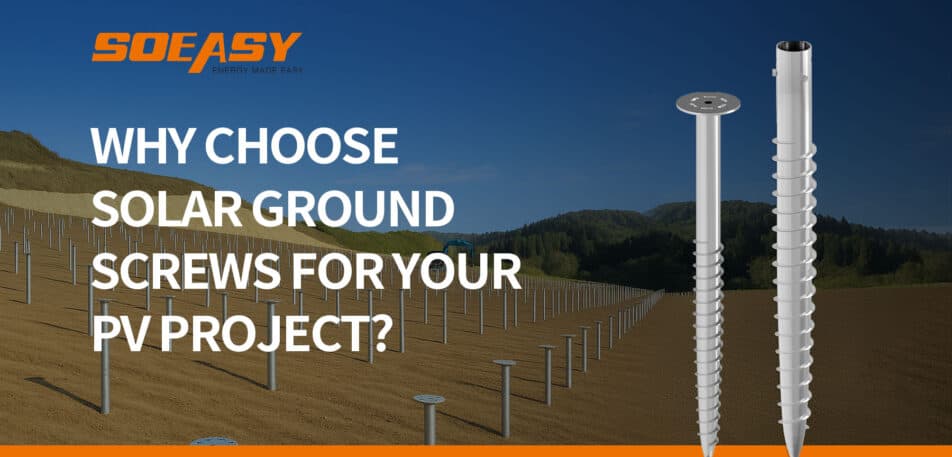
A ground screw is a steel foundation pile that anchors directly into the soil without excavation.
It includes a spiral steel shaft and a top connector — such as a flange plate or threaded adapter — to support solar mounting systems, fences, or carports.
In solar applications, ground screws form the backbone of ground-mounted systems. They work perfectly for large-scale solar farms, agrivoltaic projects, and distributed installations. With their simple structure, fast installation, and wide adaptability, ground screws have quickly become a mainstream foundation choice across the solar industry.

Eco-Friendly Advantages of Ground Screws
1. No Concrete, Lower Carbon Emissions
Concrete foundations require excavation, mixing, pouring, and curing — all processes that consume energy and release carbon. Ground screws skip these steps entirely. They drive directly into the soil, reducing construction time, material use, and carbon emissions on every project.
2. Recyclable and Reusable
After a project ends, installers can remove and reuse each ground screw. Made from hot-dip galvanized steel, they offer strong corrosion resistance and recyclability — a perfect match for the circular economy. This makes them ideal for temporary or movable solar projects.
3. Minimal Land Impact and Fast Recovery
Since ground screws are driven, not poured, they cause little disturbance to the soil. This makes them ideal for agricultural or agri-PV projects, where protecting the land is essential. Once removed, the ground returns to its natural state — with no concrete residue or contamination.
4. Low Noise and Clean Construction
Electric or hydraulic pile-driving machines install ground screws quickly and quietly. The process generates no dust and minimal vibration, making it suitable for urban environments or sites with strict environmental standards.
Applications in Solar Projects
Ground screws deliver strong performance across various solar applications:
- Utility-Scale Solar Farms: Speed up construction, cut labor costs, and boost installation efficiency.
- Agri-PV and Pasture Projects: Protect soil integrity without affecting crops or grazing land.
- Complex Terrains: Handle slopes, sandy soils, and frozen ground with customized lengths and diameters.
Unlike concrete bases, ground screws require no heavy excavation or soil removal. Their flexibility and adaptability make them the go-to choice for sustainable, high-efficiency solar construction.
SOEASY Ground Screw Solutions
SOEASY Solar develops high-strength, eco-friendly ground screw systems designed for long-term stability. Each ground screw uses Q235B carbon steel with a hot-dip galvanized coating over 80μm, providing excellent durability and corrosion protection.
With deep experience in design and manufacturing, SOEASY delivers full project support — from ground screw selection and structural design to system integration. Our engineers focus on balancing safety, cost-efficiency, and sustainability in every solution.
Currently, SOEASY ground screw systems support solar projects around the world, helping customers build a cleaner, more efficient future.
Learn more about ground mounting project:Our Projects – soeasypv.com