English

 Post by
 Introduction: Tile Roof Solar Is More Complex Than It Looks
Tile roofs are widely used in residential markets across Europe, Australia, Latin America, and southern China. They offer excellent waterproofing, durability, and architectural aesthetics.
However, these same characteristics make solar installation more complex.
What appears uniform from the outside actually varies significantly:
- Roof substructures may be wooden rafters or concrete slabs
- Tile types include flat tiles, S-shaped tiles, Roman tiles, and Spanish tiles
- Tile curvature, overlap, and fixing methods differ widely
One fundamental rule applies to all tile roof solar projects: Solar mounting systems must never be fixed directly to tiles.
Tiles are not structural components—they are only waterproof layers.
So how do you safely connect the solar mounting system to the building structure?
The answer is specialized roof hooks.
These components, installed beneath the tiles and fixed to the structural base, serve as the critical interface between the solar system and the building.
What Are Specialized Roof Hooks?
Definition
A roof hook is a metal component installed beneath tiles and fixed directly to the roof’s load-bearing structure (rafters or concrete). It acts as the anchor point for the solar mounting system.
Core Functions
- Structural connection: Links the mounting rails to the building structure
- Height adjustment: Adapts to tile thickness and uneven surfaces
- Load transfer: Transfers wind, snow, and dead loads safely
Types of Roof Hooks and Applications
| Type | Features | Typical Applications |
|---|---|---|
| Fixed Hook | Simple structure, fixed height | Standard roofs with uniform tiles |
| Adjustable Hook | Height adjustable (20–50 mm) | Uneven or older roofs |
| Reinforced Hook | Higher strength, thicker material | High wind or snow load regions |
Roof Hooks vs Standard Mounting Components
| Aspect | Standard Connectors | Roof Hooks |
|---|---|---|
| Installation Position | Rail-to-rail / module-to-rail | Roof structure to rail |
| Environment | General outdoor | Under tiles (high humidity) |
| Waterproof Requirement | None | Critical |
| Tile Compatibility | Not required | Must match tile shape |
| Structural Role | Non-structural | Load-bearing connection |
Why Standard Fasteners Are Not Suitable for Tile Roofs
1. Tiles Cannot Bear Load
Tiles are designed for waterproofing, not structural support.
Risk:
Direct mounting leads to cracking or system failure.
2. Incorrect Installation Practices
Examples:
- Fixing rails directly through tiles
- Clamping tile edges
Consequences:
- Tile breakage
- Water leakage
- System instability under wind
3. Tile Shape Complexity
Different tile profiles require precise matching:
- Flat tiles
- S-shaped tiles
- Roman tiles
- Spanish tiles
Using non-matching hooks leads to:
- Poor fit
- Stress concentration
- Waterproof failure
4. Waterproofing Risks
Tile roofs rely on proper overlap for waterproofing. Any disturbance can cause leakage.
Specialized hooks are designed to:
- Maintain tile alignment
- Integrate sealing solutions
- Preserve waterproof integrity
Key Functions of Roof Hooks in Tile Roof Systems
Load Transfer
All loads are transferred from modules → rails → hooks → building structure.
Tiles are not load-bearing.
Structural Stability
- Ensures uniform support
- Prevents vibration and displacement
Roof Protection
- Minimal tile removal
- No excessive stress on tiles
Waterproof Assurance
- Tiles can be fully restored after installation
- EPDM sealing + proper overlap maintained
Waterproof Design Comparison
| Solution | Waterproof Risk | Protection Method |
|---|---|---|
| Standard Fasteners | High | None |
| Roof Hooks | Low | EPDM + sealant + tile recovery |
Innovative Solution: ONEKEYHOOK System
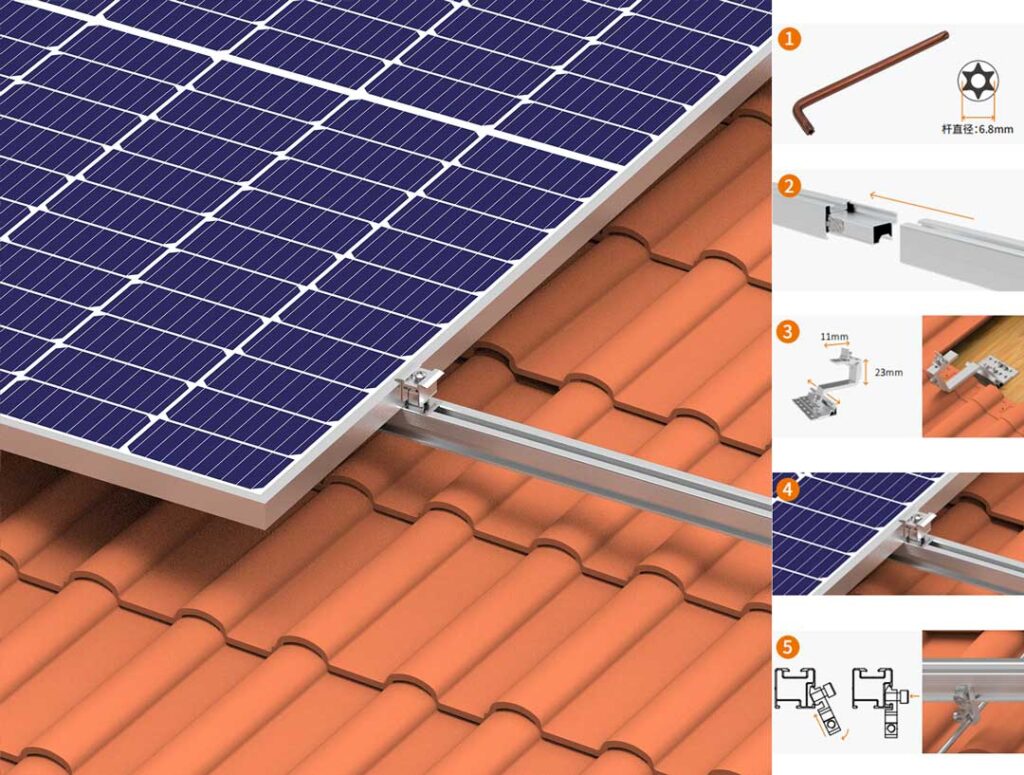
The ONEKEYHOOK system by SOEASY represents a new generation of tile roof mounting solutions, focusing on efficiency, integration, and aesthetics.
Key Innovations
| Aspect | Traditional Method | ONEKEYHOOK |
|---|---|---|
| Tools | Multiple tools | One tool for entire system |
| Rail Connection | Drilling & bolting | Patented click-in connection |
| Adjustment | Limited | 3-direction adjustable |
| Grounding | Visible wires | Hidden grounding system |
| Installation | On-site processing | Pre-assembled components |
Technical Specifications
| Parameter | Value |
|---|---|
| Material | AL6005-T6 + SUS304 |
| Wind Load | ≤45 m/s |
| Snow Load | 1.5 kN/m² |
| Service Life | 25 years |
| Warranty | 10 years |
Additional Benefits
- Compatible with mainstream modules (30–35 mm)
- Clean and aesthetic design
- Integrated electrical grounding
Key Selection Factors
Roof Structure
| Structure | Fixing Method | Recommended Hook |
|---|---|---|
| Wooden Rafters | Self-tapping screws | Fixed / Adjustable |
| Concrete Roof | Anchor bolts | Adjustable |
| Steel Structure | Self-drilling screws | Reinforced |
Tile Characteristics
- Thickness → determines hook height
- Curvature → determines hook shape
- Overlap → affects installation position
Load Requirements
| Load Level | Recommended Hook |
|---|---|
| Standard | Fixed |
| Medium | Adjustable |
| High | Reinforced |
Corrosion Resistance
| Environment | Recommended Material |
|---|---|
| Inland | SUS304 |
| Coastal | SUS316 |
| Industrial | SUS316 / coated |
Installation Best Practices
Tile Removal & Reinstallation
- Carefully lift tiles
- Install hook
- Restore tiles correctly
Accurate Positioning
Hooks must align with rafters or structural points.
Waterproofing
- Use EPDM washers
- Apply sealant
- Ensure proper tile overlap
Avoid Tile Damage
- Ensure full contact
- Avoid point loading
- Allow tile movement
Common Installation Mistakes
1. Using Tiles as Structural Support
❌ Incorrect → Tiles crack
✅ Correct → Fix to rafters
2. Using Generic Hooks
❌ Poor fit
✅ Use tile-specific or adjustable hooks
3. Ignoring Waterproofing
❌ Leads to leakage
✅ Use EPDM + sealant
4. No Structural Calculation
❌ Unsafe spacing
✅ Design based on load analysis
Benefits of Using Specialized Roof Hooks
- Improved structural safety
- Reduced leakage risk
- Faster and standardized installation
- Longer system lifespan (25+ years)
Small Component, Critical Role
Roof hooks may represent less than 5% of system cost, but they are essential to system safety and performance.
Key Takeaways
- Never fix solar systems directly to tiles
- Roof hooks are the structural connection point
- Tile compatibility is critical
- Waterproofing cannot be compromised
- Structural calculation is mandatory
SOEASY Tile Roof Hook Solutions
As a professional solar mounting system provider, SOEASY offers a comprehensive range of roof hook solutions designed to accommodate various tile types and roof structures.
- ONEKEYHOOK System:
Our flagship solution engineered specifically for tile roofs, integrating single-tool installation, patented click-in rail connection, three-directional adjustability, and a concealed grounding system—delivering over 30% faster installation. - Full Range of Hook Options:
Including fixed, adjustable, and reinforced roof hooks, compatible with flat tiles, S-shaped tiles, Roman tiles, Spanish tiles, and more. - Premium Material Selection:
Manufactured with AL6005-T6 aluminum alloy and SUS304 stainless steel, ensuring long-term durability and corrosion resistance for up to 25 years. - Integrated Waterproofing Solution:
Combined EPDM sealing washers and sealant system to maintain full roof waterproof integrity. - Customization Capability:
Tailored hook designs available for unique or project-specific tile profiles. - End-to-End Technical Support:
From load calculation and system design to installation guidance, ensuring reliable and efficient project execution.
Whether your project involves a standard residential installation or a high-end villa, and regardless of whether the roof structure is timber or concrete, SOEASY provides the most suitable and reliable tile roof hook solution for your needs.
FAQ
Why are roof hooks necessary for tile roofs?
Because tiles are not load-bearing. Hooks connect the system to the structural base.
Can solar panels be installed without roof hooks?
Not safely. Direct fixing risks structural failure and leakage.
What is the best roof hook type?
It depends on roof condition, tile type, and load requirements.