English

 Post by
 With the rapid adoption of electric vehicles (EVs) and distributed photovoltaics (PV), solar carports are becoming crucial energy infrastructure for industrial parks, commercial complexes, corporate headquarters, and public parking lots.
In recent B2B solar procurement inquiries, project owners and EPC contractors frequently ask:
“Why do market quotes for solar carports vary so drastically when they all just generate power and provide shade?”
“What really sets a cheap, traditional carport apart from a premium system if both are just steel frames with a roof?”
During early-stage decision-making, many buyers treat a solar carport as a simple stack of “mounting brackets + PV modules,” falling into the trap of looking solely at the upfront unit price. However, as a long-term capital asset with a 20-to-25-year service life, subtle differences in structural design and engineering details directly dictate driver experience, long-term O&M costs, safety risks, and overall project ROI.
A well-engineered solar carport consistently generates energy revenue. An improperly designed system, on the other hand, continually incurs extra costs across installation, maintenance, and daily operations. When procuring a solar carport system, evaluating structural design capabilities is far more critical than simply comparing prices.
Why Traditional Solar Carports Fail High-End Project Requirements
Early solar carports focused primarily on supporting PV module installation. Their structural design prioritized basic load-bearing capacity over parking experience, installation efficiency, and long-term maintenance. As commercial real estate, industrial parks, and public parking facilities demand higher spatial efficiency, architectural aesthetics, and integrated energy value, the limitations of traditional solar carports have become increasingly obvious.
1. Excessive Support Columns Disrupt Parking Experience
To meet structural load requirements, traditional carports typically rely on double-post or four-corner post configurations to distribute weight across more supports. While this secures basic stability, columns placed near vehicle doors and driving paths obstruct parking maneuvers, increase collision risks, and frustrate drivers.
For commercial parking operators, dense support columns restrict usable footprint, hinder traffic flow, and diminish total property value.
2. Sealant-Dependent Waterproofing Drives Up Long-Term O&M Costs
Many conventional carports rely on chemical sealants, silicone caulking, or rubber strips for waterproofing.
When exposed to UV radiation, extreme temperature swings, wind, and rain over long periods, these materials crack, degrade, and fail. This leads to persistent water leakage and escalating maintenance costs.
For commercial projects requiring long-term operational stability, a durable, maintenance-free waterproof design is far more valuable than a low initial construction cost.
3. Complex Installation Workflows Lengthen Construction Timelines
Traditional solar carports require extensive field cutting, manual assembly, and high-altitude installation. Workers must operate at elevation to drill holes, line up structural components, and secure individual fasteners on site. This inflates labor complexity and extends overall project schedules.
For commercial ventures seeking fast commissioning, longer installation windows mean higher labor costs and delayed revenue generation.
4. Poor Spatial Efficiency Limits Revenue Potential
Smaller structural spans require more support posts, which disrupt vehicle circulation and layout design.
To prevent cars from clipping support columns, site planners must leave wider clearance margins, reducing overall parking capacity. In an era of premium land costs, parking space density directly affects property revenue and long-term investment returns.
Redefining Next-Generation Solar Carports
Driven by breakthroughs in solar PV, energy storage, and EV adoption, market demand for solar carports has evolved from “a structure that holds solar panels” to “a high-performing asset that creates long-term value.”
To overcome traditional limitations in parking experience, structural design, installation speed, and integrated energy management, the SOEASY engineering team developed the next-generation Smart Solar Carport.
More than a mounting framework, it integrates large-span cantilever engineering, structural mechanical waterproofing, modular assembly, pre-engineered Solar-Storage-Charging infrastructure, and modern architectural aesthetics into a single solution. It offers commercial parks, corporate headquarters, public facilities, and real estate developers an efficient, intelligent, and bankable energy asset.
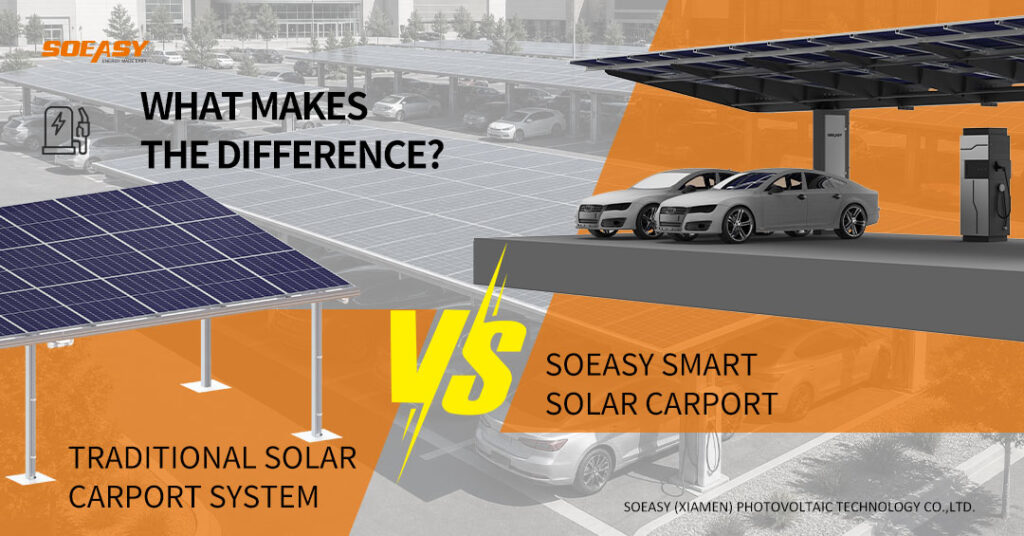
5 Key Standards for High-Quality Carport Systems: Traditional vs. Smart Solar Carport
To evaluate next-generation carport solutions effectively against legacy systems, procurement teams should benchmark five core design standards:
| Evaluation Dimension | Traditional Carport System | Premium Smart Solar Carport System |
|---|---|---|
| 1. Space & Post Configuration | Multi-post layouts that block doors and restrict vehicle clearance. | Cantilevered single-post / large-span structures for unobstructed access and maximum space efficiency. |
| 2. Structural Beam Span | Narrow spans (typically 2 parking stalls), requiring frequent support posts. | Ultra-wide spans (accommodating up to 4 stalls per bay), reducing foundation counts by half. |
| 3. Waterproofing Method | Sealants/caulking strips that degrade and leak after 3–5 years. | Structural mechanical waterproofing with integrated drainage channels for long-term, maintenance-free performance. |
| 4. Installation & Workmanship | Loose components requiring high-altitude roof assembly and lengthy construction. | Factory modular pre-assembly + under-purlin module installation, boosting efficiency by 50%. |
| 5. Functionality & Aesthetics | Basic shade and generation with exposed, cluttered wiring and low visual appeal. | Refined architectural styling + concealed electrical pathways / Solar-Storage-Charging integration for premium sites. |
Upgraded Choice: SOEASY Smart Solar Carport
If you are looking for a solar carport system that meets all high-quality standards while delivering strong ROI and premium architectural styling, the SOEASY smart solar carport is your ideal solution.
As an industry benchmark in solar mounting systems and carport engineering, SOEASY (Jianke Solar) engineered the Smart Solar Carport specifically for high-end industrial parks, commercial landmarks, luxury hotels, and enterprise facilities:
- 10-Meter Ultra-Wide Span (4 Cars Per Bay): Engineered with high-strength cantilevered beams, eliminating support column obstruction for effortless parking and door clearance while maximizing space utilization.
- Concealed Electrical Integration: EV charging infrastructure and electrical components are neatly housed inside column enclosures. Featuring vandal-resistant protection, this design eliminates messy exterior conduits to deliver a clean, modern aesthetic.
- Under-Purlin Fast Installation: An innovative bottom-up module mounting method eliminates high-altitude hazards on top of the canopy. This speeds up site progress, allowing projects to start generating power and revenue sooner.
- Slope Adaptability: Integrated column-top hinge mechanisms allow direct installation on slopes up to 10°, eliminating costly land-leveling and civil works.
- Efficient & Safe Site Construction: Factory modular pre-assembly and bottom-up PV module mounting keep crew members safely off the roof structure. This slashes safety risks and shortens total installation timelines by nearly 50%.
- Architectural Elegance & Solar-Storage-Charging Fusion: The system balances power generation performance with modern architectural design. It seamlessly routes cabling and integrates DC fast chargers and energy storage systems to form a complete Solar-Storage-Charging microgrid.
Select the Right Carport System to Boost Property Value
A solar carport is more than a shading structure; it is a forward-looking green asset for your business. An exceptional solar carport should feature built-in integration capabilities for energy storage, EV chargers, and power distribution systems, ensuring your site is fully prepared for future energy upgrades. Prioritizing structural engineering details and long-term financial returns during procurement will save your operations from decades of maintenance headaches.
Planning a Solar Carport Project?