English

 Post by
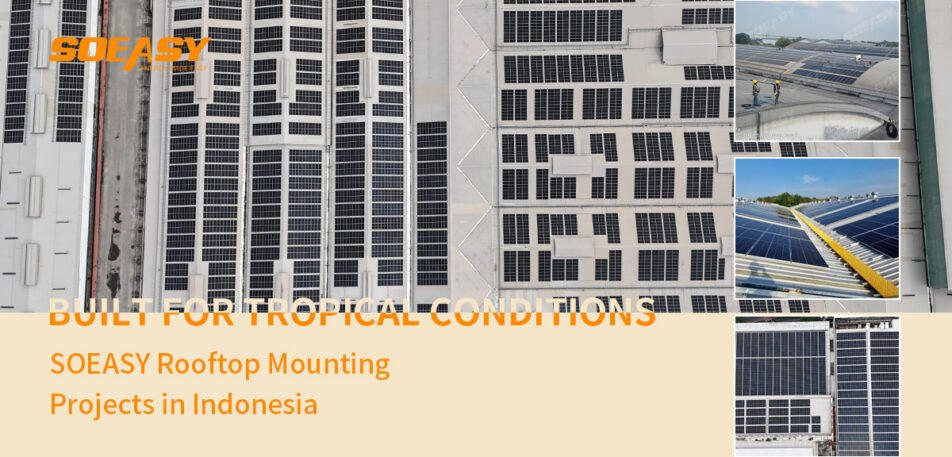
 In recent years, rooftop solar projects in Indonesia have grown steadily as commercial and industrial sectors increase their adoption of renewable energy. Factories, shopping complexes, warehouses, and office buildings provide extensive roof areas suitable for photovoltaic installations.
However, rooftop structures in Indonesia vary widely. Curved roofs, flat concrete roofs, metal sheet roofs, and mixed material roofs all require different mounting approaches. In addition, the tropical climate brings high humidity, strong sunlight, and heavy rainfall, which must be considered during system design.
Through multiple rooftop solar projects in Indonesia, SOEASY Solar has accumulated practical engineering experience in adapting mounting solutions to different roof structures and installation environments.
The following sections summarize several rooftop project scenarios delivered in Indonesia.
Arched Roof Solar Mounting Project in Indonesia
One of the rooftop solar projects in Indonesia involved installation on an arched industrial roof structure. Compared with conventional roofs, curved roofs require more precise structural adaptation.
In this project, the mounting system had to follow the curvature of the roof. Therefore, engineers divided the support structure into several inclined installation sections so that the system could match the curved roof geometry.
In addition, the rooftop system included maintenance walkway panels. Engineers optimized the connection structure of the walkway panels through several design simulations. As a result, the final structure ensured stable installation while maintaining compatibility with the curved roof.
FRP Rooftop Walkway System Project in Indonesia
Maintenance access is an important component of many rooftop solar projects in Indonesia. For this reason, several installations incorporated dedicated rooftop walkway systems.
This project adopted Fiberglass Reinforced Plastic (FRP) walkway panels as part of the rooftop infrastructure. FRP materials provide several practical advantages for rooftop environments:
- Lightweight structure suitable for rooftop load limits
- Good resistance to corrosion and humid environments
- Stable walking surfaces for maintenance personnel
- Compatibility with different rooftop layouts
Therefore, integrating FRP walkway systems helps improve safety and accessibility during long-term plant operation and maintenance.
Grand Indonesia Commercial Rooftop Solar Project
Another example of rooftop solar projects in Indonesia is the installation at the Grand Indonesia commercial complex. This project demonstrates the application of solar systems on large urban commercial buildings.
The installation took place on a flat rooftop structure within a dense city environment. Consequently, the design process required careful planning of module layout, rooftop load considerations, and maintenance access.
By optimizing the mounting layout, the project utilized the available roof area efficiently while maintaining safe installation conditions for the building.
Industrial Metal Roof Solar Project in Indonesia
Industrial factories represent a major application scenario for rooftop solar projects in Indonesia. Many manufacturing facilities feature large-span metal roofs that provide extensive space for solar installations.
This project involved the installation of a photovoltaic system on industrial metal roofing structures. During design and installation, engineers focused on adapting the mounting structure to the roof profile and structural conditions.
As a result, the system could integrate with the factory roof layout while maintaining reliable structural support for the solar modules.
Corrugated Metal Roof L-Foot Solar Installation
Corrugated metal roofs are widely used in commercial and industrial buildings across Indonesia. Therefore, they represent a common scenario for rooftop solar projects in Indonesia.
In this project, installers used an L-foot mounting connection to attach the solar system to the roof structure. This installation method provides a practical solution for corrugated metal roof applications.
Moreover, the simplified mounting structure allows efficient installation while maintaining secure structural connections.
Small Flat Roof Bifacial Solar Project in Indonesia
In addition to large installations, smaller distributed systems also contribute to the growth of rooftop solar projects in Indonesia.
One project involved a 37KW solar installation on a building with a mixed glass and concrete rooftop structure. The system used bifacial solar modules, which required careful planning during the design stage.
The project timeline included:
- Approximately 20 days for system design
- About one month for manufacturing and transportation
Despite its smaller scale, efficient project coordination allowed the installation to proceed smoothly.
Supporting the Growth of Rooftop Solar Projects in Indonesia
As distributed solar continues to expand, rooftop solar projects in Indonesia will play an increasingly important role in the country’s renewable energy transition.
Different roof structures require adaptable mounting solutions. Curved roofs, industrial metal roofs, and commercial flat roofs each present unique engineering requirements. Therefore, experience across diverse rooftop scenarios is essential for successful project implementation.
Through these installations, SOEASY Solar continues to build practical expertise in supporting rooftop photovoltaic development in Indonesia’s commercial and industrial sectors.