English

 Post by
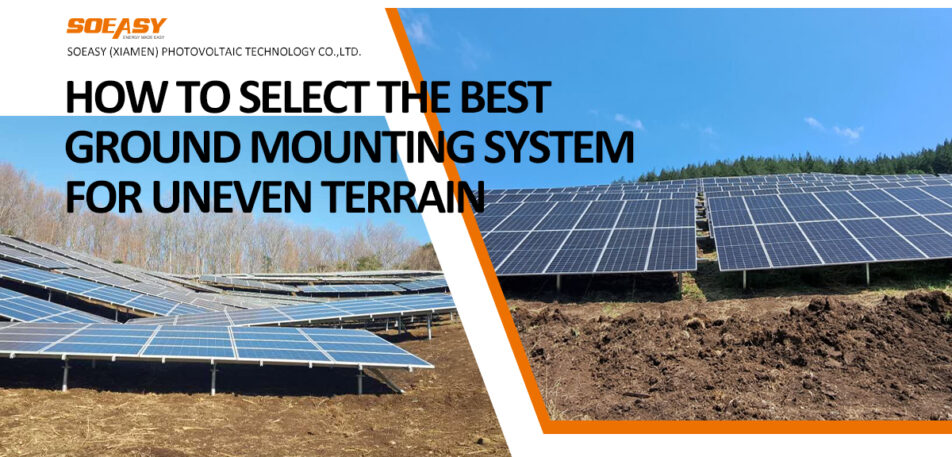
 Large-scale ground-mounted solar projects are increasingly being developed on non-flat terrain, including hills, slopes, mountains, and reclaimed or disturbed land. Irregular terrain significantly increases civil construction costs, mounting design complexity, and installation difficulty. The traditional approach of flattening a site before construction no longer works for complex terrain projects, whether for economic or environmental reasons. This article provides a systematic analysis of how to choose the best ground mounting system for uneven terrain.
Types of Uneven Terrain in Solar Projects
Gentle sloped land features slopes of less than ten degrees. Minor structural adjustments are usually sufficient to adapt to these conditions. Moderate hillsides fall within the ten to twenty degree range and require stepped or terrain-following design approaches. Steep mountainous terrain exceeds twenty degrees and demands highly customized structural solutions. Irregular or mixed terrain presents frequent slope changes across short distances, requiring zoned layouts and flexible designs for each distinct area.
Key Design Challenges in Uneven Terrain
Structural height differences arise because front and rear support columns must be at different heights to maintain module alignment. This affects rail levelness and complicates design calculations. Load distribution imbalance occurs because wind and snow loads affect sloped surfaces differently than flat ones. Localized stress concentrations can develop at transition points.
Foundation installation becomes more complex as soil depth and composition vary across the site. Piling or screw installation is harder on slopes. Cable routing and maintenance access are also more difficult. Cable paths must follow the terrain while avoiding damage, and maintenance pathways may need to be stepped or switchbacked rather than straight.
Ground Mount System Types for Uneven Terrain
Fixed Tilt Terrain-Adaptive Systems
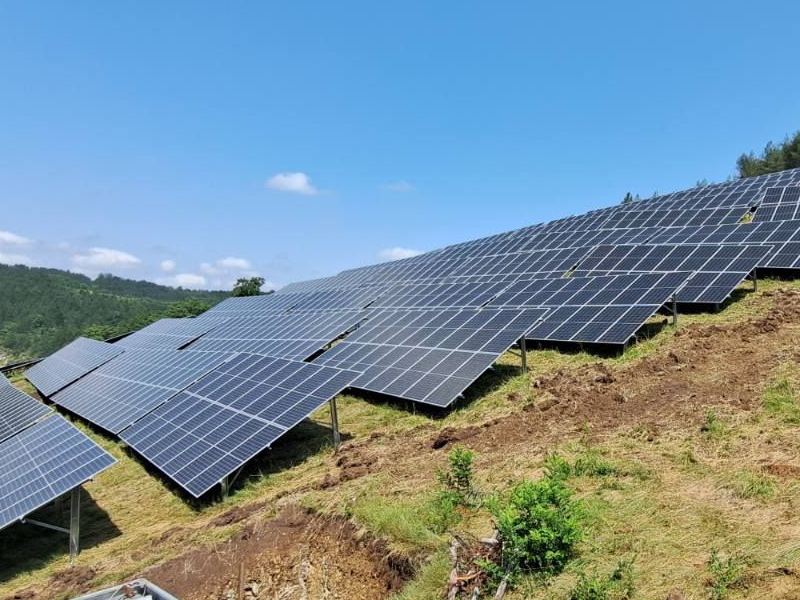
Fixed tilt terrain-adaptive systems follow the natural contours of the land without requiring extensive grading. Each support column adjusts to the local ground elevation while maintaining the desired module tilt angle. These systems work best for low to moderate slope areas. The primary advantage is reduced earthwork volume and lower construction costs. However, row-to-row shading must be carefully evaluated on north-facing slopes.
Stepped (Terraced) Mounting Systems
Stepped or terraced systems create distinct horizontal levels across the slope. Each row is installed on a leveled platform, similar to agricultural terracing. This approach works well for moderate slope terrain up to about twenty degrees. The uniform row heights produce consistent power generation across the array. However, terracing requires more site preparation and earthmoving than terrain-adaptive designs.
Flexible Adjustable Structure Systems
Flexible adjustable systems feature highly adaptable mounting frames with multiple height adjustment points. These systems can accommodate complex and frequently changing terrain conditions. They offer maximum site adaptability and reduce the need for fully custom structural designs. The trade-off is higher material costs and more complex assembly compared to simpler system types.
Foundation Selection for Uneven Terrain
| Foundation Type | Best Terrain Conditions | Key Advantage | Key Limitation |
|---|---|---|---|
| Ground Screw | Most non-rocky terrain | Fast installation, height adjustable, low environmental impact | Difficult in rocky ground |
| Driven Pile | Hard soil, large-scale projects | High load capacity, suitable for high wind zones | Requires heavy equipment access |
| Concrete | Extreme geology, high load areas | Maximum stability, reliable in poor soils | Long construction time, high earthwork volume |
Ground Screw Foundations
Ground screws work well for most non-rocky terrain conditions. Their primary advantages include fast installation without curing time, adjustable height to accommodate terrain changes, and minimal environmental disturbance. Ground screws are often the most cost-effective foundation choice for moderate slopes.
Driven Pile Foundations
Driven piles provide exceptional load capacity and are well suited for hard soil conditions and large-scale projects. They perform reliably in high-wind zones where uplift forces are significant. However, driven piles require heavy equipment access, which can be challenging on steep or remote terrain.
Concrete Foundations
Concrete foundations offer maximum stability for extreme geological conditions and high-load areas. They are the preferred choice when ground conditions are too poor for screws or piles. The disadvantages include long construction cycles and substantial earthwork volumes, making concrete more expensive and slower than other options.
Structural Design Considerations
Front pillar and rear pillar height adjustment is the most critical structural design element for uneven terrain. Each column height must be calculated based on local ground elevation to maintain a consistent module tilt angle and row alignment.
Bracing system reinforcement improves lateral stability on sloped surfaces. Wind forces on hillsides can be higher than on flat ground, and diagonal bracing helps resist side-to-side loads that could otherwise cause progressive collapse.
Rail system flexibility allows longer spans between supports, reducing the number of foundations needed on difficult terrain. However, rail spans must not exceed structural limits under snow and wind loads.
Load path optimization ensures forces travel through the structure along stable paths. Sudden changes in stiffness at terrain transition points must be avoided to prevent localized overloading.
Site Optimization Strategies
Minimal land grading is a core principle for uneven terrain projects. Instead of reshaping the entire site to a flat plane, the goal should be to work with natural contours. This reduces earthmoving costs and preserves drainage patterns.
Zoning layout design divides the project site into zones based on slope characteristics. Each zone receives an optimized structural design rather than forcing a uniform solution across diverse terrain. This approach improves overall project economics.
Row spacing optimization prevents shadowing between rows on sloped sites. South-facing slopes require different spacing than north-facing slopes. Without proper optimization, shaded rows produce significantly less power.
Material Selection for Harsh Terrain Conditions
Hot-dip galvanized steel offers economical durability for typical mountainous terrain. The thick zinc coating protects against corrosion in most moderate climate conditions.
Zn-Al-Mg coated steel provides superior corrosion resistance, making it the preferred choice for high-humidity or coastal mountain environments. The self-healing edge protection is particularly valuable where coatings may be scratched during installation.
Aluminum structures offer lightweight and easy installation advantages. For complex construction environments where access is limited and manual handling is necessary, aluminum reduces labor requirements.
Installation Efficiency in Uneven Terrain Projects
Pre-assembled components reduce on-site complexity by minimizing the number of parts that must be assembled in the field. This is especially valuable on steep slopes where workspace is limited.
Adjustable connection systems allow installers to accommodate terrain variations without cutting or modifying components on site. This speeds installation and reduces the risk of errors.
Logistics and access planning must account for challenging terrain. Smaller equipment is often preferred for steep sites. Delivery routes must be planned to avoid impassable sections during wet weather.
Common Mistakes in Uneven Terrain Solar Projects
Forcing site leveling at high cost is a frequent error. Spending heavily on earthmoving to create a flat site often destroys the economic case for marginal projects. Ignoring wind load amplification on slopes is another dangerous oversight. Wind speeds increase with elevation, and slopes can create accelerated wind channels that exceed ground-level design assumptions.
Neglecting drainage around foundations leads to erosion and settlement. Slopes concentrate water flow, and poorly placed foundations can undermine the entire array. Using mounting systems without height adjustment capability forces compromise between structural integrity and module alignment, reducing both safety and power output.
Frequently Asked Questions: Uneven Terrain Mounting Systems
What slope is too steep for standard ground mounts?
Slopes exceeding ten degrees typically require terrain-adaptive or stepped systems rather than standard flat-ground designs.
Can ground screws work on rocky slopes?
Limited rock content may be acceptable, but heavy rock requires pre-drilling or alternative foundations.
How much land grading is really necessary?
Minimal grading is preferred. Terrain-adaptive systems can follow natural contours without extensive earthworks.
Which terrain type benefits most from adjustable structures?
Irregular and mixed terrain with frequent slope changes benefits most from flexible adjustable systems.
Does SoEasy Solar offer terrain-adaptive mounting systems?
Yes. We provide terrain-adaptive ground mounts, ground screw solutions, and heavy-duty steel mounting systems for complex terrain.
The Right System Unlocks the Value of Complex Terrain
Uneven terrain should not be viewed as a limitation but rather as an optimization opportunity. The correct ground mounting system reduces civil construction costs, improves land utilization, and ensures long-term structural safety and stability. Terrain-adaptive systems work well for gentle to moderate slopes. Stepped systems provide uniform row alignment on moderate hillsides. Flexible adjustable systems offer maximum adaptability for irregular and complex terrain.
Reach out to our team for detailed project consultation: Contact Us