English

 Post by
 Global competition for land resources is intensifying. As population growth drives demand for both food production and renewable energy, developers are seeking innovative ways to maximize land-use efficiency . Meanwhile, bifacial solar modules have matured significantly, offering high bifaciality that makes vertical installations economically viable .
Across Europe, vertical PV systems are being deployed at an accelerating pace. Projects in Germany, France, and the Netherlands are demonstrating that vertical installations can successfully coexist with agriculture while delivering consistent power generation profiles that complement traditional solar farms .
As a result, vertical PV is emerging as an important complement to conventional ground-mounted solar. But this new approach requires specially designed mounting systems that address unique structural and operational challenges.
What Is a Vertical PV Mounting System?
A vertical PV mounting system installs solar modules at a near-90° angle perpendicular to the ground, rather than tilted toward the south . This innovative configuration significantly reduces land footprint and requires no major alterations to existing terrain .
The system comprises several key components: vertical mounting structures that support the modules, bifacial PV modules that generate power on both sides, a foundation system (ground screws, driven piles, or concrete), rails and columns, and bracing components for structural stability .
This configuration differs substantially from tilted ground mounts, rooftop PV systems, and solar carports. Unlike traditional south-facing installations, vertical systems typically orient modules east-west . One side captures sunlight before noon, and the other side captures sunlight in the afternoon, creating a more balanced daily generation curve .
How Vertical PV Differs from Conventional Ground Mount Systems
The table below compares vertical PV systems with conventional ground-mounted installations.
| Factor | Conventional Ground Mount | Vertical PV Mount |
|---|---|---|
| Module Orientation | South-facing, tilted | East-West, vertical |
| Land Occupation | Larger footprint | Significantly smaller footprint |
| Energy Generation Profile | Peak at midday | Balanced morning-afternoon |
| Wind Load Characteristics | Lower effective area | High wind exposure |
| Maintenance Access | Standard clearance | Easy, minimal dust accumulation |
| Agricultural Compatibility | Limited by shading | Minimal shading, full access |
Vertical PV requires less land per unit of installed capacity. The east-west orientation produces a flatter generation profile, which helps match morning and evening demand peaks . However, wind loads on vertical panels are substantial because the full panel area is exposed to wind forces, necessitating stronger structural design .
Common Applications of Vertical PV Systems
Solar Fence Systems
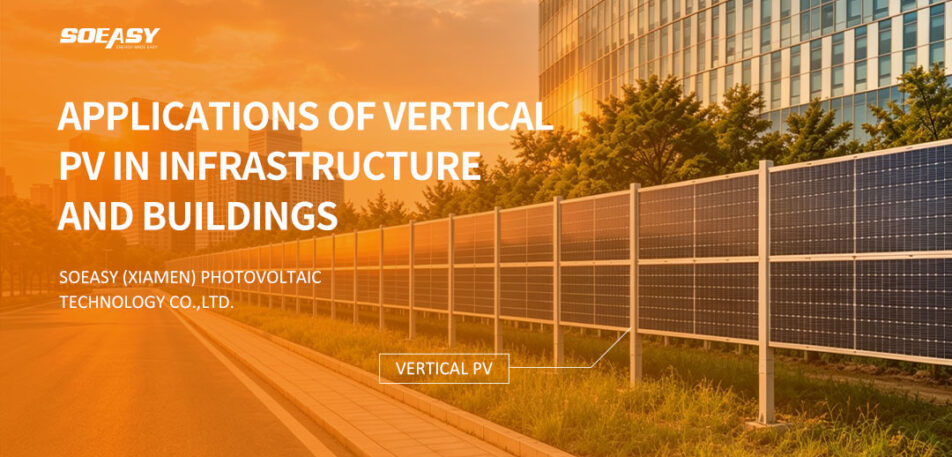
Solar fences represent one of the most promising applications for vertical PV. These systems serve dual purposes: generating electricity and providing security or privacy screening . Applications include industrial park perimeters, residential boundary fences, solar farm enclosures, and security barriers for critical infrastructure .
The German company Clickcon has launched a vertical PV fence system for residential and commercial applications. The aluminum-framed system is compatible with most commercially available framed PV modules and features bifacial modules for enhanced energy yield . Similarly, SOEASY’s Demeter DUAL system transforms fences and boundaries into efficient solar energy generators for commercial ranches, farms, and industrial sites .
Agrivoltaic Projects
Vertical PV is experiencing its strongest growth in the agricultural sector. A key advantage is the minimal shading cast on crops—vertical modules block far less sunlight than tilted installations, making them suitable for cultivation of potatoes and other permanent crops .
Farm machinery can move freely between module rows. With typical row spacing of 6 to 10 meters, tractors and harvesters operate without interference . The vertical configuration also preserves the full cultivation area, allowing livestock grazing and crop production to continue . In high-latitude regions, vertical PV prevents snow accumulation during winter, ensuring consistent year-round power generation .
Highway Infrastructure
Roadsides and highway medians offer vast, underutilized land suitable for vertical PV. These installations generate clean energy while serving as noise barriers or visual screening. The vertical orientation is well-suited for narrow corridors where conventional tilted systems would require excessive clearance or present safety concerns .
Railway Corridors
Railway rights-of-way present similar opportunities. Vertical PV can be installed along railway lines, within maintenance access roads, or integrated into fencing systems that already exist along rail corridors. The minimal footprint ensures that rail operations remain unaffected .
Industrial and Commercial Sites
Factory perimeters, logistics parks, warehouse zones, and parking lot boundaries are ideal for vertical PV installations. These systems provide security fencing while generating power for on-site consumption. The vertical aesthetic often integrates better with industrial architecture than tilted rooftop systems .
Key Design Considerations for Vertical PV Mounting Systems
Wind Load
Wind load is the most critical factor in vertical PV design. Because the panels are upright, the entire module surface faces the wind, creating substantial pressure and uplift forces . Engineers must specify strong columns, robust bracing, and perform thorough structural calculations. Some innovative designs incorporate “flapping” mechanisms—modules that rotate around a pivot under extreme wind loads—to reduce stress on the mounting system .
Foundation Selection
The choice of foundation depends on soil conditions. Ground screws offer fast installation and minimal environmental disturbance for most non-rocky terrain. Driven piles provide high load capacity for large projects and hard soils. Concrete foundations deliver maximum stability for extreme geological conditions or heavy snow regions. Engineers must conduct geotechnical investigations before selecting a foundation type .
Structural Stability
All structural components—columns, beams, rails, connection kits, and bracing—must be designed for the unique loads of vertical PV. The high wind area places greater demands on connections and fasteners than conventional systems. Vertical mounting systems must resist bending, torsion, and fatigue over a 25-year service life.
Module Layout
Module orientation and spacing are essential for performance. For most locations, east-west orientation of bifacial modules is preferred, allowing power generation from both sides across the day. Row spacing must be optimized to prevent self-shading and maximize ground coverage while allowing maintenance access.
Advantages of Vertical PV Mounting Systems
Enhanced land utilization is the primary advantage. Vertical PV systems occupy significantly less land area per installed kilowatt compared to conventional tilted installations .
Agricultural compatibility is a major driver in Europe. Vertical systems allow full farming activities between rows, support livestock grazing, and produce minimal shading that could affect crop growth .
Ease of maintenance results from the vertical orientation. Rain naturally washes dust from panels, reducing cleaning requirements. Snow accumulation is minimal or non-existent .
Balanced energy generation from east-west orientation produces power earlier in the morning and later in the afternoon compared to south-facing systems, better matching typical grid demand patterns .
Dual-purpose functionality allows vertical PV to serve as fencing, screening, or noise barriers while generating power. This value-add improves project economics .
Reduced dust accumulation occurs because airborne particles fall vertically, with minimal adherence to upright panels .
Challenges and Engineering Solutions
High wind pressure is the most significant structural challenge. Solutions include strengthening columns and bracing, optimizing foundation depth and size, and considering flapping or pivot mechanisms that reduce wind loads .
Foundation forces increase with panel height and wind area. Detailed site-specific geotechnical analysis and structural calculations are essential to ensure that foundations provide adequate resistance.
Connection stability under cyclic wind loads requires careful fastener selection and torque control. Standardized connection designs and quality inspection during installation prevent premature failures.
Module vibration can occur in high winds or when panel support spans are too large. Reducing support spacing and using anti-vibration clips or clamps mitigates these effects.
Why Engineering Support Matters
Vertical PV is not a standard product that can be selected off the shelf. Structural design, wind load calculation, foundation design, and project optimization require engineering expertise .
Developers should look for suppliers that provide structural calculation reports, wind and snow load analyses, foundation recommendations, and material selection support. Professional engineering documentation is essential for project approval and financing.
For inquiries about custom vertical PV designs, contact the SoEasy Solar team for expert assistance.
How SoEasy Solar Supports Vertical PV Projects
SOEASY provides comprehensive solutions for vertical PV installations. Our product portfolio includes vertical solar mounting systems, solar fence structures, customized engineering design, structural calculations, ground screw solutions, and complete mounting accessories .
SOEASY’s Demeter DUAL system is a revolutionary vertical ground-mounted solution designed for large-scale installation of bifacial solar panels, transforming fences and boundaries into efficient solar energy generators . The company has delivered over 10 GW of solar mounting capacity across 100+ countries and holds more than 60 patent certificates .
Frequently Asked Questions: Vertical PV Mounting Systems
What modules work best for vertical PV?
Bifacial double-glazed modules are strongly recommended because they generate power on both front and rear surfaces, maximizing energy yield .
Is vertical PV suitable for high-wind regions?
Yes, but designs must incorporate reinforced columns, deeper foundations, and possibly aerodynamic features such as pivoting mounts to reduce wind loads .
How much land does vertical PV save compared to traditional ground mounts?
Vertical installations require significantly smaller footprints, often representing a 50% or greater reduction in land use per installed capacity .
Can vertical PV be installed on slopes?
Yes. Vertical systems adapt well to varied terrain, though foundation design must account for slope stability and drainage .
Does SoEasy Solar provide custom vertical PV designs?
Yes. We offer customized engineering, structural calculations, foundation design, and complete material selection for vertical PV projects .
Vertical PV Is Emerging as a New Trend
Vertical PV is emerging as an important direction for the future of ground-mounted solar. By enabling solar fencing, agrivoltaics, and infrastructure integration, vertical systems unlock land that conventional solar cannot effectively utilize.
Choosing the right mounting system determines not only structural safety but also long-term power generation returns. Proper engineering—from wind load calculation to foundation selection—is essential for project success.
SoEasy Solar is committed to providing reliable, efficient, and customized vertical photovoltaic mounting solutions. Our products help customers maximize land-use efficiency and promote the deep integration of renewable energy with infrastructure development.
Explore our vertical pv mounting system page: SoEasy Solar Fence – Product Page.