English

 Post by
 As solar projects face increasing demands for construction efficiency and environmental sustainability, ground screw foundations are steadily replacing some traditional concrete foundations as a preferred foundation type for ground-mounted PV systems. Compared to concrete, ground screws offer faster installation, minimal land disturbance, and full removability at the end of a project’s life . However, ground screws are not suitable for every project. Their performance depends heavily on proper engineering design and accurate geological assessment. This article outlines the key factors that developers, EPC contractors, and engineering firms must consider when designing ground screw foundations for solar projects.
What Is a Ground Screw Foundation?
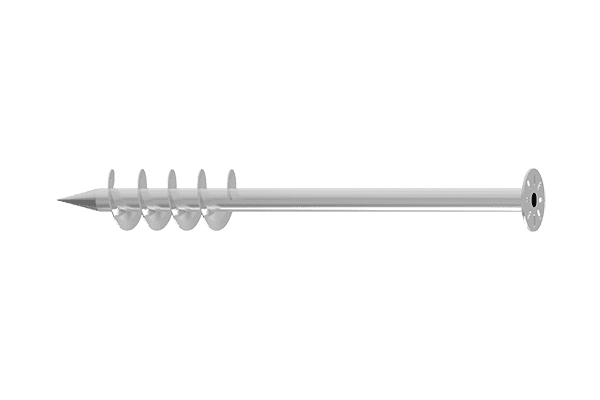
A ground screw is a steel foundation that forms load-bearing capacity by being rotated directly into the soil . It requires no excavation or concrete pouring and serves as the direct foundation for solar mounting structure columns. The main components include the screw shaft, helical plate or plates, a connection plate or flange at the top, and anchor bolts for securing the mounting structure.
Typical applications span utility-scale solar farms, commercial and industrial projects, agrivoltaic systems, and temporary solar installations where removability is beneficial.
Why Choose Ground Screw Foundations?
Faster Installation
Ground screws require no concrete curing time, enabling mechanized continuous installation that significantly shortens project timelines . This speed advantage is particularly valuable for large-scale projects where schedule compression directly reduces financing costs.
Lower Environmental Impact
Ground screws minimize excavation and preserve existing vegetation. They are fully removable and recyclable at project end, making them the most environmentally friendly foundation option.
Cost Savings
Reduced civil works, lower labor requirements, and savings on transport and material costs make ground screws economically attractive for many projects .
Flexible for Various Terrains
Ground screws adapt well to flat land, gentle slopes, and certain complex terrains. Different pile lengths can accommodate variations in ground elevation, reducing the need for extensive site grading.
Site Assessment Before Foundation Design
Soil Investigation
A proper geotechnical investigation is essential before any ground screw design. Key parameters to assess include soil bearing capacity, soil density and compaction, soil type classification, and groundwater level. Understanding these factors prevents foundation failure and ensures reliable load transfer.
Terrain Conditions
The site terrain—whether flat, sloping, rocky, or filled ground—determines the installation method and screw type selection. Steep slopes may require adjustable bracket designs or different equipment access strategies.
Climate Conditions
Frost depth, seasonal rainfall patterns, and flood risk must be evaluated . Foundations installed above the frost line can be displaced by freeze-thaw cycles. Ground screws must extend below the maximum frost depth to maintain stability.
Structural Design Considerations
Vertical Load Capacity
Ground screws must support the weight of the mounting structure, PV modules, and snow loads. The shaft diameter and wall thickness determine the compressive capacity of the foundation .
Uplift Resistance
Wind uplift is often the governing design force for ground screws. Uplift resistance depends on screw length, helical plate size and shape, and the soil’s shear strength. Engineers must calculate pullout capacity based on site-specific soil data and local wind speed requirements.
Lateral Load Resistance
Wind loads and seismic forces create lateral loads that can cause foundation tilting. Lateral capacity is enhanced through larger shaft diameters, diagonal bracing, and optimized pile spacing . The embedded depth-to-diameter ratio significantly affects lateral stiffness.
Foundation Embedment Depth
The required embedment depth is influenced by soil conditions, frost depth, wind load category, and mounting structure height. Adequate depth is the most critical factor for long-term stability . Too shallow and the screw pulls out under wind uplift; too deep and installation costs increase unnecessarily.
Selecting the Right Ground Screw
Screw Length
Length is selected based on soil layer thickness, load requirements, and site topography . Deeper penetration typically provides higher capacity, but in soft soil, the helix must reach a denser bearing layer to achieve adequate capacity.
Shaft Diameter
The shaft diameter affects both load capacity and bending resistance . Larger projects typically use larger diameter piles to handle higher loads and longer spans between supports.
Helical Plate Size
The helical plate creates the bearing surface that resists both compression and uplift. Larger plates provide greater uplift capacity and perform better in soft soils . Multiple helical plates on a single shaft can further increase capacity.
Material and Coating
Hot-dip galvanized steel is the standard material for ground screws, providing reliable corrosion protection for most environments . For aggressive environments such as coastal zones, high-humidity regions, or chemically active soils, Zn-Al-Mg coated steel offers superior corrosion resistance with self-healing properties .
Installation Considerations
Accurate Positioning
Precise pile positioning is essential to avoid misalignment during mounting structure installation . Laser-guided equipment and pre-marked layout plans improve accuracy.
Verticality Control
Installation must be vertical to ensure uniform load distribution across the foundation. Tilted piles experience eccentric loading that can cause premature failure. Industry standards typically allow a maximum verticality deviation of 1% to 2% .
Installation Torque Monitoring
Installation torque is a valuable indicator of soil conditions and pile capacity. A minimum torque requirement is typically established during the design phase and used as a field acceptance criterion . However, torque and load capacity are not directly proportional in all soils.
Quality Inspection
After installation, key quality checks include verifying embedment depth, confirming installation torque meets specifications, checking verticality within allowable limits, and ensuring the corrosion coating remains intact.
Common Challenges and Solutions
Soft Soil
In soft soils, increasing pile length or using larger helical plates improves both compression and uplift capacity . Installing a second helix at a deeper bearing layer is also effective.
Rocky Ground
Rocky conditions may require pre-drilling to create a pilot hole for screw insertion. In extreme cases, driven piles or concrete foundations may be more suitable than ground screws.
Corrosive Environment
Hot-dip galvanizing with adequate thickness provides standard protection. For severe coastal or industrial environments, Zn-Al-Mg coating or stainless steel components are recommended.
Frost Heave
Embedding the foundation below the frost depth is the most reliable way to prevent freeze-thaw displacement. In very cold regions, active frost layer depths must be carefully evaluated.
Ground Screw vs Other Foundation Types
The table below compares ground screws with driven piles and concrete foundations.
| Foundation Type | Ground Screw | Driven Pile | Concrete Foundation |
|---|---|---|---|
| Installation Speed | ★★★★★ | ★★★★☆ | ★★☆☆☆ |
| Environmental Impact | ★★★★★ | ★★★★☆ | ★★☆☆☆ |
| Construction Cost | ★★★★☆ | ★★★★☆ | ★★☆☆☆ |
| Removability | Excellent | Moderate | Poor |
| Suitable Soil Conditions | Most soils | Medium to hard soils | Almost all soils |
Ground screws offer the fastest installation and lowest environmental impact. Driven piles provide excellent capacity for medium to hard soils. Concrete foundations work in almost any soil but are slower and more expensive. The final selection should be based on geotechnical reports, structural calculations, and local code requirements rather than cost alone.
How SoEasy Solar Optimizes Ground Screw Foundation Design
SoEasy Solar provides complete foundation design support, including ground screw selection guidance, customized foundation design, structural calculation reports, wind and snow load analysis, terrain-adaptive ground mount solutions, and installation guidance . By integrating site-specific soil conditions with environmental load data, the company delivers safe, efficient, and economical foundation solutions for every project.
For inquiries about custom foundation designs, contact the SoEasy Solar team for expert assistance.
Frequently Asked Questions: Ground Screw Foundations
What soil types are best for ground screws?
Ground screws perform best in granular and cohesive soils with adequate bearing capacity. They are less suitable for hard rock or extremely loose fill without pre-drilling.
How deep should ground screws be installed?
Depth depends on soil conditions, frost depth, and load requirements. Typical depths range from 1.5 to 5 meters depending on site conditions.
Are ground screws more expensive than concrete?
Ground screws are often more cost-effective overall due to faster installation and reduced labor, though material costs may be comparable.
Can ground screws be removed?
Yes. Ground screws can be completely removed using reverse torque, leaving minimal environmental impact. This makes them ideal for temporary projects .
Does SoEasy Solar offer ground screw solutions?
Yes. We provide ground screw selection, custom foundation design, and full engineering support for solar projects.
Conclusion: Ground Screws as a Smart Foundation Choice
Ground screw foundations are becoming the preferred choice for an increasing number of ground-mounted solar projects due to their fast installation, environmental compatibility, and low lifecycle cost. However, ground screw design is never a simple matter of picking a standard product. Geotechnical conditions, environmental loads, material performance, structural design, and installation quality must all be considered together. Proper foundation engineering ensures long-term stability and reduces both project risk and maintenance costs.
SoEasy Solar provides integrated ground mount and foundation solutions, including ground screw systems, terrain-adaptive designs, and heavy-duty steel structures. We help customers achieve safe, efficient, and reliable solar project deployment on any site..