English

 Post by
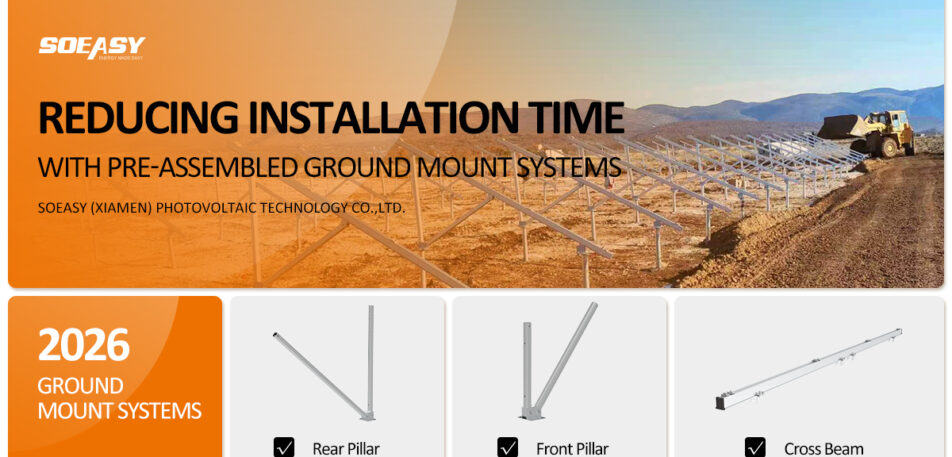
 As ground-mounted solar projects continue to grow in scale worldwide, installation efficiency has become a critical factor affecting project costs and return on investment. For EPC contractors and project developers, shortening the construction timeline means faster grid connection, earlier revenue generation, lower site management costs, and reduced risk of weather-related or other delays. Pre-assembled ground mount systems are therefore emerging as an important trend for large-scale solar farms and commercial and industrial projects.
What Are Pre-Assembled Ground Mount Systems?
Pre-assembled ground mount systems are mounting solutions where some or all structural components are assembled in advance at the factory. On site, workers only need to perform quick connections and final fastening. Components that are typically pre-assembled include front pillars, rear pillars, beam kits, rail connections, bracing components, and fastener sets including bolts and nuts.
How They Differ from Conventional Mounting Systems
Traditional installation requires extensive on-site work. Workers must sort through bins of loose parts, assemble each frame from individual components, connect every bolt manually, adjust dimensions to fit site conditions, and perform multiple calibration steps. This process is labor-intensive and error-prone.
Pre-assembled systems take a different approach. The factory handles the complex assembly work. On site, the main tasks are foundation preparation, connecting modular components together, installing rails, and finally securing the PV modules. This dramatically reduces the on-site assembly workload and improves overall efficiency.
Major Sources of Installation Delays
Several factors commonly slow down solar installation projects. Large quantities of loose parts often lead to confusion, missing components, or incorrect assembly. Labor-intensive assembly requires significant time for on-site measurement, alignment, construction, and calibration. Weather conditions such as strong winds, heavy rain, or extreme heat can delay progress for days or weeks. Finally, a shortage of skilled workers means less experienced teams take longer to complete the same tasks while commanding higher labor rates
How Pre-Assembled Systems Reduce Installation Time
Factory pre-assembly improves efficiency by reducing the number of on-site steps, lowering construction complexity, and increasing installation consistency. When components arrive at the site already partially assembled, workers spend less time figuring out how parts fit together.
Faster on-site deployment becomes possible. Installers can quickly position front and rear pillars, rapidly connect beams and rails, and fasten solar modules without repeated adjustments. The process becomes more predictable and easier to manage.
Reduced fastener handling is another major benefit. Fewer bolts mean fewer steps in the installation process and a lower risk of missing fasteners. A typical pre-assembled system can reduce bolt count by thirty to fifty percent compared to conventional systems.
Standardized installation procedures complete the picture. The simplified assembly process allows rapid team training, reduces human error, and improves overall project management efficiency. A crew that might need two weeks to master a conventional system can become productive with a pre-assembled system in just a few days.
Cost Benefits Beyond Labor Savings
The advantages of pre-assembled systems extend far beyond direct labor savings. Lower labor costs are obvious, but shorter construction periods also reduce equipment rental expenses. Cranes and other lifting machinery are typically rented by the day or week, so fewer days on site directly lowers costs.
Faster project completion means earlier grid connection and earlier revenue generation. In many markets, even one week of earlier operation can significantly improve project cash flow and internal rate of return. For large utility-scale projects, the financial impact of accelerated schedules runs into hundreds of thousands of dollars.
Design Features That Improve Installation Efficiency
The table below summarizes key design features that make pre-assembled systems more efficient than conventional alternatives.
| Design Feature | Description | Benefit |
|---|---|---|
| Modular Structural Design | Components designed as repeatable modules | Simplifies transport and speeds up assembly |
| Pre-Cut and Pre-Punched Components | All cutting and drilling done at factory | Eliminates on-site fabrication work |
| Universal Connection Design | Standardized interfaces across all parts | Enables quick, tool-efficient assembly |
| Lightweight Components | Optimized weight without sacrificing strength | Easier handling and faster positioning |
Modular structural design means components are designed as repeatable building blocks rather than unique pieces. This simplifies transportation packaging and makes assembly intuitive.
Pre-cut and pre-punched components eliminate the need for on-site cutting or drilling. Workers never need to measure and cut rails to length or drill bolt holes in the field. Every part fits exactly as intended.
Universal connection design uses standardized interfaces across all components. The same connection method works for pillars, beams, and rails. This reduces the number of tools required and speeds up training.
Lightweight components make handling easier and faster. While structural strength is never compromised, optimized designs reduce unnecessary weight, allowing smaller crews to move and position parts without heavy lifting equipment.
Project Types That Benefit Most
Utility-scale solar farms benefit significantly from pre-assembled systems because large projects have tight schedules and any delay multiplies across thousands of mounts. Commercial and industrial solar projects also gain advantages, as shorter construction periods reduce operational disruption to the business hosting the solar array.
Remote site installations are another strong fit. When projects are far from supply centers, labor and logistics costs are high. Faster installation directly reduces these expenses. Agricultural solar projects benefit as well, because shorter construction timelines mean less disturbance to crops or livestock.
Key Considerations When Choosing a Pre-Assembled Ground Mount System
Structural strength remains the top priority. A pre-assembled system must still meet all wind load and snow load requirements for the specific project location. Pre-assembly should never compromise structural integrity.
Transportation efficiency requires balance. Higher pre-assembly rates mean larger and more fragile shipments. The optimal level of pre-assembly depends on shipping distances, container sizes, and site access conditions. A good supplier helps find the right balance.
Material durability is essential for long-term performance. Zn-Al-Mg coated steel and hot-dip galvanized steel are recommended for their corrosion resistance and strength retention over twenty-five years or more.
Supplier engineering support completes the picture. The best pre-assembled systems come with structural calculations, foundation design recommendations, and detailed installation guidance. Without this support, even the best-designed system can be installed incorrectly.
How SoEasy Solar Supports Faster Installation
SoEasy Solar designs pre-assembled ground mount systems with installation speed as a primary goal. High pre-assembly rates reduce on-site work to the absolute minimum. Modular structural design simplifies both transport and assembly. Pre-cut and pre-punched components eliminate field fabrication. Reduced bolt counts speed up fastening while lowering the risk of missing parts. Optimized packaging and logistics get components to site quickly and in good condition.
Beyond the hardware, SoEasy Solar provides custom engineering support including wind and snow load analysis, foundation design recommendations, and project-specific installation plans. This combination of thoughtful design and technical support helps customers complete projects faster, at lower cost, with greater confidence.
Frequently Asked Questions: Pre-Assembled Ground Mount Systems
How much installation time can pre-assembled systems save?
Typical savings range from thirty to fifty percent compared to conventional systems, depending on project size and site conditions.
Are pre-assembled systems stronger than conventional ones?
Yes, when properly designed. Factory assembly often results in more consistent and reliable connections than field assembly.
Do pre-assembled systems cost more?
Upfront material costs may be slightly higher, but total installed costs are usually lower due to labor and equipment savings.
Can pre-assembled systems handle high wind and snow loads?
Yes. SoEasy Solar designs all systems to meet local wind and snow load requirements based on engineering calculations.
What project size works best for pre-assembled systems?
All sizes benefit, but the largest time savings occur on utility-scale projects with thousands of mounts.
Pre-Assembled Systems as a Key Efficiency Strategy
Pre-assembled ground mount systems significantly shorten construction schedules, lower labor costs, and increase installation standardization. These advantages make them a key strategy for improving efficiency in large-scale solar farms and commercial and industrial projects. By reducing on-site assembly work, minimizing fastener handling, and enabling rapid crew training, pre-assembled systems help EPC contractors complete projects faster and more profitably.
SoEasy Solar provides pre-assembled ground mount systems featuring high pre-assembly rates, modular design, pre-cut and pre-punched components, and reduced bolt counts. We also offer custom engineering support including wind and snow load analysis, foundation design, and installation optimization.