English

 Post by
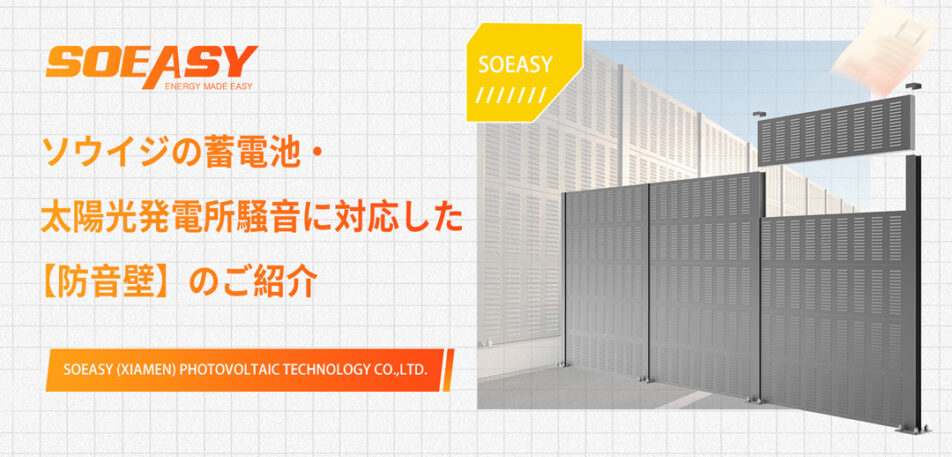
 Battery Energy Storage System (BESS), solar‑storage hybrid parks, substations and industrial energy facilities are expanding rapidly across Japan. As we covered in our earlier risk‑assessment article, broadband noise generated by cooling fans, PCS converters and transformers creates tangible project risks for developers, EPC contractors and asset owners. Generic highway noise walls are not optimised for the mixed high‑low frequency noise profiles of energy‑storage sites, creating demand for localised engineering‑grade noise‑mitigation hardware built for Japanese field conditions.
Product core design philosophy
Soeasy Solar’s engineering‑grade noise barrier is purpose‑engineered for the Japanese market, instead of simply adapting general‑purpose overseas sound‑wall products. Japanese outdoor energy projects face combined constraints including regional wind‑load requirements, coastal anti‑corrosion demands, site fire‑safety rules and strict neighbourhood noise‑management standards.
The product follows a triple‑reinforcement design concept balancing three critical project requirements:
-
- Noise attenuation: Optimised for mixed broadband noise produced by BESS and industrial energy equipment
-
- Fire‑resistant performance: Built to satisfy fire‑safety considerations for energy‑storage facilities
-
- Structural robustness: Delivers stable outdoor performance matching Japan’s building‑code wind‑load specifications
This barrier solution supports project teams to integrate noise‑control planning at the pre‑development feasibility phase, helping teams avoid costly post‑construction retrofits.
Soundproof Fence – soeasypv.com
Composite multi‑layer working principle
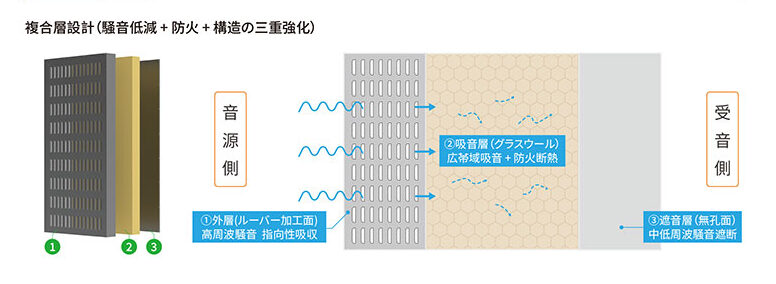
BESS facilities produce two distinct noise types: high‑mid‑frequency airflow noise from banks of cooling fans, plus persistent low‑frequency hum from transformers and power‑conversion hardware. Single‑layer noise panels can only handle narrow‑band sound. Soeasy Solar adopts a three‑layer composite system to address this mixed‑frequency acoustic environment:
-
- Outer louvered panel: Guides sound waves inward toward internal absorbing material; blocks rain, dust and UV exposure to extend component service‑life under open‑air conditions.
-
- Acoustic glass‑wool absorption layer: Absorbs high‑and‑mid‑frequency fan‑driven airflow noise.
-
- Solid non‑perforated sound‑insulation back layer: Suppresses low‑frequency mechanical hum and reduces sound transmission through the barrier panel.
These three layers work together to mitigate the full‑spectrum noise signature typical for Japanese energy‑storage and industrial sites.
Two main configurations: Straight‑top vs Arched‑top
Straight‑top
Straight‑top is the standard modular configuration with flat upper edge. It delivers cost‑effective performance and high part commonality.
Best‑fit scenarios: BESS parks, substations and industrial zones located with moderate distance to residential housing; projects prioritising budget‑controlled engineering solutions.
Arched‑top
The arched‑top variant reshapes sound‑wave diffraction paths, further restraining high‑frequency noise travelling over the top of noise barrier.
Best‑fit scenarios: BESS or solar‑storage sites with property boundaries close to residential neighbourhoods; densely‑populated Japanese regional locations with strict acoustic review requirements.
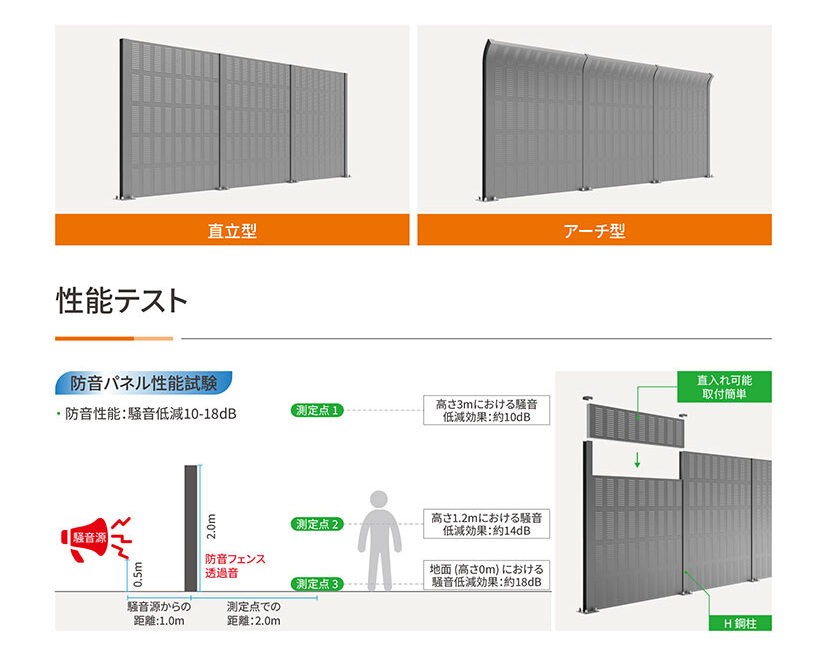
Modular specifications & wind‑rating for Japan market
Height‑selection guide
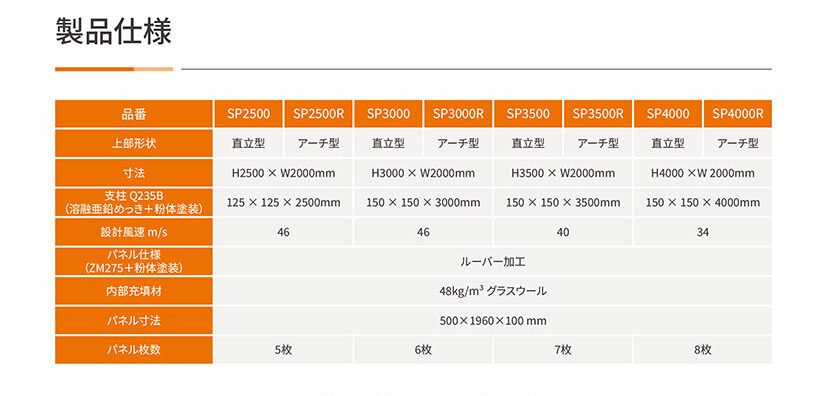
-
- 2.5 m: BESS and solar‑storage projects adjacent to low‑rise residential buildings
-
- 2.5 m‑3.5 m: Substations, peri‑urban BESS facilities and general‑purpose industrial sites
-
- 3.5 m‑4.0 m: Heavy‑duty industrial zones with elevated equipment‑noise output
Wind‑resistance rating
Different barrier heights correspond to distinct design wind‑speed parameters. Final specification selection must reference local wind‑load values defined under Japanese Building Standard Law. Maximum allowable design wind‑speed decreases as overall barrier height increases.
Anti‑corrosion system for Japan outdoor environment
-
- H‑steel support posts: Hot‑dip galvanized finish
-
- Surface panels: ZM275 base substrate with powder‑coating finish This material combination resists humidity, coastal salt‑spray and long‑term outdoor weathering, lowering ongoing site‑maintenance workload.
On‑site installation advantage:H‑steel post direct‑insert modular construction
The noise‑barrier system utilises H‑steel main support columns with direct‑insert modular panel assembly. All panels are pre‑fabricated inside factory facilities. No on‑site welding is required during field erection; panels simply slot into H‑steel post grooves.
Key project‑side benefits:
-
- Shortens overall on‑site installation cycle
-
- Eliminates field‑side welding and painting work for EPC contractors
-
- Individual panels can be quickly detached and replaced for convenient later‑stage maintenance
-
- Can be scheduled alongside civil‑foundation work in early‑phase site construction, avoiding expensive retrofitting after facility commissioning.
Application matrix
| Project Scenario | Recommended configuration notes |
|---|---|
| BESS / Solar‑storage co‑located plant | Evaluate residential separation distance. Prefer arched‑top for sites close to housing |
| Utility‑scale solar farm | Select height and top‑shape based on surrounding residential conditions |
| Substation | Mainly within 2.5‑3.5 m height range, aligned with local noise‑control ordinances |
| Industrial plant & heavy‑noise equipment zone | 3.5‑4.0 m height; finalise specification referencing site acoustic simulation output |
Note: Table guidance serves as reference only. Final specifications require combined review of acoustic‑simulation results, local statutes and wind‑load conditions.
Performance note
All noise reduction figures quoted are based on laboratory test results. Actual noise reduction performance will be influenced by factors such as the frequency of the noise source, the height at which the barrier is installed, the distance from the noise source, the topography of the site, reflections from buildings and weather conditions.
Wrap‑up
Soeasy Solar engineering‑grade noise barrier is not a general‑purpose perimeter fence. It is purpose‑built to address real‑world pain‑points within Japan’s fast‑growing energy‑storage industry. Its composite‑layer acoustic architecture, dual top‑profile options, modular pre‑fabrication and Japan‑optimised anti‑corrosion / wind‑resistance properties make it applicable across BESS energy‑storage, solar farm, substation and industrial‑site use‑cases. Project stakeholders are encouraged to include noise‑mitigation evaluation during early‑stage feasibility study to reduce later‑phase operational risks.
Contact U
If you are an EPC developer, asset owner or distributor involved in energy-related projects in Japan, you may submit an enquiry to receive a configuration assessment tailored to your specific project.
Email:sales@soeasyrobot.com