English

 Post by
 The Rise of Solar Carports on Commercial and Industrial Sites
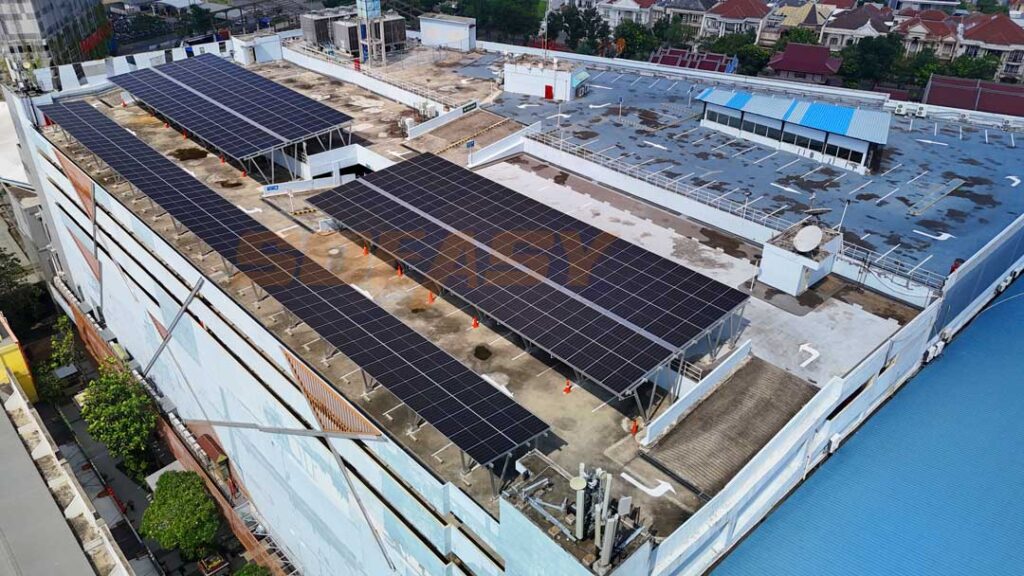
Commercial and industrial buildings possess some of the most underutilized assets in the renewable energy landscape: large, open rooftops. Moreover, instead of merely covering the roof surface with conventional solar arrays, a more innovative approach has emerged—rooftop solar carports. These structures elevate photovoltaic modules above the roof, creating usable shaded space beneath for employee and visitor parking.
This dual-purpose design transforms a single roof area into both a power plant and a parking facility. In addition, solar carports generate clean electricity to offset building energy costs while providing weather protection for vehicles against sun, rain, hail, and snow. Furthermore, they enhance property value, offer readiness for electric vehicle (EV) charging stations, and help reduce urban heat island effects by shading dark roof surfaces. This article provides a comprehensive guide to designing efficient, safe, and maintainable solar carport solutions specifically for commercial and industrial rooftops.
Understanding Solar Carport Requirements
Before diving into design specifics, it is essential to understand what a rooftop solar carport must achieve. First and foremost, it must securely support PV modules while resisting wind uplift and snow loads. Additionally, it must provide sufficient clearance for vehicles—typically 2.1 to 2.5 meters for cars and higher for vans or trucks. Moreover, it must transfer all loads safely to the underlying roof structure without compromising waterproofing. Finally, it must accommodate cabling, inverters, and potentially EV charging equipment.
Key functions of a rooftop solar carport include:
- Supporting PV modules and resisting wind uplift and snow loads
- Providing vehicle clearance (2.1–2.5m for cars, higher for trucks)
- Transferring loads safely to roof structure
- Protecting roof waterproofing integrity
- Accommodating electrical cabling and EV charging equipment
Conducting a thorough site assessment represents the critical first step. Engineers must actively evaluate the roof’s structural capacity to ensure it can support the additional dead load of the carport. Additionally, they should inspect the waterproofing membrane and drainage system to prevent future issues. Solar access must be analyzed to identify obstructions such as vent pipes, HVAC units, or neighboring buildings that could cast shadows. Furthermore, prevailing wind direction should be noted, as roof edges and corners experience significantly higher uplift forces than interior zones.
Structural Design Considerations
Load Calculations
Every solar carport must withstand all foreseeable loads based on local building codes such as ASCE 7 or Eurocode 1. Dead load includes the weight of modules, rails, support posts, connections, and hardware. Live load encompasses personnel during installation and maintenance, as well as snow accumulation where applicable. Importantly, wind load is often the dominant factor, creating uplift and lateral forces that can reach 80 to over 200 kilograms per square meter depending on local wind speeds. Roof perimeters experience two to three times higher forces than interior zones. Seismic loads must also be considered in earthquake-prone regions.
| Load Type | Description | Typical Range |
|---|---|---|
| Dead Load | Modules, rails, posts, hardware | 10–20 kg/m² |
| Live Load | Personnel, snow accumulation | 50–100+ kg/m² |
| Wind Load | Uplift and lateral forces | 80–200+ kg/m² |
| Seismic Load | Lateral acceleration | Region-dependent |
Safety factors are non-negotiable. Designers must ensure a minimum 1.5× for wind uplift and 2.0× for all critical connections.
Material Selection
The choice of materials directly impacts durability, cost, and long-term performance. Aluminum alloy offers lightweight construction and excellent corrosion resistance for inland projects, but it has lower strength than steel. Zn-Al-Mg coated steel has emerged as the preferred choice for most commercial rooftop carports because it combines high strength with excellent corrosion resistance at a significantly lower cost than stainless steel. Stainless steel grades 304 and 316 provide superior corrosion resistance and very high strength, although they are expensive and best reserved for extreme coastal locations or chemical plant environments.
Material Recommendations:
- Aluminum Alloy (6063-T5/T6): Lightweight, corrosion-resistant, easy to extrude. Best for standard inland projects.
- Zn-Al-Mg Coated Steel: High strength, excellent corrosion resistance, cost-effective. Best for most commercial carports, including coastal areas.
- Stainless Steel (304/316): Superior corrosion resistance and very high strength. Ideal for extreme coastal (<500m from saltwater) or chemical plants.
For most commercial rooftop carports, Zn-Al-Mg coated steel offers the best balance of strength, corrosion resistance, and cost.
Compatibility with Roof Type
Different roof types demand different attachment strategies. For example, flat concrete roofs can accept penetrating anchors with proper waterproofing seals, or ballasted systems that rely on weight alone. Flat membrane roofs made of TPO, EPDM, or PVC require either non-penetrating ballasted trays or carefully detailed penetrating posts with flashing and sealing. Sloped metal roofs are best served by clamp-based attachment systems that grip standing seams or corrugated ribs without drilling. Sloped tile roofs require tile hooks or rafter attachments with proper flashing, while careful tile handling is often necessary.
| Roof Type | Recommended Attachment | Key Consideration |
|---|---|---|
| Flat Concrete | Penetrating anchors or ballasted | Verify concrete strength |
| Flat Membrane | Non-penetrating ballasted or protected posts | Avoid membrane punctures |
| Sloped Metal | Clamp-based (no drilling) | Match clamps to profile; use isolation pads |
| Sloped Tile | Tile hooks or rafter attachments | Careful tile handling; may need reinforcement |
Additionally, for existing roofs with limited structural capacity, ballasted systems that distribute weight across larger areas or lightweight aluminum structures are recommended to minimize added load.
Design Optimization for Efficiency
Modular and Pre-Assembled Components
Speed of installation is critical for commercial projects where roof downtime translates directly into lost business or increased labor costs. Therefore, modular and pre-assembled components dramatically accelerate construction. Pre-assembled support frames with factory-welded or bolted posts and beams arrive on site ready to install. Pre-cut rails sized exactly to the array layout eliminate on-site cutting and waste. Pre-installed hardware, including bolts, washers, and clamps positioned at the factory, reduces the number of loose parts handled at height. Color-coded components simplify field assembly and reduce errors. Consequently, these features can reduce installation time by 30 to 50 percent compared to piece-by-piece assembly, lowering labor costs while ensuring consistent quality and fit.
Adjustable Height and Angle
Every rooftop carport must accommodate two potentially conflicting requirements: vehicle clearance and optimal module tilt. Post height adjustment, typically ranging from 50 to 100 millimeters, allows the system to compensate for uneven roof surfaces and achieve a level carport canopy. Module tilt angle adjustment, typically from 5 to 15 degrees on flat roofs and 10 to 30 degrees on sloped roofs, optimizes solar yield based on latitude and improves self-cleaning by allowing rainwater to wash away dust.
- Post height adjustment (50–100mm): Compensates for uneven roof surfaces
- Module tilt angle (5–15° for flat roofs, 10–30° for sloped): Optimizes energy yield and self-cleaning
- Row spacing adjustability: Prevents inter-row shading
For instance, flat roofs in the Northern Hemisphere benefit from a 10-degree north-south tilt to balance annual energy production. For east-west oriented carports, a shallower 5-degree tilt toward the equator is often the best compromise.
Cable Management and Electrical Considerations
A well-designed carport hides electrical components for safety and aesthetics. Integrated cable trays attached to the underside of rails or running between support posts keep DC cabling organized and protected. Conduit routing should follow structural members from modules to string inverters or combiner boxes. Accessible junction boxes located at aisle ends or post bases allow for easy inspection and troubleshooting. Moreover, forward-thinking designs include spare conduit or junction boxes for future EV charger installation. All metal components must be properly grounded and bonded per local electrical codes.
Safety and Maintenance Considerations
Structural Safety
Ensuring safety remains non-negotiable in any solar carport design. Otherwise, a carport failure could lead to serious injury, property damage, and significant liability. Designers must actively address wind uplift resistance by providing adequate ballast for non-penetrating systems or correctly torqued anchors for penetrating systems. Corner and edge reinforcement is essential because roof perimeters experience two to three times higher wind loads than interior zones. Redundant connections should be specified so that each structural joint has at least two fasteners, eliminating single-point failure risks. In snow regions, design must accommodate drifted snow, which can accumulate to two or three times the uniform snow load specified in building codes.
Maintenance Access
A carport that is difficult to maintain will not be maintained. Therefore, design should include walkways between rows to provide safe access for module cleaning and inspection. Removable end modules allow access to rail ends and electrical connections without dismantling entire rows. A modular panel layout allows individual modules to be replaced without disturbing the surrounding array. Clear labeling should mark torque specifications, grounding points, and electrical disconnects. A minimum clearance of 600 millimeters (24 inches) between the top of parked vehicles and the underside of modules is recommended for safe maintenance access.
Corrosion Resistance
Rooftop environments are often more corrosive than ground level due to trapped moisture, temperature cycling, and, in some cases, chemical fumes. Thus, choosing the right material and protective coating is critical.
| Environment | Recommended Protection |
|---|---|
| Inland / rural | Anodized aluminum (≥10μm) or Zn-Al-Mg coating |
| Urban / suburban | Zn-Al-Mg coating or stainless steel 304 for connections |
| Coastal (1–5 km from saltwater) | Zn-Al-Mg coating + stainless steel 304 fasteners |
| Coastal (<1 km from saltwater) | Stainless steel 316 for all exposed components |
| Industrial (chemical/agricultural) | Stainless steel 316 or heavy Zn-Al-Mg (>100μm) |
Special attention must be paid to bolted connections, cut edges, and areas where water pools, as these are the most common corrosion initiation points.
Client-Specific Customization
Commercial Parking Lots
For retail centers, office buildings, hotels, and hospitals, aesthetics and customer experience are top priorities. Therefore, the solar carport must look attractive because it is visible to customers and visitors. Weather protection for customer vehicles is a key selling point, and EV charging integration has become increasingly important.
Recommended solution for commercial applications:
- Sleek aluminum or Zn-Al-Mg structures with powder coating color-matched to the building
- Tilt angle of 10–15 degrees for optimal generation while maintaining clean appearance
- Integrated LED lighting under the canopy for safety after dark
- Pre-wired for 2–4 EV chargers per 10 parking spaces
Industrial Warehouses
For distribution centers, factories, logistics hubs, and cold storage facilities, priorities differ. Thus, fast installation minimizes roof downtime and disruption to operations. High load capacity is essential for regions with heavy snow or high wind. Low maintenance is critical because industrial rooftops may be accessed infrequently.
Recommended solution for industrial applications:
- Modular Zn-Al-Mg steel carports with pre-assembled frames for rapid installation
- Tilt angle of 5–10 degrees for self-cleaning and reduced wind profile
- Heavy-duty cable trays and accessible junction boxes for simplified maintenance
- Optional security bollards to protect support posts from forklift damage
Fully Custom Solutions
Beyond standard scenarios, some clients need fully custom solutions tailored to their specific requirements. For example, clear height can be customized from 2.0 meters for standard cars up to 4.5 meters for trucks and RVs. Module orientation can be portrait, landscape, or a mix of both. Finish color can be matched to any RAL code to align with building architecture or brand identity. Additional features such as EV chargers, LED lighting, security cameras, signage, and rainwater collection systems can be integrated. Roof attachment methods can be penetrating, non-penetrating ballasted, or a hybrid approach depending on roof construction and client preferences.
Delivering Efficient and Safe Solar Carport Solutions
Designing rooftop solar carports for commercial and industrial clients requires balancing multiple priorities. Therefore, structural safety must never be compromised, but energy yield, vehicle clearance, roof integrity, maintenance access, and aesthetics all demand careful consideration.
Key success factors include:
- Thorough site assessment including roof structure, waterproofing, drainage, and shading analysis
- Accurate load calculations accounting for dead, live, wind, snow, and seismic forces
- Appropriate material selection based on corrosion environment (Zn-Al-Mg coated steel offers the best balance for most projects)
- Modular and pre-assembled design to accelerate installation and reduce labor costs
- Maintenance-friendly features such as walkways, accessible connections, and corrosion protection
- Client-specific customization that matches priorities for commercial versus industrial applications
SOEASY Solar provides complete solar carport solutions for commercial and industrial rooftops. Moreover, our offering includes engineered structural systems for Zn-Al-Mg steel and aluminum, pre-assembled modular components for rapid installation, corrosion-resistant options for coastal and industrial environments, and custom design services for unique roof shapes, heights, and client requirements. Every SOEASY carport is designed to meet international building codes, delivered with detailed installation documentation, and backed by responsive engineering support.
Ready to elevate your client’s rooftop into a dual-purpose power plant and parking facility? Contact the SOEASY technical team for load calculations, structural drawings, and a customized carport solution.