English

 Post by
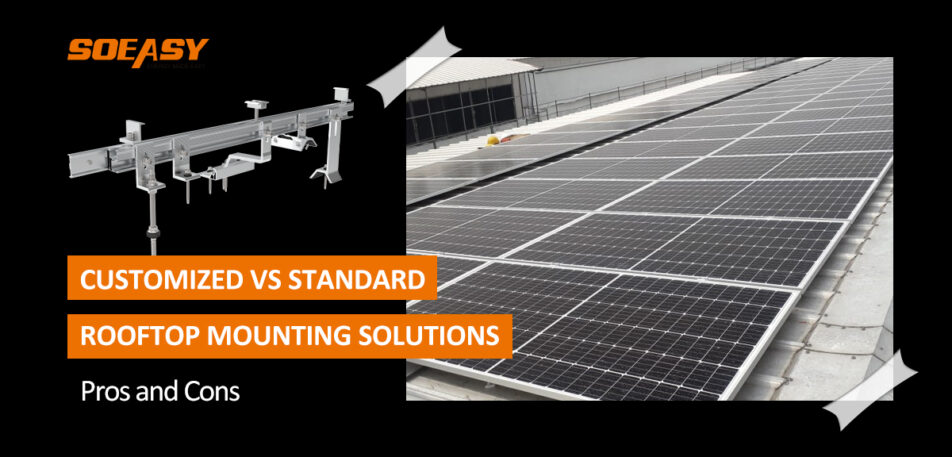
 As the distributed solar market grows rapidly, rooftop types have become increasingly diverse. EPC companies, installers, and building owners often face a critical question: should they choose a standard mounting solution or a customized one? Both approaches offer distinct advantages, and each suits different project scenarios. This article provides a complete analysis covering design, cost, delivery time, installation efficiency, and long-term financial returns.
What Are Standard Rooftop Mounting Solutions?
Standard rooftop mounting solutions are pre-engineered systems developed for common roof types. They feature fixed product parameters and mass-produced components. Typical applications include corrugated metal roofs, standing seam roofs, trapezoidal metal roofs, and standard tile roofs. Common standard solutions include mini rail systems, L-foot mounting systems, standing seam clamp systems, and standard tile roof hook systems. These products are ready to ship and designed for straightforward installation.
Advantages of Standard Rooftop Mounting Solutions
Standard solutions offer several compelling benefits. The lower initial cost comes from mass production reducing manufacturing expenses, with no additional engineering fees required. Faster delivery is another advantage because products are typically held in inventory, shortening procurement lead times significantly. Installation is easier since the process follows standardized steps that installation teams quickly master. Finally, proven reliability gives peace of mind, as these systems have been validated across thousands of projects with relatively low risk.
Limitations of Standard Solutions
Despite their benefits, standard solutions have clear limitations. Adaptability is restricted, meaning they cannot fully match unusual or complex roof structures. Material waste can occur when extra配件 are needed to adapt the standard system to special requirements. Optimization potential is reduced because standard systems cannot maximize usable roof space in every situation. For complex projects with extreme environmental loads, standard solutions may even present safety risks.
What Are Customized Rooftop Mounting Solutions?
Customized rooftop mounting solutions are designed specifically for a project’s unique conditions. This includes structural optimization, connection method adjustments, material selection, and foundation parameter changes. Typical customization scenarios include older factory roofs, non-standard roof panel profiles, large-span roof structures, high-wind zones, heavy-snow regions, and coastal areas with high corrosion risks. Common custom design elements include special clamp development, non-standard rail lengths, reinforced support structures, tailored corrosion protection, and optimized panel layouts.
Advantages of Customized Rooftop Mounting Solutions
Customized solutions excel where standard products fall short. Optimized structural safety is achieved by designing specifically for the project’s actual load conditions, improving wind and snow resistance. Maximum roof utilization allows installers to cover more of the available area, increasing total system capacity. Better compatibility means unusual panel profiles, irregular roof shapes, and complex structures are no longer obstacles. Improved long-term performance reduces maintenance risks and extends the overall system lifespan.
Challenges of Customized Solutions
Customization does come with trade-offs. The higher initial investment includes engineering design and structural calculation costs that standard products avoid. The design cycle is longer because more time is required for project assessment and solution development. More engineering resources are needed, typically requiring a dedicated technical team rather than off-the-shelf products. Manufacturing complexity is also higher, and small-batch production results in relatively higher component costs.
Comparing Customized and Standard Solutions
The table below summarizes how the two approaches compare across key decision factors.
| Comparison Factor | Standard Solution | Customized Solution |
|---|---|---|
| Initial Cost | Lower | Higher |
| Engineering Design | Minimal | Extensive |
| Delivery Time | Faster | Longer |
| Installation Speed | Faster | Moderate |
| Roof Compatibility | Limited | Excellent |
| Structural Optimization | Basic | Advanced |
| High Wind/Snow Adaptation | Limited | Excellent |
| Long-Term Performance | Good | Better |
| Material Utilization | Standard | Optimized |
When Should You Choose a Standard Solution?
Standard solutions work best for specific project types. These include small commercial rooftops, standard corrugated metal roofs, standing seam roofs, residential rooftop systems, projects with tight budgets, and those requiring rapid delivery. The key goals for choosing standard are fast deployment, cost control, and short project cycles. If your roof matches common profiles and your environmental loads are moderate, standard is likely the right choice.
When Is Customization Necessary?
Customization becomes necessary under several conditions. In high wind regions such as typhoon zones or coastal areas, standard clamps may lack sufficient grip strength. In high snow regions like Northern Europe, Canada, or parts of Japan, standard rails may not handle the vertical pressure. Complex roof structures including irregular shapes or older factory roofs often cannot accommodate standard attachments. For large commercial and industrial projects in the multi-megawatt range, customization maximizes energy yield and long-term reliability. The key goals for customization are maximizing power generation returns, improving long-term safety, and reducing total lifecycle costs.
How SoEasy Solar Supports Both Approaches
SoEasy Solar provides both standard and customized solutions under one roof. Our standard product portfolio includes mini rail systems, L-foot systems, standing seam clamp solutions, and tile roof mounting systems. For projects requiring customization, we offer engineering services such as structural calculations, wind and snow load analysis, special clamp development, non-standard mounting design, and corrosion protection optimization. We also provide one-stop technical support covering initial assessment, solution design, manufacturing, and installation guidance.
Frequently Asked Questions: Customized vs Standard Rooftop Mounting
Which is cheaper: standard or customized mounting?
Standard solutions have lower upfront costs because no engineering or custom tooling is required.
Does customization pay off in the long run?
Yes, for complex or high-load projects. Better space utilization and higher durability increase long-term returns.
Can I use standard products on an old factory roof?
Not always. Older roofs often have non-standard profiles or weak structures requiring customized attachments.
How much longer does customization take?
Typically two to four weeks additional for engineering design and testing, depending on project complexity.
Does SoEasy Solar offer both options?
Yes. We provide standard products for common roofs and full engineering services for customized solutions.
The Best Solution Depends on the Project
Standard solutions work well for fast, cost-effective, and conventional rooftop projects. Customized solutions are better suited for complex environments and demanding performance requirements. When choosing a mounting solution, do not focus only on initial cost. Long-term power generation, structural safety, and maintenance expenses matter just as much.
SoEasy Solar provides both standard products and customized engineering solutions based on your specific roof conditions and project goals. We help customers achieve the best possible return on investment for any rooftop solar project.