English


 Post by
Noise Barrier Height Calculation Guide for Japanese BESS & Substation Projects
In Japan, the development of BESS (Battery Energy Storage Systems) and substations often faces noise compliance challenges before getting construction permits. Some projects just set the soundproof wall heights based on the equipment size. This simplified approach often leads to insufficient soundproofing, failure in pre-commissioning noise tests, high rework costs, and project delays. This practical guide is aimed at energy project consultants and EPC contractors, covering an end-to-end process for calculating soundproof wall heights in line with Japanese environmental and building standards. We also introduce how the Soeasy modular soundproof wall solution can meet the custom height requirements of energy storage and industrial facilities. …
1. Clarify Japanese Noise Compliance Requirements for Energy Storage Facilities
Noise permit review is a mandatory stage for Japanese BESS and substation developments. The Noise Regulation Act defines separate daytime and nighttime noise thresholds by land-use zone. Cooling fans, inverters and transformers of containerized BESS produce broadband continuous noise. Noise sources are commonly positioned 1.0 m to 2.5 m above finished ground. Noise monitoring is performed at site boundaries and sensitive residential receivers nearby. Critical takeaway: Noise barrier height calculation must target noise reduction at receiver points, not merely cover the height of BESS containers.
2. Acoustic Basics: Sound Diffraction Governs Noise Barrier Attenuation
The primary noise reduction mechanism of a noise barrier is sound diffraction over its top edge. When the barrier breaks the direct line-of-sight between noise source and receiver, sound waves must travel a longer path. The longer path difference creates noise attenuation. Three core parameters to define the geometry:
- Elevation of noise sources (fans, inverters, transformers)
- Elevation of sensitive receivers (residential windows, ground measurement points)
- Horizontal distances: source to barrier, barrier to receiver
Practical rule: To achieve meaningful noise reduction, the barrier crown must sit above the straight line connecting noise source and receiver.
3. Full Engineering Workflow to Compute Required Noise Barrier Height
Step 1: Survey site geometry, noise sources and sensitive receivers
Document coordinates and elevations for all major noise-generating equipment on site. Record each unit’s noise spectrum and operating hours. Map all sensitive receptors: residential houses, schools and public facilities. Capture receiver heights and horizontal separation distances.
Step 2: Confirm required noise reduction target
Define target dB attenuation according to municipal permit conditions. Most container BESS projects require 5–15 dB noise reduction. Higher attenuation targets demand taller noise barriers.
Step 3: Calculate theoretical minimum height using Maekawa formula
Japanese environmental impact assessment widely adopts the Maekawa diffraction formula for noise barrier prediction. Input source height, receiver height and horizontal separation to obtain the theoretical minimum barrier height. This value is only a baseline and cannot be directly used for construction.
Step 4: Add engineering safety margin and terrain adjustment
Japanese civil engineering convention adds a safety margin of 0.3–0.8 m to the theoretical height. Topography strongly affects effective barrier height. Upward slopes toward residential areas increase required height; depressions may reduce it. Site topographic survey data is mandatory.
Step 5: Verify wind resistance and structural capacity
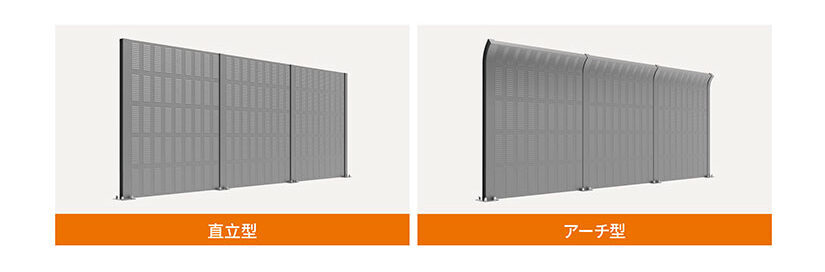
Acoustic calculation alone cannot finalize barrier height. Japan’s building code mandates wind load calculation, especially for typhoon-prone regions. Higher barriers bear greater wind pressure and require stronger supporting structures. Soeasy supplies two panel types: straight-top and arched-top noise barriers. The arched-top variant optimizes acoustic performance while mitigating wind load pressure.
4. Reference Height Specifications for Japanese Energy Storage Sites
| Project Type | Recommended Noise Barrier Height | Application Condition |
|---|---|---|
| Small-scale BESS / substation, remote from residences | 2.0–2.5 m | Low noise limit, long distance to sensitive receivers |
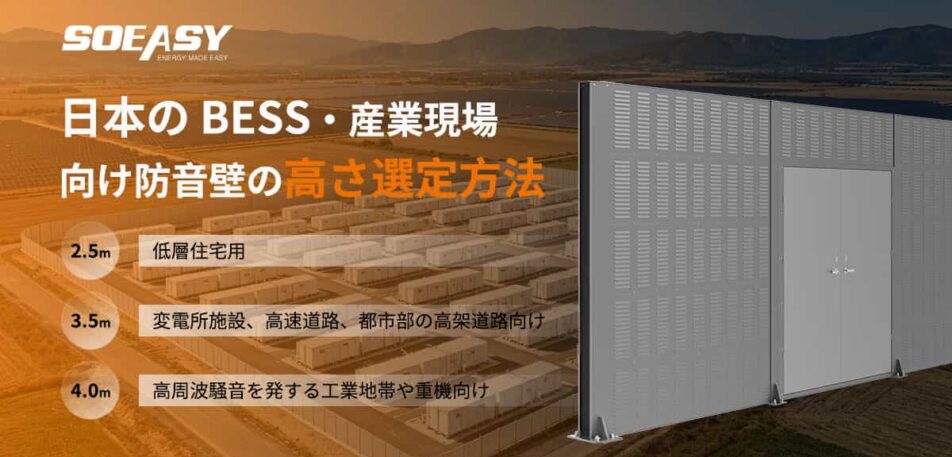
| Standard container BESS with nearby residential buildings | 3.0–4.0 m | Most common commercial energy storage projects |
| High-noise equipment, receptors in close proximity | 4.0–5.0 m | Structural reinforcement + detailed wind load review required |
Important note: Barriers exceeding 4 m usually require extra structural calculation documents for prefectural permit submission.
5. Frequent Pitfalls in Noise Barrier Height Specification
- Matching barrier height only to BESS container height. Direct line-of-sight remains, resulting in poor noise reduction.
- Applying flat-ground calculation formulas on sloped sites without terrain correction.
- Ignoring typhoon wind load; oversized height exceeds structural bearing capacity.
- Evaluating only daytime noise, while residential zones impose stricter nighttime noise limits.
- Forgetting seasonal operating modes: BESS fans run faster in summer and raise noise levels.
6. Soeasy Modular Noise Barrier Tailored for Calculated Height Requirements
Soeasy engineering-grade noise barrier is developed specifically for Japanese BESS, substations and industrial sites.
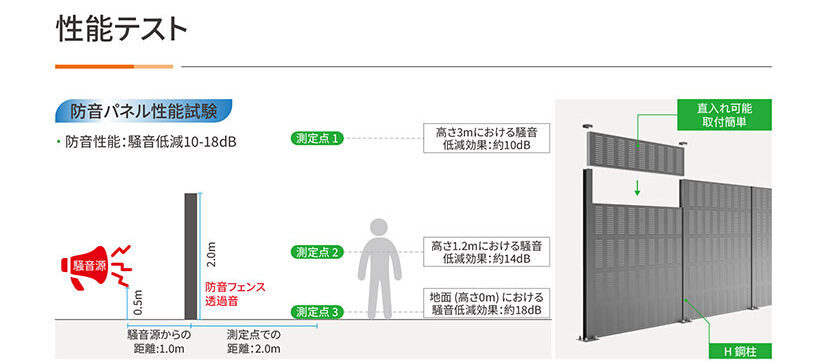
- Two panel options: straight-top and arched-top panels to match different height designs.
- Multi-layer composite panel structure: outer louver layer, glass wool sound-absorbing layer and solid sound-insulating layer. Effectively handles mixed high-frequency and low-frequency noise from energy storage containers.
- Pre-fabricated modular assembly. Panel sections can be customized according to acoustic simulation reports.
- Full-set structural components have passed wind resistance testing. Ready for technical document submission for Japanese construction permits.
FAQ
Q1: What is the standard noise barrier height for BESS projects in Japan?
A: 3.0 m to 4.0 m is the typical range for containerized BESS close to residential areas. The final height is determined by acoustic simulation, source-receiver geometry and local municipal noise regulations.
Q2: Can arched-top noise barriers cut down the required physical height?
A: Yes. The arched top optimizes sound diffraction. It delivers equivalent noise attenuation at a slightly lower physical height than straight-top noise walls, and lowers wind load stress on supporting frames.
Q3: Why must terrain data be included in noise barrier height calculation for Japan projects?
A: Sloped terrain changes the line-of-sight path between noise sources and receivers. Topographic survey results are required in noise assessment reports for Japanese permit applications.
Conclusion
Specifying the height of sound barriers for BESS and substation projects in Japan is a multidisciplinary engineering task that requires a combination of acoustics, local regulations, topographic surveys, and structural wind resistance assessments. Starting from the permitted noise limits, map the locations of noise sources and receptors, run Maekawa diffraction calculations, and SOEASY, focusing on the Japanese market, provides reliable sound barriers (soundproof walls) for BESS and substation projects in Japan.
Contact SOEASY SOLAR: sales@soeasyrobot.com
Understand our products:Soundproof Fence – soeasypv.com