English

 Post by
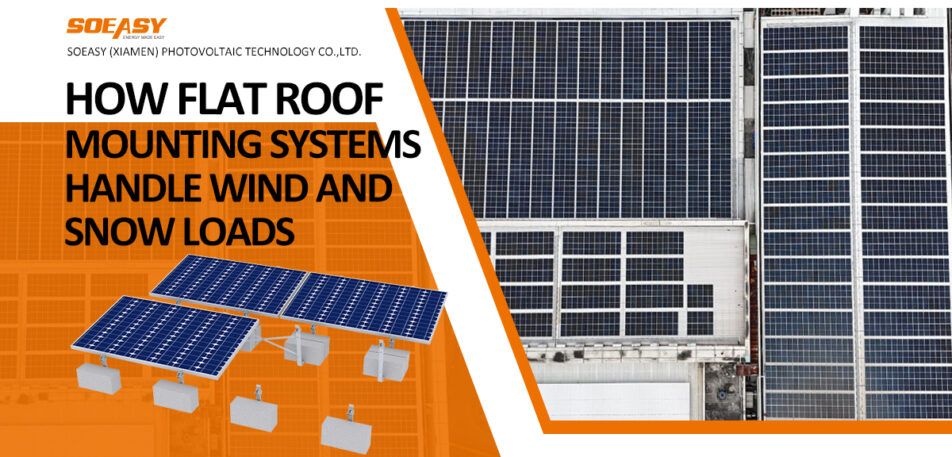
 Flat roof photovoltaic systems are widely used on commercial buildings, industrial facilities, and large warehouse roofs. The central structural safety challenge for these systems comes from two major external forces: wind loads and snow loads. Poor design in either area can lead to mounting system displacement or overturning, damage to the roof waterproofing membrane, micro-cracks in solar modules, or complete structural failure. This article explains how flat roof mounting systems address these loads through thoughtful structural design.
Understanding Wind Loads on Flat Roof Solar Systems
Wind behaves differently on flat roofs than on pitched ones. Instead of flowing smoothly over the surface, wind creates uplift forces that try to pull the solar array upward. Edge and corner areas experience especially strong vortices that concentrate wind pressure in small zones. The highest wind pressures occur at roof edges and corners, while the central roof area experiences relatively lower forces.
Critical risk zones on flat roofs include exposed edges without parapets, building corners where wind accelerates, buildings with no parapet walls at all, and high-rise industrial roofs where wind speeds are naturally higher. These zones demand special attention during the design phase.
The design implications are clear. Engineers must reinforce edge areas with additional ballast or anchoring. Array spacing should be optimized to reduce wind channeling effects. The overall system height above the roof surface should be minimized to reduce wind leverage.
Wind Resistance Strategies in Flat Roof Mounting Systems
Ballasted Systems (Non-Penetrating)
Ballasted systems rely on concrete blocks or other weights to hold the solar array in place against wind forces. The primary advantage is clear: no roof penetration means the waterproofing membrane remains completely intact. However, ballasted systems present challenges. The substantial weight requires careful verification that the roof structure can support the additional load. Ballasted systems are best suited for moderate wind zones where the required ballast weight remains within roof capacity limits.
Penetrating Anchored Systems
Anchored systems use roof anchors and structural fasteners that penetrate through the roof membrane into the structural deck below. These systems offer superior wind resistance because the mechanical connection directly transfers loads to the building structure. They are therefore well suited for high-wind regions where ballast alone would be insufficient or too heavy. The trade-off is the need for careful waterproofing around each penetration point.
Hybrid Systems
Hybrid systems combine ballast with partial anchoring. This approach balances wind resistance against roof protection. A moderate amount of ballast provides baseline stability, while strategically placed anchors provide additional security for critical edge and corner zones. Hybrid systems offer flexibility for projects with moderate wind loads and roof structures that can support some ballast but not full ballasted weight.
Snow Load Considerations in Flat Roof PV Design
Snow accumulation on flat roof solar arrays follows different patterns than on pitched roofs. While the roof itself is flat, the solar modules are typically installed at a tilt angle between five and fifteen degrees. This tilt means snow can slide off modules in warmer conditions, but in cold climates, snow may accumulate and remain for extended periods.
Snow load risks include structural compression and deformation, localized instability where snow drifts concentrate between array rows, and rail bending or fracture under excessive weight. Snow drifting is particularly dangerous because it creates uneven loads far higher than the average snow depth would suggest.
Design adaptations for snow loads include increasing the structural strength of all load-bearing components, optimizing tilt angles to encourage natural snow shedding, increasing row spacing to reduce snow trapping between arrays, and using high-strength rail systems with greater bending resistance.
Structural Design Factors for Load Resistance
System tilt angle optimization matters for both wind and snow. Common angles for flat roof systems range from five to fifteen degrees. Lower angles reduce wind exposure and wind uplift forces, while higher angles improve snow shedding. The optimal angle depends on local climate conditions and wind patterns.
Rail and frame strength must be sufficient to resist both upward wind forces and downward snow pressure. High-strength aluminum alloys or galvanized steel are typical choices. Increasing the section modulus of rails enhances bending resistance without adding excessive weight.
Connection system strength is equally important. Mid-clamps and end-clamps must provide secure module fixation under all load conditions. Bolt grades should meet or exceed Grade 8.8 for steel or A2-70 for stainless steel fasteners. Underspecified connections are a common failure point.
Module layout design affects wind performance significantly. Arrays should be arranged to minimize wind channeling between rows. Edge setbacks reduce corner vortex effects. Proper spacing between rows reduces both wind acceleration and snow trapping.
Ballasted vs Anchored Flat Roof Systems Comparison
The table below compares ballasted, anchored, and hybrid flat roof mounting systems across key performance factors.
| Factor | Ballasted System | Anchored System | Hybrid System |
|---|---|---|---|
| Waterproofing Impact | No penetration | Requires membrane sealing | Limited penetration |
| Wind Resistance | Moderate | High | High |
| Roof Load Requirement | High | Moderate | Moderate |
| Installation Speed | Fast | Moderate | Moderate |
| Best Suited For | Low to moderate wind zones | High wind and high snow zones | Projects with balanced requirements |
| Long-Term Maintenance | Low | Moderate | Moderate |
Ballasted systems offer speed and roof protection but require substantial roof capacity. Anchored systems provide superior wind resistance at the cost of roof penetrations. Hybrid systems offer a middle path for projects with balanced requirements.
Material Selection for Load Resistance
Aluminum structures are lightweight and naturally corrosion-resistant, making them suitable for most flat roof systems. Aluminum reduces dead load on the roof, which is particularly valuable when the existing roof structure has limited additional capacity.
Hot-dip galvanized steel offers higher strength at a cost advantage. Steel systems are ideal for large-span structures where aluminum would require excessive material thickness. Galvanized steel provides excellent long-term corrosion protection when properly coated.
Zn-Al-Mg coated steel represents the latest advancement. This coating offers superior corrosion resistance compared to traditional galvanizing, especially in coastal and high-humidity environments. The self-healing edge protection makes Zn-Al-Mg particularly valuable for high-wind coastal regions where salt spray accelerates corrosion.
Engineering Standards and Wind/Snow Load Calculations
Every flat roof solar project must comply with recognized engineering standards. Europe uses Eurocode standards, North America follows ASCE 7, and Japan enforces JIS requirements. These standards provide consistent methodologies for calculating wind and snow loads.
Load calculation inputs include geographic wind speed data based on location and building height, roof height above ground, building shape and exposure coefficients, and local snow pressure data. Each input affects the final load values significantly.
Safety factors are built into all calculations. Wind load safety factors are typically higher than for snow because wind events are more variable and less predictable. Extreme weather design redundancy ensures the system survives rare but severe events.
Installation and Maintenance Considerations
Installation accuracy directly affects system performance. Ballast must be distributed evenly to prevent uneven loading that could overload one roof area while under-loading another. Anchors must be precisely positioned according to structural calculations.
Roof integrity protection requires careful attention during installation. Protective mats or pads prevent damage to the waterproof membrane when walking on the roof. For anchored systems, proper flashing and sealing around each penetration is essential to prevent leaks.
Long-term maintenance keeps systems performing safely. Regular inspections should check fastener tightness, look for signs of rail deformation, and clear accumulated debris or snow from between rows. Seasonal inspections after major storms are particularly important.
Frequently Asked Questions about Flat Roof Solar Mounting
What is the best flat roof mounting system for high wind areas?
Anchored or hybrid systems provide superior wind resistance compared to fully ballasted systems.
Can I install flat roof solar without penetrating the roof?
Yes. Ballasted systems use weights instead of penetrations, but roof load capacity must be verified.
How much tilt angle is recommended for flat roof systems?
Between five and fifteen degrees, depending on wind and snow conditions.
What material resists corrosion best on flat roofs?
Zn-Al-Mg coated steel or aluminum with appropriate surface treatment.
Does SoEasy Solar offer flat roof mounting systems?
Yes. We provide ballasted, anchored, and hybrid flat roof solutions for commercial and industrial projects.
Designing Safe and Stable Flat Roof PV Systems
Wind and snow loads are the defining factors in flat roof PV system design. Proper structural choices significantly improve system safety and service life. Ballasted systems work well for low-risk roofs where weight capacity is sufficient. Anchored systems provide superior resistance for high-wind and high-snow regions. Hybrid systems offer flexibility for moderate conditions.
SoEasy Solar provides a full range of flat roof photovoltaic mounting solutions, including ballasted, penetrated, and hybrid systems. We help customers achieve safe, efficient, and long-term stable installations for any flat roof project.
Reach out to our team for detailed project consultation: Contact Us