English

 Post by
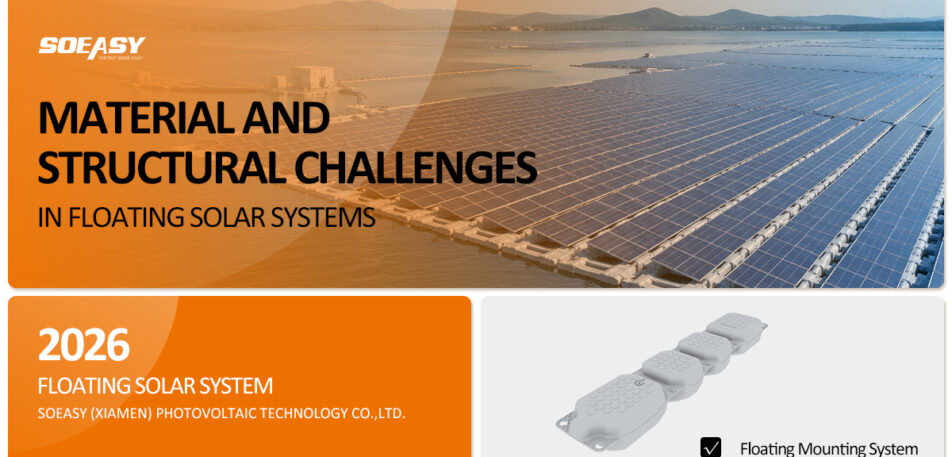
 Floating photovoltaic systems, or floating PV, are installed on water surfaces rather than on ground or rooftops. This fundamental difference creates unique engineering challenges. Water environments introduce factors such as corrosion, buoyancy forces, and wave loads that traditional solar structures never face. As a result, material selection and structural design become critical to project success. This article examines the core material and structural challenges in floating solar systems and presents best practices for reliable deployment.
Floating PV System Overview
A floating PV system consists of several basic components. Floats or buoys provide the necessary buoyancy to keep the entire array on the water surface. PV modules are mounted above the floats using rails or frames. An anchor and mooring system prevents the array from drifting or rotating. Cables and grounding equipment handle electrical connections and safety.
Floating PV applications continue to expand. Common installation sites include reservoirs for drinking water or hydroelectric dams, natural or man-made lakes, wastewater treatment ponds, and industrial cooling water ponds. Each water body presents different conditions in terms of water chemistry, wave activity, and depth.
Material Challenges
Corrosion Resistance
Floating PV systems remain exposed to water for their entire operational life, which typically spans 20 to 25 years. This constant exposure makes corrosion resistance the number one material priority. The risk is highest in freshwater and saltwater transition zones, such as estuaries or coastal reservoirs.
Materials used in floating PV must offer high corrosion resistance. Suitable options include hot-dip galvanized steel, Zn-Al-Mg coated steel, aluminum alloys, and engineering plastics. Each material has trade-offs in cost, strength, and weight. For metal components exposed to splashing or intermittent submersion, additional protective coatings are often necessary.
UV and Weather Resistance
Floats and other non-metal components must withstand decades of direct sunlight, rain, wind, and temperature swings without degrading. High-density polyethylene (HDPE) and polypropylene (PP) are the most common materials for floating bodies because they offer excellent UV resistance and long-term weatherability. For steel structures exposed to sunlight, protective coatings are essential to prevent UV-accelerated corrosion.
Mechanical Strength
The floating structure must support the weight of PV modules while withstanding水面波动, wind pressure, and snow accumulation. Materials need sufficient stiffness to prevent excessive deflection and enough toughness to resist cracking under dynamic loads. A material that works well for stationary ground mounts may fail when subjected to continuous wave-induced motion.
Fatigue and Creep Resistance
Long-term floating introduces cyclic loading that can cause material fatigue. Waves create repeated up-and-down forces that metal components may not experience in ground-mounted systems. Plastic floats face an additional risk: creep deformation under constant load over many years. Metal structures require fatigue analysis, especially at connection points where stress concentrates. Plastic components need creep-resistant formulations and proper support designs.
Structural Challenges
Load Considerations
Floating PV systems must resist multiple load types simultaneously. Wind load pushes against the elevated PV modules, creating overturning moments. Buoyancy load must be distributed evenly to keep the array level. Wave load applies cyclic forces that vary with water depth and weather conditions. Module weight and snow load add vertical compression.
Unlike ground mounts, floating systems cannot rely on soil friction or deep foundations to resist these loads. Every force must be managed through the buoyancy and anchoring systems.
Anchor and Mooring Design
Anchor and mooring design prevents the entire floating array from drifting across the water body or capsizing in extreme weather. The choice of anchor type depends on water depth, flow velocity, and bottom conditions. Common options include pile anchors for shallow, stable bottoms, chain anchors for moderate depths, and hybrid systems that combine multiple approaches.
The distribution of mooring points directly affects float stability. Too few anchor points allow excessive movement. Too many increase cost and installation complexity without proportional benefit.
Connection and Flexibility
Floating PV systems are not rigid structures. Individual floats move relative to one another as waves pass through the array. This means the module mounting system must accommodate relative motion between adjacent floats.
Connection design must balance three competing needs. First, the system needs enough flexibility to absorb wave-induced movement without breaking. Second, it needs high-strength fixation to prevent modules from shifting out of position. Third, connections must allow easy access for maintenance and potential component replacement.
System Layout Optimization
The spacing between floats and between array rows affects both power generation and system durability. Adequate gaps allow water flow, which reduces wave reflection and prevents debris accumulation. Maintenance channels must be incorporated into the layout so workers can access any part of the array. At the same time, the layout should maximize PV power generation efficiency by avoiding unnecessary shading.
Maintenance and Longevity Considerations
Floating PV systems are harder to maintain than ground-mounted systems. Technicians cannot simply walk up to a floating array without specialized access equipment. This makes material selection even more critical, because repairs are more expensive and time-consuming on water.
Material choices directly determine system service life, typically targeted at 10 to 25 years. Corrosion-resistant materials, UV-stable plastics, and fatigue-resistant connections all reduce long-term operation and maintenance costs. A small upfront investment in better materials often pays back many times over through reduced repair needs.
Material-Structure Integration Best Practices
The table below summarizes key best practices for integrating materials and structures in floating solar systems.
| Best Practice | Description | Benefit |
|---|---|---|
| Combining Materials | Metal rails with plastic floats, or composite floats with防腐 steel frames | Optimizes strength-to-weight ratio and corrosion resistance |
| Pre-assembled Modular Design | Factory-assembled modules shipped to site | Reduces on-site complexity, improves stability and installation speed |
| Corrosion and Fatigue Testing | Water surface simulation, UV aging, salt spray, and cyclic load testing | Validates performance before deployment, prevents field failures |
Combining Materials
No single material excels in every floating PV requirement. Metal rails provide high strength and stiffness for module support, while plastic floats offer buoyancy without corrosion concerns. Composite floats paired with corrosion-protected steel frames represent another effective combination. The key is designing the interface between different materials to avoid galvanic corrosion and stress concentrations.
Pre-assembled Modular Design
Modular, pre-assembled floating units reduce on-site construction time and improve quality control. Factory assembly ensures consistent connections and proper sealing. Modular designs also make transportation and deployment more predictable.
Corrosion and Fatigue Testing
Testing validates material and structural choices before full-scale deployment. Water surface simulation reproduces real-world wave conditions. UV aging and salt spray tests accelerate decades of environmental exposure into weeks or months. Dynamic load cycling reveals fatigue vulnerabilities that static analysis misses.
Frequently Asked Questions: Floating Solar Systems
What is the biggest challenge in floating solar?
Corrosion management, because water exposure is constant and repairs are difficult.
Which materials work best for floating PV floats?
HDPE and polypropylene, due to their UV resistance, buoyancy, and durability.
How do waves affect floating solar structures?
Waves create cyclic loads that cause material fatigue and require flexible connections.
What anchors are used for floating solar?
Pile anchors, chain anchors, or hybrid systems depending on water depth and bottom conditions.
Does SoEasy Solar offer floating PV mounting solutions?
Yes. We provide Zn-Al-Mg steel mounting structures, HDPE float modules, and complete anchoring solutions.
Designing for Reliability in Floating PV
Floating photovoltaic systems face unique material and structural challenges that ground-mounted systems never encounter. Water exposure demands exceptional corrosion and UV resistance. Wave action requires fatigue-tolerant designs and flexible connections. Proper anchoring keeps the array stable in changing conditions.
With the right material selection and structural optimization, floating PV systems can achieve long-term durability, safety, and high power generation efficiency.
Reach out to our team for detailed project consultation: Contact Us