English

 Post by
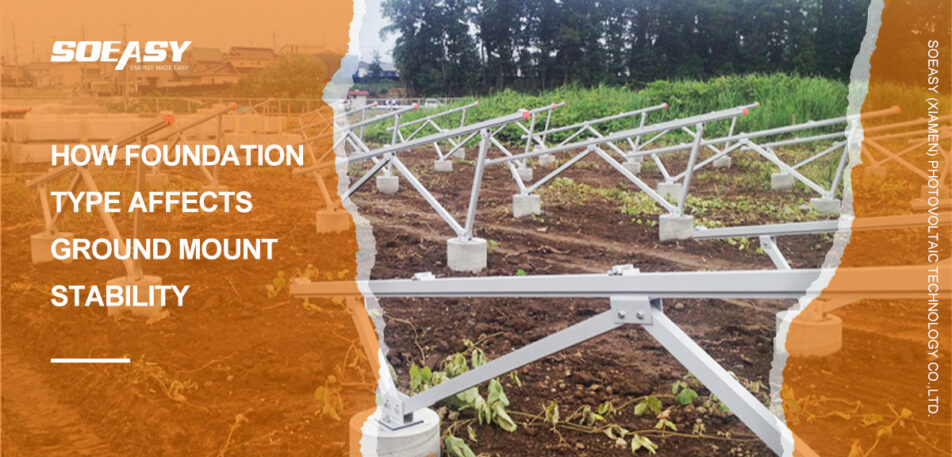
 Why Foundations Matter in Ground-Mounted PV Systems
When designing a ground-mounted solar PV system, much attention is given to modules, inverters, and racking. However, the component that literally grounds the entire system—the foundation—is often overlooked until problems arise. The foundation is the critical interface between the solar array and the earth, responsible for transferring all loads safely into the ground while resisting uplift from wind, downward pressure from snow, and lateral forces from seismic events.
A poorly chosen or inadequately designed foundation can lead to settling, tilting, or even catastrophic collapse of the entire array. Conversely, the right foundation ensures that the PV system remains stable, level, and productive for 25 years or more. This article analyzes common ground mount foundation types—concrete piers, ground screws, driven piles, and hybrid solutions—and provides practical guidance for selecting the optimal foundation based on soil conditions, environmental loads, and project constraints.
Understanding Ground Mount Foundations
Definition and Function
A foundation is the structural element that secures a ground-mounted solar racking system to the earth. It may be a concrete block cast in place, a steel screw twisted into the soil, or a pile driven deep underground. Regardless of the type, every foundation must fulfill three primary functions. First, it must bear the dead load of the modules, racking, and all associated hardware. Second, it must resist environmental loads including wind uplift, snow compression, and seismic forces. Third, it must maintain precise alignment of the entire array over decades of service, preventing differential settlement that could stress modules or reduce energy production.
Key Design Considerations
Selecting the correct foundation requires evaluating several interconnected factors. Soil type and bearing capacity determine how much weight the ground can support and how well it will hold a screw or pile. Wind and snow loads at the project site dictate the required pullout resistance and downward capacity. Groundwater level affects corrosion risk and may rule out certain foundation types. Environmental regulations may limit noise or vibration from pile driving. Finally, project timeline and budget inevitably influence the foundation decision, as some types install much faster than others.
Common Ground Mount Foundation Types
Concrete Pier / Pad Foundations
Concrete piers or pads are the most traditional foundation type for ground-mounted solar. A hole is excavated, forms are placed, and concrete is poured either around embedded steel posts or with anchor bolts cast in place for later racking attachment. This method creates an extremely stable, permanent foundation that distributes loads over a broad area.
Concrete foundations offer exceptional bearing capacity and resistance to uplift, making them ideal for large utility-scale projects and sites with high wind or snow loads. They perform well on virtually any soil type, from clay to sand to rocky ground, provided excavation is possible.
However, concrete foundations have significant drawbacks. They require substantial labor and material costs, plus curing time that can delay project schedules by days or weeks. Excavation and concrete work generate carbon emissions, and the foundations are permanent—relocating the array later is impractical and expensive. Concrete piers are best suited for large, permanent installations where long-term stability outweighs higher upfront costs and longer construction timelines.
Ground Screw Foundations
Ground screws, also known as helical piles or screw anchors, are steel shafts with helical plates welded to the lower section. A hydraulic motor attached to an excavator or skid steer twists the screw into the ground, with the helix providing both bearing and pullout resistance. The top of the screw is threaded or fitted with a bracket to accept the solar racking.
The primary advantage of ground screws is speed. Installation typically takes one to two minutes per screw, with no concrete curing delay. They are also removable and reusable, making them attractive for temporary installations or projects on leased land. Ground screws perform exceptionally well in soft soils, sandy conditions, and on sloped terrain where excavating for concrete would be difficult.
That said, ground screws have limitations. They require adequate torque to install; very rocky soil or hard clay can prevent proper penetration. Pullout resistance depends entirely on soil conditions and helix size, so thorough geotechnical investigation is essential. In highly corrosive soils, the steel screw requires special coatings or thicker wall sections. Ground screws are ideal for medium-sized commercial projects, challenging terrain, and sites where minimal ground disturbance is required.
Driven Pile Foundations
Driven piles are steel posts—typically C-sections, pipes, or H-beams—forced directly into the ground using impact or vibratory hammers mounted on excavators or dedicated pile drivers. No excavation or concrete is required. The pile achieves bearing capacity through friction along its shaft and end bearing at the tip.
Driven piles offer excellent depth penetration, making them suitable for soft or loose soils where other foundation types might fail. They can be driven very deep—three meters or more—to reach competent bearing strata. Installation is fast, often several piles per minute, and the process generates no concrete or excavation spoils.
However, driven piles are noisy and produce vibration, which may be restricted near sensitive buildings, schools, or hospitals. The driving process can bend slender piles if they encounter rocks or hard layers. Rust protection is critical; driven piles are typically hot-dip galvanized or made from corrosion-resistant steel. Driven piles are best for large, open sites with uniform soil conditions and no noise restrictions.
Hybrid / Terrain-Adaptive Foundations
Not all sites are flat and uniform. Some projects span rolling hills, former landfills, or reclaimed mining land with significant elevation changes. Hybrid foundations combine elements of multiple types—for example, a ground screw with an extended threaded shaft that allows racking height adjustment, or a concrete pier with an adjustable steel standoff.
Terrain-adaptive foundations use telescoping posts, adjustable brackets, or ball-and-socket connections to maintain a level array surface even when the ground slopes. This approach minimizes grading and excavation, preserving the natural terrain and reducing environmental impact.
The trade-off is increased complexity and cost per foundation. Adjustable components have more parts that could loosen or corrode over time. Design requires detailed topographic surveys and customized engineering. Hybrid foundations are best for challenging terrain where conventional foundations would require massive earthwork or become prohibitively expensive.
Comparison Table: Foundation Types at a Glance
| Foundation Type | Installation Speed | Load Capacity | Best Soil Conditions | Key Limitation |
|---|---|---|---|---|
| Concrete Pier | Slow (curing time) | Very High | All soil types | High cost, permanent |
| Ground Screw | Fast (1-2 min each) | Medium to High | Soft soil, sand, slope | Rocky soil problematic |
| Driven Pile | Fast | High | Soft or loose soil | Noise, vibration |
| Hybrid/Adaptive | Medium | Medium to High | Sloped or uneven terrain | Higher complexity |
Impact of Foundation Type on Stability
Resistance to Wind Load
Wind uplift is often the governing load for ground-mounted solar foundations. When wind passes over and under a tilted solar array, it creates a powerful lifting force that tries to pull the foundation out of the ground. Deep foundations—driven piles and longer ground screws—resist uplift through skin friction along their shafts. Concrete piers resist uplift through the sheer mass of concrete and the weight of soil above any footing. Shallow foundations or lightweight ballasted systems must rely on broad footprints or additional anchoring to resist the same forces.
In high-wind regions such as coastal areas or open plains, driven piles or deep concrete piers are the safest choices. Ground screws can also perform well if installed to sufficient depth in competent soil. However, a short screw in loose sand may pull out under extreme wind, whereas a concrete pier of adequate size will not.
Resistance to Snow and Live Load
Heavy snow accumulations impose large downward forces on a solar array. The foundation must support this added weight without settling or tilting. Concrete piers excel here because they distribute load over a large base area, reducing ground pressure. Driven piles transfer load to deeper, more competent soil layers, also performing well. Ground screws rely on the bearing capacity of the helix plates; in soft soils, a screw may sink deeper under sustained heavy load.
For projects in regions with deep snowpack—northern latitudes or high-altitude sites—concrete piers or driven piles are generally preferred. If ground screws are used, larger helix diameters and deeper embedment are required.
Soil and Terrain Adaptability
Different foundations handle challenging ground conditions differently. In soft, water-saturated soils, driven piles and ground screws can reach competent strata below the weak surface layer. Concrete piers may require excavation and dewatering, which becomes expensive. In rocky terrain, ground screws may not penetrate at all; drilled concrete piers or rock-anchored systems are more appropriate. On sloped terrain, adjustable ground screws or hybrid terrain-adaptive foundations maintain level rows without extensive grading.
The table below summarizes foundation suitability across common site conditions.
| Site Condition | Concrete Pier | Ground Screw | Driven Pile | Hybrid/Adaptive |
|---|---|---|---|---|
| Flat, firm soil | Excellent | Good | Good | Not needed |
| Soft / wet soil | Poor (dewatering needed) | Excellent | Excellent | Good |
| Rocky ground | Good (drilled) | Poor | Poor | Fair |
| Sloped terrain | Fair (grading required) | Excellent | Fair | Excellent |
| High water table | Poor | Good | Good | Fair |
Longevity and Maintenance
Solar projects are designed for 25 to 30 years of service. Foundation longevity must match or exceed that timeframe. Concrete piers are extremely durable in most soil conditions, resisting corrosion and biological attack indefinitely. However, if an array needs to be relocated or decommissioned, removing concrete piers is expensive and labor-intensive.
Ground screws are removable and reusable, making them ideal for leased land or future relocation. However, the steel shaft is vulnerable to corrosion in acidic or saline soils. Hot-dip galvanizing, Zn-Al-Mg coatings, or stainless steel screws address this concern at added cost. Regular inspection of ground screw tops and connections is recommended.
Driven piles face similar corrosion risks, particularly at the soil-air interface where moisture and oxygen combine to accelerate rust. Thick galvanized coatings or corrosion-resistant steel alloys are standard for long-life installations. Hybrid foundations introduce more moving parts and connections, potentially increasing maintenance requirements over the life of the system.
Tips for Selecting the Right Foundation
Conduct Soil Investigation
No foundation should be selected without a proper geotechnical investigation. At minimum, this should include soil borings or test pits at representative locations across the site, laboratory testing to determine soil classification, bearing capacity, and corrosivity, and groundwater level measurement. For large projects, a full geotechnical report from a licensed engineer is essential. For smaller projects, local soil maps and simple field tests (penetrometer, hand auger) may suffice.
Consider Local Environmental Conditions
Wind speed, snow depth, seismic zone, and corrosion environment all influence foundation selection. High-wind areas demand deeper foundations with greater pullout resistance. Heavy snow regions require larger bearing areas to prevent settling. Coastal sites with salt spray require corrosion-protected steel or concrete foundations that resist chloride attack. Industrial areas with chemical emissions may require specialized coatings or stainless steel components.
Balance Cost, Time, and Performance
Each foundation type offers a different balance of upfront cost, installation speed, and long-term performance. Concrete piers are expensive and slow but extremely stable. Ground screws are fast and moderate in cost but may have lower capacity in poor soils. Driven piles offer a middle ground—fast installation with good capacity—but require noise-tolerant sites.
General guidance:
- Choose concrete piers for permanent, large-scale projects with high loads and no schedule pressure.
- Choose ground screws for speed, terrain adaptability, or leased land where removal is anticipated.
- Choose driven piles for open sites with soft soils and no noise restrictions.
- Choose hybrid foundations for challenging slopes or unique site constraints.
Engage Structural Calculations
Foundation selection must be validated by engineering calculations. Minimum requirements include wind uplift and downward load calculations per local building codes, determination of required embedment depth and diameter or helix size, pullout and bearing capacity verification based on soil data, and corrosion allowance or coating specification. A qualified structural or geotechnical engineer should review all foundation designs before installation begins.
Foundation Choice Determines Ground Mount Stability
The foundation is the literal bedrock of any ground-mounted solar PV system. Choosing the wrong type—or correctly choosing but improperly designing—can lead to settlement, tilting, structural failure, and costly repairs or energy losses over the system’s lifetime. Conversely, a properly matched foundation ensures that the array remains level, stable, and productive for 25 years or more, regardless of wind, snow, or soil conditions.
The key to success is matching foundation type to site-specific conditions. Concrete piers offer unmatched stability for permanent installations on firm ground. Ground screws provide speed and flexibility on challenging terrain or leased land. Driven piles deliver deep penetration in soft soils at high speed. Hybrid solutions tackle slopes and uneven sites without massive grading.
SOEASY offers a complete range of ground mount foundation solutions to meet diverse project requirements. Our portfolio includes engineered designs for concrete pier foundations, certified ground screw systems with corrosion-resistant coatings (Zn-Al-Mg and hot-dip galvanized), driven pile solutions for utility-scale projects, and custom hybrid foundations for terrain-adaptive installations. Every SOEASY foundation solution is backed by detailed engineering calculations, installation guides, and technical support to ensure long-term reliability.
Ready to optimize your ground mount foundation selection? Contact the SOEASY engineering team for site assessment, soil analysis support, and foundation recommendations tailored to your project’s unique conditions