English

 Post by
 Over the past decade, the global solar industry has undergone a profound transformation. The market has shifted from policy-driven growth to grid parity and commercial self-consumption. From European industrial parks in sub-zero winds to scorching Middle Eastern deserts, solar power has become the core path for global enterprises to reduce energy costs and achieve carbon neutrality goals. However, facing vastly different climate conditions, building codes, and customs standards across regions, choosing a factory with genuine global delivery capability has become the top priority for overseas EPC contractors and solar developers.
As the structural backbone of any PV system, the quality of solar mounting structures directly determines a power station’s structural safety and investment returns over its 25-year lifecycle. When projects span different latitudes and longitudes, you need far more than standard metal profiles. Specifically, you need a strong strategic partner that withstands the scrutiny of rigorous global markets.
How do you evaluate and select a factory with true international delivery strength? In this guide, we break down the core evaluation standards and explore how SOEASY earned its global reputation as a trusted solar mounting supplier.
How to Choose a Factory with Genuine Overseas Delivery Strength?
In the fierce competition of the global PV market, a vendor’s true capability goes far beyond the numbers on a price quotation. Evaluating whether a factory can guarantee long-term delivery for cross-border projects usually requires examining five core dimensions:
1. Global Project Experience and Multi-Environment Adaptability
For any enterprise seeking overseas expansion, true globalization capability is not merely about exporting products to different countries. Instead, it means understanding unique project requirements across different markets and adapting product designs, engineering solutions, and delivery workflows to local environments.
Solar projects face distinct operating conditions depending on their location. For instance, high-latitude regions require a heavy focus on snow loads. Coastal areas demand resistance against high humidity, salt spray, and long-term corrosion, while other regions must withstand extreme wind loads. Simultaneously, residential rooftops, commercial rooftops, utility-scale ground plants, and solar carports impose varying requirements on mounting structures and installation methods.
Therefore, a mature solar mounting supplier must possess rich overseas project experience. The supplier should design solutions based on actual site conditions rather than offering generic, standardized products. For global partners, extensive project experience means lower trial-and-error costs. Consequently, it ensures faster demand comprehension, rapid troubleshooting, and tailor-made technical solutions for diverse markets.
2. Adaptation to International Standards and Local Compliance
Different countries enforce strict local building codes and PV regulations, such as AS/NZS 1170 in Australia, Eurocode in Europe, ASCE 7 in the United States, and JIS standards in Japan. If a manufacturer lacks an international compliance mindset, its products can easily face delays during customs clearance or grid-connection acceptance, causing project delays and contract defaults.
Accordingly, when entering different international markets, suppliers must thoroughly evaluate local structural design requirements, including wind load, snow load, seismic conditions, material performance, and industry standards. In addition, international projects routinely demand clear product certifications, verified material quality, and rigorous structural analysis. That is why choosing a reliable solar mounting manufacturer requires looking beyond available product lines to verify their R&D design capacity, certification credentials, and technical support systems.
For distributors and EPC partners, these capabilities significantly reduce communication friction and delivery risks caused by mismatched standards, inadequate technical documentation, or compliance failures.
3. Core Patents and Authoritative International Certifications
In the solar mounting industry, products may look visually similar on the surface. However, true technical differences reside in structural design, material application, connection methods, and total system integration. Patents reflect a company’s continuous investment in R&D and structural innovation. Meanwhile, international certifications offer objective proof of product quality, structural performance, and manufacturing management.
A leading mounting enterprise must hold independent patents for innovations like BIPV mechanical waterproofing, long-span cantilever design, and quick-locking clamp structures. Furthermore, its products should pass stringent testing by authoritative global bodies, including TÜV Rheinland, CE, ISO9001, and UL. Certifications serve not only as market passports but also as the ultimate endorsement of product reliability.
When evaluating a solar mounting supplier, patent counts and certification portfolios are not mere corporate trophies. Instead, they serve as crucial indicators of R&D capacity, quality control, and international adaptability. For partners building long-term overseas businesses, a supplier backed by robust technology and complete certification simplifies local project development and customer satisfaction.
4. Localized Service and Global Response Mechanisms
Solar projects operate under tight deadlines and demanding workloads. When purchasing overseas, the worst scenario is losing vendor support right after placing an order. Whether a vendor establishes overseas branch offices, maintains a multilingual technical support team, and offers a 24-hour response mechanism directly dictates construction smooth sailing.
The complete project lifecycle demands continuous vendor involvement—from initial engineering design and technical confirmation to manufacturing, logistics, job-site installation, and post-commissioning support. In overseas projects specifically, geographical distance, language barriers, time zone differences, and local construction conditions elevate communication complexity. If a vendor possesses manufacturing capacity alone without a mature service system, partners must handle enormous technical friction and customer support pressures by themselves.
Therefore, a truly reliable solar mounting partner provides full-lifecycle support. This includes engineering design, technical documentation, installation guidance, issue resolution, and after-sales service. For channel partners, comprehensive support improves delivery efficiency and helps build lasting client relationships.
5. Vertically Integrated R&D and Smart Manufacturing
As global project volumes scale up, manufacturing requirements grow increasingly demanding. On one hand, mounting systems must maintain consistent material performance, machining accuracy, and product uniformity. On the other hand, large-scale projects demand predictable lead times and high-volume supply capability. Full supply-chain vertical integration—spanning aluminum profile extrusion, surface anodization, galvanized steel processing, automated mold development, and precision stamping—determines delivery stability, cost control, and custom manufacturing speed.
If R&D, production, and quality control operate in silos, even an excellent product design can fail due to capacity bottlenecks, unstable lead times, or poor quality assurance. Consequently, a mature solar mounting manufacturer builds a unified pipeline from R&D to manufacturing, turning raw R&D capacity into stable, mass-delivery capability. This distinction separates basic product vendors from true long-term partners.
SOEASY’s Global Footprint and Manufacturing Strength
Starting from Xiamen, China, and expanding across global solar markets, SOEASY’s growth represents much more than simple product export. Instead, it reflects a continuous journey of building global project experience, R&D depth, smart manufacturing, and localized service capabilities.
Backed by 18 years of industry dedication, SOEASY’s products and engineering solutions now span over 60 countries and regions with more than 3,000 completed projects. These diverse projects across varied application scenarios have provided SOEASY with deep engineering experience, driving ongoing optimizations in product design and global delivery capabilities.
From residential and commercial rooftops to utility-scale ground plants and solar carports, SOEASY continuously innovates across diverse application scenarios, providing global customers with customized mounting solutions tailored to local needs.
- 18 Years of Industry Focus: For nearly two decades, SOEASY has focused exclusively on the R&D and manufacturing of solar mounting systems. Having navigated multiple industry cycles, we maintain a deep understanding of global market evolution and customer needs.
- Footprint Across 60+ Countries: Spanning Asia, Oceania, Europe, the Americas, and Africa, SOEASY’s mounting and carport systems have successfully protected over 3,000 benchmark PV projects across extreme weather conditions and challenging terrains.
- 70+ Core Patents and Global Certifications: SOEASY holds over 70 national and international patents. Our full product line passes strict testing for TÜV, CE, ISO9001, ISO14001, and various regional market access standards.
- Two Smart Manufacturing Bases: SOEASY operates two modern manufacturing bases covering vast production areas. These facilities provide dual-engine support for PV mounting structures and energy storage equipment from R&D design to mold making and mass production.
- 21 Automated Production Lines: Equipped with high-precision CNC stamping, automatic roll forming mills, robotic welding, and advanced surface treatment lines, SOEASY ensures rapid order scheduling and on-time global delivery.
From preliminary Finite Element Analysis (FEA) structural testing and customized 3D layout design to factory modular pre-assembly and global logistics coordination, SOEASY delivers high-quality products while empowering global partners to win in competitive regional markets.
Partner with a Trusted Global Supplier
For overseas distributors, EPC contractors, project developers, and channel partners, choosing a solar mounting manufacturer is essentially choosing a long-term partner to share project delivery responsibilities.
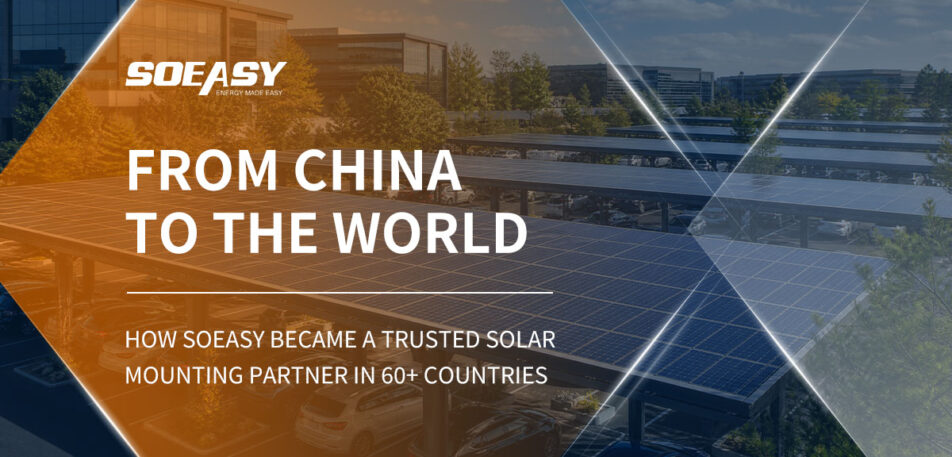
From Chinese manufacturing to global trust, solar mounting systems connect clean green energy and carry a solemn commitment to long-term investment returns. Journeying from Xiamen to more than 60 countries and regions, SOEASY remains dedicated not just to shipping products globally, but to bringing world-class R&D, manufacturing, engineering, and service capabilities to every corner of the world.