 English

 Post by
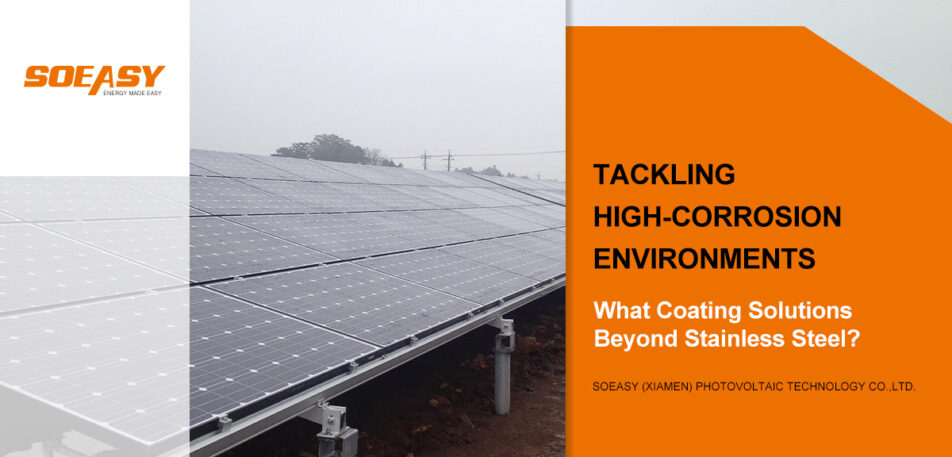
 Challenges of High-Corrosion Environments for Solar Systems
As the global photovoltaic market continues to expand, high-corrosion environments like coastal areas, tropical rainforests, and industrial pollution zones are becoming increasingly important locations for solar projects. These regions typically have abundant sunlight and available land, but they also impose severe durability requirements on solar mounting systems.
Corrosion is one of the primary factors affecting the lifetime and safety of solar mounting systems. In environments with salt mist, high humidity, acid rain, and other corrosive factors, regular carbon steel mounts may start showing noticeable rust in just a few years, leading to a reduction in structural strength, increased maintenance costs, and even system failure.
While stainless steel is a top choice for corrosion resistance, it is expensive, and not every project or environment requires stainless steel. So, what are more cost-effective solutions that still ensure corrosion resistance?
This article will explore various coating solutions beyond stainless steel, including hot-dip galvanization, powder coating, spray coating, and aluminum coatings. We will analyze their characteristics, suitable applications, and cost performance to help you make a scientifically informed clamp selection in high-corrosion environments.
Understanding Corrosion and Its Impact on Solar Systems
1. What Is Corrosion?
Corrosion is a chemical or electrochemical reaction between a material and its surrounding environment that leads to material degradation or failure. For solar mounting systems, corrosion is a gradual, irreversible process.
The main environmental factors affecting corrosion rates include:
- Salt (Chlorides): Coastal environments contain large amounts of chlorine ions in salt mist, which can penetrate the metal’s passivation layer and accelerate corrosion.
- Humidity: Moisture is essential for electrochemical corrosion, and high humidity environments extend the duration of the metal’s “wetting time.”
- Acid Rain: Industrial zones emit acidic gases like SO₂ and NOₓ, which dissolve in rain to form acid rain, speeding up corrosion.
- Oxygen: Oxygen is a key participant in oxidation reactions, and a sufficient oxygen supply accelerates the corrosion process.
2. Impact of Corrosion on Solar Mounting Systems
Corrosion has several detrimental effects on solar mounting systems:
- Decreased Structural Strength: Corrosion reduces the cross-section of the mounts, lowering their load-bearing capacity. In extreme wind or snow load conditions, severely corroded mounts may break or topple.
- Reduced Service Life: Ordinary carbon steel mounts in coastal high-corrosion environments may show severe rust in 10–15 years, far below the 25-year design life of a solar system.
- Increased Maintenance Costs: Corrosion requires regular inspections, re-coating of the protective layer, and, in severe cases, part replacements, significantly increasing operational and maintenance costs.
- Safety Risks: Corrosion-induced failures could lead to module detachment or electrical faults, resulting in safety accidents.
3. Main Types of High-Corrosion Environments
- Coastal Areas: Salt mist and humid air cause severe corrosion of metal materials. The closer the site is to the coastline, the higher the chloride concentration and the faster the corrosion rate. Areas within 5 km from the coast are considered extremely high corrosion zones (C5-M) and require the most advanced anti-corrosion solutions.
- High Humidity Areas: Tropical rainforests, monsoon regions, and areas near lakes often experience relative humidity over 80%, causing prolonged wet conditions on metal surfaces and continuous electrochemical corrosion.
- Chemical Corrosion Environments: Industrial zones, around chemical plants, and near coal-fired power plants are filled with sulfides, nitrogen oxides, and other corrosive gases that form acid rain or directly corrode metal surfaces.
The Role of Coatings in Corrosion Protection
1. Overview of Protective Coatings
Coatings are one of the most widely used metal corrosion protection methods. The basic principle involves forming a continuous physical barrier on the metal surface to isolate the metal substrate from moisture, oxygen, salt, and other corrosive elements, thus delaying or preventing corrosion.
Common coating types for solar mounting systems include:
- Hot-Dip Galvanization (HDG)
- Powder Coating
- Spray Coating (e.g., Polyurethane, Epoxy)
- Aluminum Coating
2. How Coatings Provide Corrosion Protection
- Physical Barrier: Coatings create a dense protective layer on the metal surface, blocking contact with corrosion-inducing elements like moisture, oxygen, and salt. This is the primary corrosion protection mechanism.
- Sacrificial Anode Protection (only for Galvanized Steel): Zinc has a lower electrochemical potential than steel, so when the galvanized coating is damaged, zinc corrodes first, protecting the exposed steel. This is an additional protection mechanism provided by hot-dip galvanization.
- Inhibitor Release: Some coatings contain inhibitors that, when the coating is damaged, can release chemicals to slow down the corrosion process.
Coating Solutions Beyond Stainless Steel
1. Hot-Dip Galvanization (HDG)
Overview:
Hot-dip galvanization involves immersing steel components, which have been cleaned and treated, in molten zinc at around 450°C to form a zinc-iron alloy layer. The zinc coating thickness typically ranges from 65–100μm.
Advantages:
- Excellent corrosion resistance, especially in extreme humidity and salt mist environments
- Metallurgically bonded with the steel, ensuring strong adhesion and wear resistance
- Provides both physical barrier and sacrificial anode protection
- Cost-effective compared to stainless steel and ideal for high-corrosion environments
- Mature technology with an established supply chain and extensive processing experience
Limitations:
- Coatings at cut or weld points can be damaged and require touch-up
- Large components may be limited by galvanizing bath size
- High energy consumption during the galvanization process, with some environmental impact
Applicable Scenarios:
- Coastal photovoltaic mounts
- Ground-mounted stations in industrial or high-humidity areas
- Cost-sensitive projects requiring 25-year durability
2. Powder Coating
Overview:
Powder coating involves applying a thermosetting or thermoplastic powder coating to metal surfaces via electrostatic spray, followed by heat curing to form a continuous film. The coating thickness is typically 60–120μm.
Advantages:
- Excellent weather resistance, UV and moisture aging resistance
- Available in various colors, making it ideal for architectural integration
- Environmentally friendly (no solvents or VOC emissions)
- Uniform coating with no drips or runs
- One-step application achieves desired thickness
Limitations:
- Hard but brittle, prone to cracking under impact
- Cannot self-repair when damaged, requiring touch-up
- Requires high-quality surface preparation; poor preparation can lead to peeling
- Potential for chalkiness and fading with long-term outdoor exposure
Applicable Scenarios:
- Commercial rooftop projects with aesthetic requirements
- Inland or moderate corrosion environments
- Distributed solar and BIPV projects needing color customization
3. Spray Coating (Polyurethane, Epoxy)
Overview:
Spray coating involves applying liquid coatings such as epoxy-based zinc-rich primers and polyurethane topcoats via air or airless spraying, followed by curing at room or elevated temperatures.
Advantages:
- Customizable coating systems (primer + intermediate layer + topcoat)
- Flexible and easy to apply, suitable for complex parts
- Better adhesion and flexibility compared to powder coatings
- Can be repaired easily on-site
- Suitable for post-galvanization applications (Duplex systems)
Limitations:
- Requires multiple coats, leading to longer application times
- VOC emissions from solvent-based coatings, less environmentally friendly
- Quality depends heavily on environmental conditions (temperature, humidity) and skill level
- Long-term weather resistance is lower than hot-dip galvanization
Applicable Scenarios:
- Large steel structure on-site coatings
- Repairing cut or weld points on galvanized parts
- Duplex systems for extreme corrosion zones
4. Aluminum Coating
Overview:
Aluminum coatings can refer to either aluminum alloy materials (naturally forming a corrosion-resistant oxide layer) or sprayed aluminum coatings on carbon steel surfaces (e.g., thermal spray aluminum).
Advantages:
- Excellent natural corrosion resistance due to dense aluminum oxide layer
- Lightweight (1/3 the weight of steel)
- No additional coating needed, reducing maintenance costs
- Recyclable, eco-friendly
Aluminum vs Stainless Steel:
- Aluminum is typically more cost-effective than stainless steel
- Lighter weight and natural corrosion resistance make it suitable for most coastal environments
- However, aluminum’s strength is lower than steel, requiring larger sections or more support for large-span designs
Applicable Scenarios:
- Coastal projects where weight reduction is critical (e.g., rooftop distributed systems)
- Areas needing lightweight yet corrosion-resistant materials
- Compatible with aluminum rail systems
Coating Solution Comparison: Cost and Performance
Cost Analysis
| Coating Type | Initial Cost | Durability | Applicable Environment |
|---|---|---|---|
| Hot-Dip Galvanization | Low | 25+ years | Coastal, industrial zones, humid areas |
| Powder Coating | Moderate | 10–20 years | Inland, commercial rooftops, moderate corrosion |
| Spray Coating | Moderate | 10–15 years | High corrosion, repair of galvanized parts |
| Aluminum Coating | Moderate | 15–25 years | Coastal, lightweight, aluminum rail systems |
Performance Analysis
- Hot-Dip Galvanization: Best for extreme humidity and high salt mist environments, with long-term corrosion resistance and sacrificial protection.
- Powder Coating: Excellent UV resistance, suitable for inland and moderate environments, but less durable in high-corrosion zones.
- Spray Coating: Flexible, ideal for repairs and Duplex systems, but less durable than HDG.
- Aluminum Coating: Excellent natural corrosion resistance, lightweight, but less durable than stainless steel.
How to Choose the Right Coating Solution for Your Project
1. Assess Environmental Conditions
- Coastal Areas (within 5 km): C5-M (very high marine corrosion), Hot-Dip Galvanization or Aluminum Coating
- Coastal Areas (5–20 km): C4-M (high marine corrosion), Hot-Dip Galvanization or Powder Coating
- High-Humidity Inland: C3-C4, Hot-Dip Galvanization or Powder Coating
- Inland Dry Zones: C2-C3, Powder Coating or Spray Coating
- Industrial Polluted Areas: Hot-Dip Galvanization with increased coating thickness
2. Balance Durability and Budget
- Hot-Dip Galvanization: Best for large-scale ground stations with 25+ years lifespan and lowest lifecycle cost.
- Powder Coating: Cost-effective for medium-sized projects with moderate corrosion environments.
- Spray Coating: Ideal for short-term projects or specific repair needs.
- Aluminum Coating: Lightweight and corrosion-resistant for coastal rooftop systems.
Choose the Right Coating Solution for Long-Term Success
In high-corrosion environments, selecting the right coating solution is critical for ensuring the long-term success of your photovoltaic mounting system. Stainless steel may be effective, but it is not the only solution, and often not the most cost-effective choice.
SOEASY Diverse Coating Solutions
As a professional supplier of solar mounting systems, SOEASY provides a wide range of coating solutions tailored to the specific needs of different environments:
- Hot-Dip Galvanized Systems: Coating thickness from 65–110μm, suitable for C2–C5 environments
- Powder Coated Systems: Available in multiple colors and finishes, UV and moisture resistant
- Duplex Coating Systems: Combining hot-dip galvanization and powder coating for extreme environments
- Aluminum Coated Systems: Lightweight and corrosion-resistant, perfect for coastal rooftop systems
- Custom Anti-Corrosion Solutions: Tailored to specific corrosion levels, budgets, and project timelines
FAQ
What is the most cost-effective coating solution for coastal solar projects?
Hot-Dip Galvanization is the most cost-effective and durable solution for coastal and high-humidity areas.
How long does powder coating last in moderate corrosion environments?
Powder coating lasts 10–20 years in inland or medium corrosion environments.
Can I use spray coating in high-corrosion zones?
Spray coatings are flexible but typically require Duplex systems (e.g., combined with hot-dip galvanization) for high-corrosion areas.


1 Comment
I believe that is one of the most important info for me. And i’m happy studying your article. However want to statement on some normal things, The web site style is ideal, the articles is actually nice : D. Excellent task, cheers
pharmacy online
16 May, 2026