English

 Post by
 Introduction: Why Rail Selection Is Critical for Rooftop Solar Systems
In rooftop solar systems, rails are the core structural components that connect photovoltaic modules to the roof structure. They play a key role in transferring loads—including dead load, wind load, and snow load—to the building structure.
The choice of rail system directly impacts three critical project metrics:
- Installation efficiency: Affects labor cost and project timeline
- System cost: Determined by material usage and installation complexity
- Structural safety: Defines system reliability over a 25-year lifecycle
In recent years, mini rail systems (short rail systems) have gained rapid adoption in distributed rooftop projects. Especially on trapezoidal metal roofs, Mini Rail offers clear advantages in cost and installation efficiency.
However, can Mini Rail fully replace traditional long rail systems?
And in which scenarios is each solution more suitable?
This article provides a systematic comparison of mini rail and traditional solar rails, covering structure, cost, installation efficiency, structural performance, and application scenarios.
What Is a Traditional Solar Rail System?
Definition
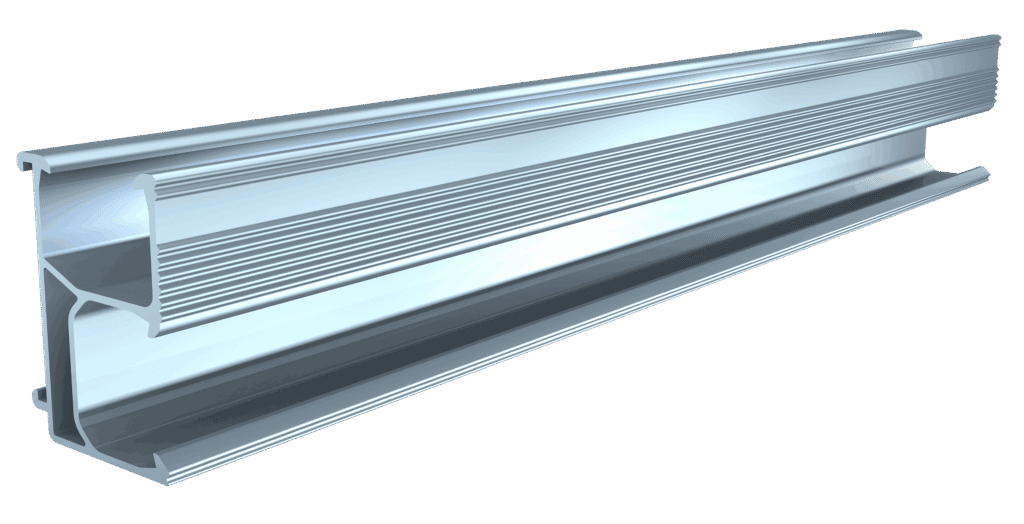
A traditional solar rail system uses continuous long rails running across the entire module array. These rails are typically aluminum profiles (2–4 meters per piece) connected into a continuous structure.
Typical Components
| Component | Function |
|---|---|
| Rails | Continuous support for modules |
| Rail Splice | Connects rail sections |
| L Feet / Roof Hooks | Fix rails to roof structure |
| Mid & End Clamps | Secure modules to rails |
Key Characteristics
- High structural continuity: Forms a continuous beam system
- Clear load path: Module → rail → base → roof structure
- Mature technology: Decades of engineering validation
- Wide applicability: Suitable for all roof types
What Is a Mini Rail System?
Definition
A Mini Rail system uses short, segmented rails (typically 300–600 mm) to support modules. Each module is supported by multiple short rails instead of continuous long rails.
Typical Components
| Component | Function |
|---|---|
| Mini Rails | Short segmented support (300–600 mm) |
| Integrated Base | Combined rail + mounting base |
| Mid & End Clamps | Fix modules to rails |
Key Characteristics
- Simplified structure: No continuous rails required
- Flexible installation: Easily avoids roof obstacles
- Lightweight design: 30–50% less aluminum usage
- Primary application: Metal roofs (especially trapezoidal roofs)

Core Differences: Mini Rail vs Traditional Rails
1. Structural Configuration
| Aspect | Traditional Rails | Mini Rail |
|---|---|---|
| Rail continuity | Continuous | Segmented |
| Components | More (rails + splices + bases) | Fewer (integrated design) |
| Structural logic | Continuous beam | Point support |
| Roof flatness requirement | Higher | Lower (independent leveling) |
2. Load Distribution
| Aspect | Traditional Rails | Mini Rail |
|---|---|---|
| Load distribution | Evenly distributed | Concentrated at fixing points |
| Redundancy | High | Lower |
| Stress concentration | Low | Higher |
Cost Comparison
1. Material Cost
| Cost Item | Traditional Rails | Mini Rail | Difference |
|---|---|---|---|
| Aluminum usage | Baseline | 30–50% less | No continuous rails |
| Splice connectors | Required | Not required | Reduced components |
| Base components | Required | Integrated | Cost shifted |
| Packaging | Higher | Lower | Short profiles advantage |
Conclusion:
Mini Rail reduces material cost by approximately 20–35%.
2. Installation Cost
| Cost Item | Traditional Rails | Mini Rail | Difference |
|---|---|---|---|
| Installation time | Baseline | 30–50% less | Fewer steps |
| Tools | Cutting equipment needed | Basic tools | Simpler |
| Skill requirement | Medium | Lower | Easier installation |
Conclusion:
Mini Rail reduces installation cost by approximately 30–50%.
3. Logistics Cost
| Cost Item | Traditional Rails | Mini Rail | Difference |
|---|---|---|---|
| Packaging volume | Large | Compact | Short rails |
| Transport efficiency | Lower | Higher | More units per container |
| Handling | Multi-person | Single-person | Lightweight |
Conclusion:
Mini Rail reduces logistics cost by approximately 20–30%.
4. Overall Cost Summary
| Cost Category | Traditional Rails | Mini Rail |
|---|---|---|
| Material | Baseline | ↓ 20–35% |
| Installation | Baseline | ↓ 30–50% |
| Logistics | Baseline | ↓ 20–30% |
| Total Project Cost | Baseline | ↓ 25–40% |
Installation Efficiency Comparison
Advantages of Mini Rail
| Advantage | Description |
|---|---|
| No long-distance alignment | Independent installation |
| No cutting required | Standard short rails |
| No splicing | Fewer connections |
| One-person installation | Lightweight |
| Flexible layout | Easily avoids obstacles |
Typical result:
Installation time reduced by 30–50%.
Characteristics of Traditional Rails
| Feature | Description |
|---|---|
| Precise alignment required | Entire row must be level |
| Cutting required | On-site adjustment |
| Splicing required | Multiple rail connections |
| Multi-person handling | Long rails |
Structural Performance Comparison
1. Strength and Stability
| Aspect | Traditional Rails | Mini Rail |
|---|---|---|
| Overall stiffness | Higher | Lower |
| Bending resistance | Excellent | Depends on rail |
| Torsional resistance | Good | Lower |
| Redundancy | High | Lower |
Conclusion:
Traditional rails offer better performance in high-load and large-span scenarios.
2. Wind Load Performance
| Aspect | Traditional Rails | Mini Rail |
|---|---|---|
| Uplift resistance | Excellent | Good |
| High wind suitability | ✅ Yes | ⚠️ Reinforcement needed |
| Vibration | Lower | Higher |
Design recommendation:
- Normal wind → Both suitable
- High wind → Increase fixing points for Mini Rail
- Typhoon zones → Prefer traditional rails
3. Snow Load Performance
| Aspect | Traditional Rails | Mini Rail |
|---|---|---|
| Load capacity | Excellent | Good |
| Heavy snow areas | ✅ Suitable | ⚠️ Reinforced design |
4. Long-Term Reliability
| Aspect | Traditional Rails | Mini Rail |
|---|---|---|
| Design maturity | Very high | High |
| Engineering validation | Decades | Recent |
| Failure predictability | High | Requires precision |
Application Scenarios
When to Choose Mini Rail
- Trapezoidal metal roofs
- Small to medium projects (<500 kW)
- Cost-sensitive projects
- Fast installation requirements
- Roofs with obstacles
When to Choose Traditional Rails
- Large-scale projects (>1 MW)
- High wind or snow regions
- High structural reliability requirements
- Regular, unobstructed roofs
Design Considerations
Fixing Point Layout
| System | Recommendation |
|---|---|
| Traditional | 2–3 fixing points per side |
| Mini Rail | 3–4 fixing points per side |
Roof Structure
All fixing points must align with purlins.
Waterproofing
| System | Solution |
|---|---|
| Penetrating systems | EPDM + sealant |
| Standing seam | Non-penetrating clamps |
Load Calculation
- Always calculate wind and snow loads
- Increase fixing density in extreme conditions
- Pay attention to vibration in Mini Rail systems
Common Misconceptions
Here’s a more concise version while keeping it professional:
Misconception 1: Mini Rail Can Replace Traditional Rails
Fact: Mini Rail has advantages in some cases, but traditional rails perform better in large projects and high wind/snow areas. They are complementary, not replacements.
Misconception 2: Ignoring Roof Structure
Fact:Mini Rail requires accurate purlin positioning. Poor layout can prevent proper installation. A roof survey is essential.
Misconception 3: Focusing Only on Low Cost
Fact: Cost savings depend on proper design. In harsh conditions, insufficient fixing points can cause structural risks.
Misconception 4: Mini Rail Is Always Faster
Fact: Mini Rail is faster for small or complex roofs, but on large, regular roofs, the efficiency gap is smaller.
Industry Trends
- Shift toward lightweight and fast-install systems
- Growth of pre-assembled Mini Rail solutions
- Development of rail-free systems
- Increasing focus on installation efficiency
Choosing the Right Rail System
Mini Rail and traditional rails are complementary solutions, not competitors.
Quick Selection Guide
| Project Condition | Recommended System |
|---|---|
| Trapezoidal roof + small project | Mini Rail |
| Large, regular roof | Traditional Rails |
| High wind/snow | Traditional Rails |
| Tight schedule | Mini Rail |
| Complex roof | Mini Rail |
| High reliability | Traditional Rails |
SOEASY Rail System Solutions
SOEASY provides complete rooftop mounting solutions:
- Mini Rail System:
Designed specifically for trapezoidal metal roofs, featuring a lightweight structure, fast installation, and optimized cost, with support for rail-free solutions. - Traditional Rail System:
A mature and reliable continuous rail solution, suitable for all roof types and capable of meeting high-standard project requirements. - Material Selection:
Made from AL6005-T6 aluminum alloy with anodized surface treatment, offering excellent corrosion resistance. - Complete Accessories:
Full range of components including L feet, roof hooks, mid & end clamps, and waterproof sealing washers. - Technical Support:
Comprehensive services covering load calculation, system design, and installation guidance.
FAQ
Is Mini Rail better than traditional rails?
It depends on the project. Mini Rail is better for small, cost-sensitive projects, while traditional rails are better for high-load scenarios.
Can Mini Rail be used in high wind areas?
Yes, but additional fixing points and reinforcement are required.
Which system is more cost-effective?
Mini Rail generally reduces total project cost by 25–40%.