English

 Post by
 With rapid urbanization and increasing land scarcity, efficiently using available space for solar power generation while maintaining functional utility has become a top concern for commercial property owners and public facility managers.
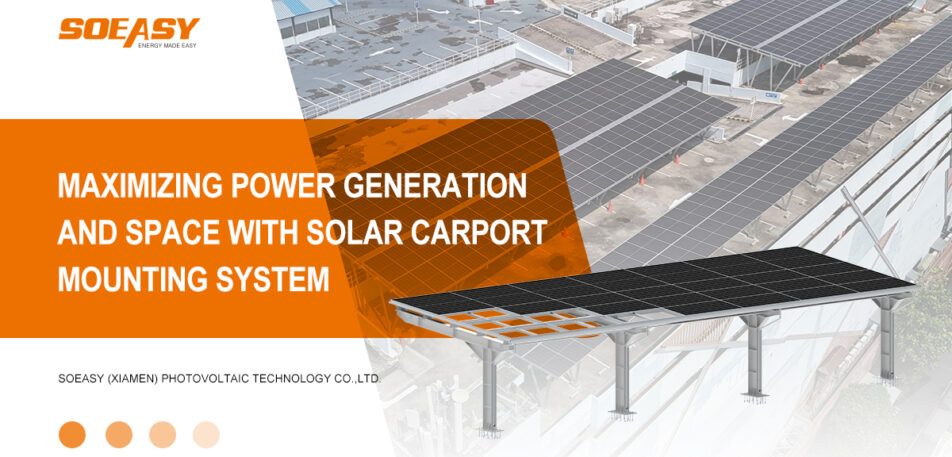
Solar carport mounting systems address this demand by combining photovoltaic (PV) generation with covered parking. They provide clean energy while protecting vehicles from sun and rain, achieving “dual-use” of space.
From commercial complexes and industrial parks to schools, hospitals, and airports, solar carports are becoming integral to modern building infrastructure. The core challenge in project design is maximizing power generation while maintaining practical space utilization.
This article explores the design strategies, material selection, space optimization, and construction challenges for solar carport mounting systems, illustrated with real-world examples showing how to achieve both energy production and space efficiency.
Core Advantages of Solar Carport Mounts
Dual Value: Parking / Shade + Solar Power
The primary value of a solar carport lies in its multifunctionality. Traditional parking canopies provide only shade and rain protection, representing a pure cost. In contrast, solar carports generate electricity in the same footprint, turning a cost center into a revenue source.
Vehicles parked beneath are protected from weathering, extending paint and interior life. Meanwhile, solar modules above continuously generate clean electricity for building use, EV charging, or grid feed-in revenue.
Land Cost Savings
In urban or land-scarce regions, dedicating land for a ground-mounted PV station is increasingly costly. Solar carports cleverly use already occupied space: parking areas are already consuming land, so installing PV systems above does not incur extra land cost. This “vertical utilization” makes solar carports among the most economical PV deployment methods in dense urban environments.
Flexible Application Scenarios
Solar carports are suitable for various contexts:
- Commercial complexes: parking lot PV can reduce operational costs
- Industrial parks: employee parking can supply clean electricity to production facilities
- Schools, hospitals, public institutions: serve both energy and demonstration/educational purposes
- Airports, train stations, bus depots: long-term parking with clean EV charging energy
Integration with Storage and Smart Energy Management
Solar carports naturally pair with energy storage systems. During daytime generation peaks, excess power can be stored in batteries; at night or on cloudy days, stored energy can charge EVs or supply buildings. Smart energy management enables coordinated optimization of PV generation, storage, and EV charging, improving green energy self-consumption.
Key Factors for Efficient Power Generation
1. Optimal Tilt and Orientation
Tilt angle and orientation directly impact energy yield. The ideal tilt typically matches the site latitude. For example, the Philippines (10–20° N) has optimal tilt around 10–20°.
- South-facing carports: fixed tilt generally sufficient
- East-West-facing carports: small tilt to balance morning/evening sunlight
In tropical regions, high solar altitude year-round means excessive tilt can reduce radiation per unit area. Therefore, tropical PV carports often adopt 5–15° small tilt, balancing energy yield and self-cleaning via rain.
2. Module Layout Optimization
Module rows must balance power output and maintenance access. Overly tight row spacing causes shading; overly wide spacing wastes space and reduces installed capacity. Standard layouts ensure no shading from 9 AM to 3 PM on winter solstice.
Maintenance aisles (≥600 mm) allow cleaning, inspection, and replacement. Modules should also be set back from canopy edges to prevent wind-induced stress at margins.
3. Durable Material Selection
Material choice is critical for long-term reliability, especially in coastal, high-humidity, or typhoon-prone areas.
Aluminum vs Steel Structures:
| Material | Advantages | Disadvantages | Recommended Use |
|---|---|---|---|
| Aluminum Alloy | Lightweight, corrosion-resistant, easy to install | Lower strength/stiffness, higher cost for large spans | Coastal/visual-sensitive projects |
| Steel (Hot-Dip Galvanized / ZAM) | High strength, suitable for long spans, lower material cost | Heavier, higher foundation requirements, needs reliable corrosion protection | Inland/large-span projects, high-clearance bus depots |
Recommendation: Aluminum or ZAM steel in coastal environments; hot-dip galvanized steel in inland, low-corrosion areas. Steel better for large-span, high-clearance projects; aluminum better for weight-sensitive or aesthetic projects.
4. Expandability and Modular Design
Commercial projects often require phased installation. Ideal designs allow staged capacity expansion, standardizing components for rapid installation while reducing complexity. Modular designs also support multiple module brands and sizes, avoiding delays due to component supply variations.
Space Utilization Strategies
Parking Compatibility Design
Clear height is critical:
- Regular cars: ≥2.2–2.5 m
- SUVs / light trucks: ≥2.8–3.0 m
- Buses / large trucks: ≥4.5–5.0 m
Columns should avoid key parking areas. Edge columns should include protective barriers and signage.
Multi-Level / Elevated Carports
Land-scarce areas can employ multi-level carports:
- Double-layer carports double installed capacity
- Elevated carports (6–8 m) allow vehicle passage, container storage, or landscaping below
Higher structures require advanced structural engineering, possibly deeper foundations and denser supports.
Flexible Layout
Not all parking areas are rectangular. Systems should adapt to irregular geometries (curved rows, L-shaped, triangular plots). Modular components allow on-site adjustment to maximize usable space.
Maintenance Aisles Optimization
Maintenance access impacts long-term yield. Recommended aisle width ≥600 mm, covering key devices like inverters and combiner boxes. Large carports should include ladders and platforms for safe cleaning and inspection.
Design and Construction Challenges
Structural Stability in Typhoon / High Wind Areas
Coastal typhoon-prone regions experience high wind pressures. Carports have large wind-exposed areas, especially elevated structures. Design must account for 50-year return period wind speed, shape factor, height factor, and gust factor. Edge wind load can be 2–3x interior loads, requiring reinforced columns and diagonal bracing.
Roof or Parking Structure Load Limitations
Existing lots may have limited load capacity. Solutions include:
- Increasing foundation area to distribute load
- Reducing column spacing
- Reinforcing local structure
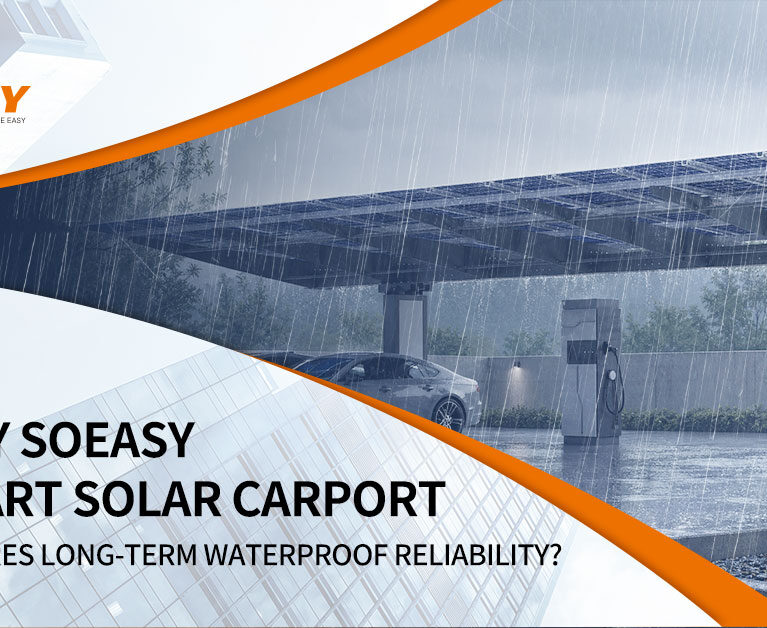
Electrical Safety and Waterproofing
Outdoor PV systems must ensure:
- Inverters / combiner boxes in waterproof enclosures
- UV- and abrasion-resistant PV cables in conduit
- Reliable grounding and lightning protection
EV charging points require load capacity, metering, and safety protection (RCD, overload, surge).
Material Cost and Long-Term Maintenance
Initial cost is higher than ground-mounted systems. However, when considering the parking structure itself, incremental cost is reasonable. Coastal areas require corrosion inspection; aluminum requires minimal maintenance. Module cleaning depends on rainfall.
Summary
Solar carports provide dual value: energy generation + functional parking. They are highly economical in land-scarce urban areas.
Key factors for efficient generation:
- Optimal tilt and orientation
- Layout balancing power and maintenance access
- Durable, corrosion-resistant materials (aluminum, ZAM steel, hot-dip galvanized steel)
- Modular, expandable design
Space utilization strategies:
- Safe and convenient parking
- Multi-level or elevated designs
- Flexible layout for irregular plots
- Maintenance aisle access
Challenges to address professionally:
- Wind-resistant design in typhoon regions
- Structural assessment of existing parking lots
- Waterproofing and grounding of electrical systems
- Lifecycle cost optimization
SOEASY Solar Carport Solutions
SOEASY provides full-process carport mounting solutions:
- Dual-material products: Aluminum (lightweight, corrosion-resistant) and Steel (high strength, long span)
- Modular design: Standard prefabricated components, rapid on-site assembly
- Wind & corrosion protection: Typhoon-ready designs with SS316 fasteners and ZAM coating
- Customization: Non-standard designs for irregular plots, column layouts, and clear heights
- Integrated systems: Compatible with energy storage, EV chargers, and smart energy management
For more information or project consultation, contact SOEASY Solar.
Appendix: Maintenance Guidelines & FAQ
Coastal / Tropical Maintenance Recommendations
- Inspection (every 6 months): Check bolts, grounding points, coating integrity, rubber pads.
- Cleaning: Rinse with water every 2–3 months; use rain in wet seasons. Avoid high-pressure washing at edges.
- Anti-corrosion touch-up: Reapply zinc-rich primer on damaged galvanized/ZAM steel; aluminum usually requires no touch-up.
FAQ
Q1: Are SOEASY carports compatible with all PV modules?
A: Yes. Universal clamps fit mainstream framed modules (156–210 mm) and bifacial modules. Frameless modules need special clamps.
Q2: What wind speeds can the carport withstand?
A: Custom-designed per site. Standard: typhoon level 12 (0.5 kN/m²); coastal projects can reach level 15 (0.85 kN/m²).
Q3: What is the warranty?
A: 10-year product warranty; 25-year design life. Aluminum/ZAM steel meet 25-year durability.
Q4: Can carports be custom-sized or colored?
A: Yes. SOEASY supports size, column spacing, clear height, and powder-coat color customization.