English

 Post by
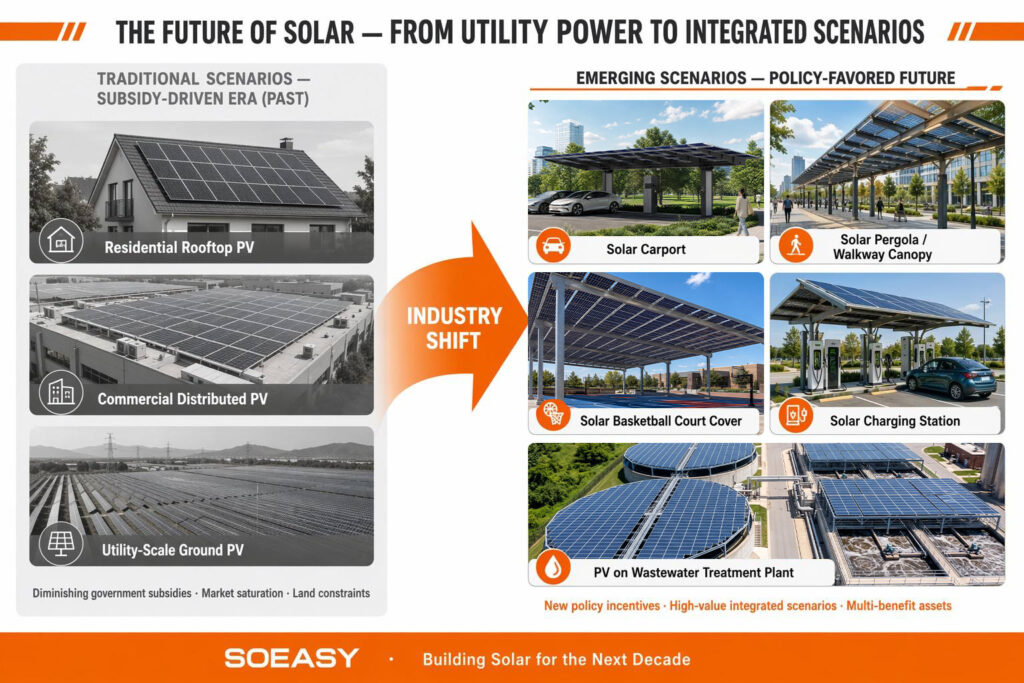
 Against the backdrop of global energy transition and carbon neutrality goals, when people think of solar energy, the first applications that usually come to mind are still the three traditional segments:
- Residential solar (low-voltage grid-connected systems for households)
- Commercial and industrial (C&I) distributed solar (using factory and commercial building rooftops for self-consumption with surplus electricity fed back to the grid)
- Utility-scale solar power plants (large-scale energy bases ranging from hundreds of megawatts to gigawatts)
However, as land resources become increasingly limited and rooftop installation conditions face more restrictions, solar applications are expanding beyond traditional rooftops and large ground-mounted power plants toward more innovative scenarios.
From solar walkways and solar basketball courts to solar-powered wastewater treatment plants and solar EV charging stations, various “Solar +” integrated applications are emerging worldwide.
Among these emerging applications, solar carports—a new type of energy infrastructure integrating parking spaces, solar power generation, energy storage, and EV charging—are becoming one of the most promising growth areas in the global renewable energy market.
Driven by both policy support and market demand, solar carports are entering an unprecedented development phase.
Emerging Solar Application Scenarios
Although residential solar, C&I distributed solar, and utility-scale solar remain the major application models in the global solar market, the industry is now exploring more innovative “Solar Beyond Rooftop” applications due to decreasing high-quality rooftop availability, rising land development costs, and increasing demand from commercial users for integrated energy solutions.
To better understand the market positioning of solar carports, it is necessary to distinguish them from traditional solar project categories:
| Project Type | Typical Scale | Core Characteristics |
|---|---|---|
| Residential Solar | 3–10 kW | Low-voltage grid connection (220V), residential rooftop installation |
| C&I Distributed Solar | 100 kW–5 MW | Installed on commercial/industrial rooftops, self-consumption with surplus electricity sold to the grid |
| Utility-Scale Solar Power Plants | 100 MW–10 GW | Large-scale ground-mounted installation with high-voltage grid connection |
Solar carports do not completely belong to any of the above categories.
They are photovoltaic structures installed above parking spaces, combining solar power generation, vehicle shading and protection, rain protection, and increasingly, EV charging integration.
This multi-functional approach makes solar carports naturally suitable for commercial properties, industrial parks, public facilities, transportation hubs, and other high-value application scenarios.
Other emerging solar applications alongside solar carports include:
- Solar walkways;
- Solar basketball courts;
- Solar canopies for EV charging stations;
- Solar systems for wastewater treatment plants.
Among these emerging applications, solar carports currently represent one of the most commercially mature and policy-driven market segments.
① Solar Carport: A New Model Connecting Parking Spaces with Renewable Energy Infrastructure
Solar carports are becoming one of the most promising solar applications in urban and commercial environments. By utilizing existing parking areas for solar installation, solar carports provide vehicle shading and protection while enabling solar power generation, energy storage, and EV charging capabilities. Unlike traditional rooftop solar systems, solar carports do not depend on building roof resources. Instead, they utilize available spaces in commercial parking lots, industrial parks, corporate headquarters, and public facilities, transforming parking areas into sustainable energy assets.
With the rapid adoption of electric vehicles, the integration of solar carports with EV charging facilities creates a Solar + Storage + EV Charging ecosystem, becoming an important component of future smart energy infrastructure.
② Solar Walkway / Solar Corridor: Creating Public Spaces with Both Functional and Energy Value
Solar walkways represent an innovative application that combines solar power generation with public infrastructure. They are commonly applied in commercial parks, campuses, tourist attractions, pedestrian pathways, and urban public areas. By installing solar modules on shelters, corridors, or pedestrian pathways, solar walkways provide shade and weather protection while continuously generating clean electricity.
This application is particularly suitable for cities where land resources are limited but public spaces are abundant, providing governments, businesses, and public institutions with a solution that combines energy transition with urban landscape improvement.
③ Solar Basketball Court: Transforming Sports Facilities into Green Energy Assets
With the development of green cities and low-carbon infrastructure, sports facilities and public recreational spaces are becoming new opportunities for solar deployment. Solar basketball courts integrate solar structures into basketball courts, sports facilities, and recreational areas, combining sports activities with renewable energy generation.
Beyond producing clean electricity, these projects help schools, communities, and commercial operators reduce energy costs while creating visible green infrastructure that enhances social value and strengthens brand image.
④ Solar EV Charging Station: A Key Energy Solution Driving the EV Ecosystem
The rapid growth of the electric vehicle market is increasing global demand for charging infrastructure. However, traditional grid-powered charging systems may face energy pressure during peak periods, while solar EV charging stations provide a more sustainable alternative.
By integrating solar modules, energy storage systems, and EV chargers, solar charging stations can directly utilize clean energy to power electric vehicles, reduce charging operation costs, and improve overall energy efficiency.
In the future, as EV adoption continues to grow, solar charging stations will play an increasingly important role in highway service areas, commercial parking facilities, logistics parks, and urban charging networks.
⑤ Solar for Wastewater Treatment Plants: Unlocking Green Energy Potential from Industrial Infrastructure
Wastewater treatment plants typically have large available spaces and operate as energy-intensive facilities requiring continuous electricity consumption, making them ideal locations for solar deployment. By installing solar systems on rooftops, unused land, or facility areas within wastewater treatment plants, operators can effectively reduce electricity costs and improve energy self-sufficiency.
Furthermore, combining solar energy with environmental infrastructure aligns with global sustainability trends, helping wastewater treatment companies reduce carbon emissions and achieve more sustainable operations.
Global Policies Are Driving Solar Carports into a Rapid Growth Phase
Solar carports are no longer simply a supplementary source of green electricity. They are becoming legally required infrastructure promoted by governments worldwide. More countries are introducing regulations and incentive policies to accelerate solar deployment in parking facilities.
1. South Korea: Mandatory Renewable Energy Installation for Large Public Parking Areas
South Korea’s Ministry of Climate, Energy and Environment has officially introduced new renewable energy deployment requirements. According to the policy, public parking facilities with an area exceeding 1,000 m² must install at least 100 kW of renewable energy generation systems, primarily solar carport systems.
The implementation of this policy marks a significant transition toward legally mandated solar adoption in public parking spaces.
2. France: Large Outdoor Parking Lots Required to Install Solar Systems, Creating GW-Level Market Demand
The French Senate approved a landmark renewable energy legislation requiring outdoor parking facilities with more than 80 parking spaces to install solar power systems.
According to official estimates, this regulation could create 6.7 GW to 11 GW of additional solar capacity in France.
In the future, parking facilities without solar carports may face compliance challenges under the new regulatory framework.
Global Solar Policies Continue to Send Strong Investment Signals
Beyond dedicated solar carport mandates, major solar markets worldwide are promoting renewable energy through subsidies, tax incentives, and mandatory installation policies.
Meanwhile, 2026 represents a critical timing window for securing attractive financial benefits.
30% ITC Tax Credit in the United States (Key 2026 Deadline)
Under the U.S. Investment Tax Credit (ITC) policy, commercial solar projects can receive tax credits of up to 30%.
Projects that begin construction before July 4, 2026, may secure this highly attractive incentive level, significantly reducing initial investment costs.
Japan: Up to JPY 80,000/kW Solar Subsidies
Japan provides substantial financial support for certain distributed solar and solar carport projects, with subsidies reaching up to JPY 80,000/kW.
Meanwhile, Japan’s ground-mounted solar FIT/FIP (Feed-in Tariff / Feed-in Premium) support mechanism is expected to end in April 2027.
As a result, utilizing unused spaces such as parking areas for solar carport deployment has become an attractive alternative for investors seeking stable returns while reducing dependence on changing ground-mounted solar policies.
Europe: Mandatory Solar Installation for Public and Commercial Buildings Starting in 2026
Europe is strengthening solar installation requirements for buildings.
From 2026, newly constructed public and commercial buildings will be required to install solar systems.
Combined with solar carport construction, these projects can not only meet building energy requirements but also provide solutions for parking and EV charging needs.
Why Choose SOEASY Smart Solar Carport Solutions?
Facing rapidly growing global demand for solar carports and increasingly urgent construction timelines, EPC contractors and project owners need structural solutions that comply with international standards while enabling rapid project delivery.
SOEASY Smart Solar Carport helps global customers capture policy-driven market opportunities through the following advantages:
Modular Pre-Assembly for Rapid Delivery
With highly pre-assembled factory production, zero on-site welding, zero secondary cutting, and fully bolted connections, SOEASY improves installation efficiency by more than 50%.
This enables project owners to complete construction and grid connection faster before incentive deadlines.
Premium Structural Design and Waterproofing Innovation
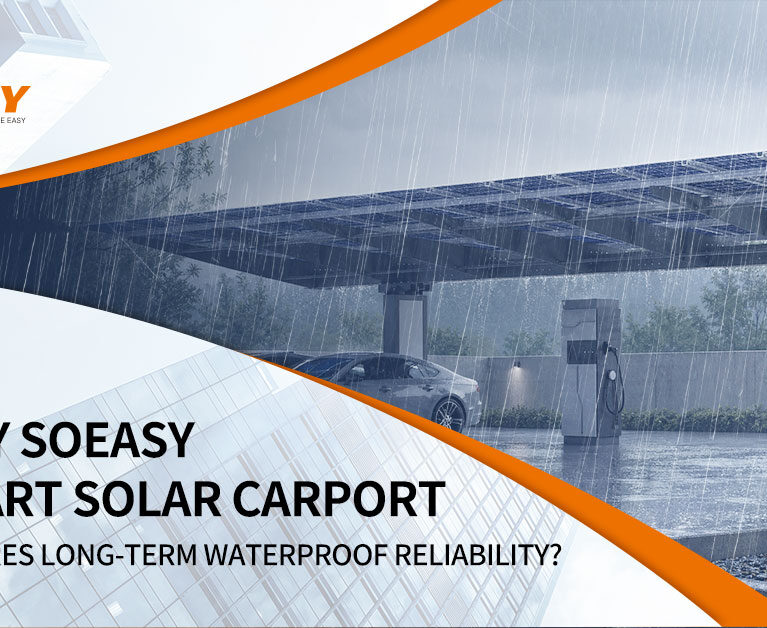
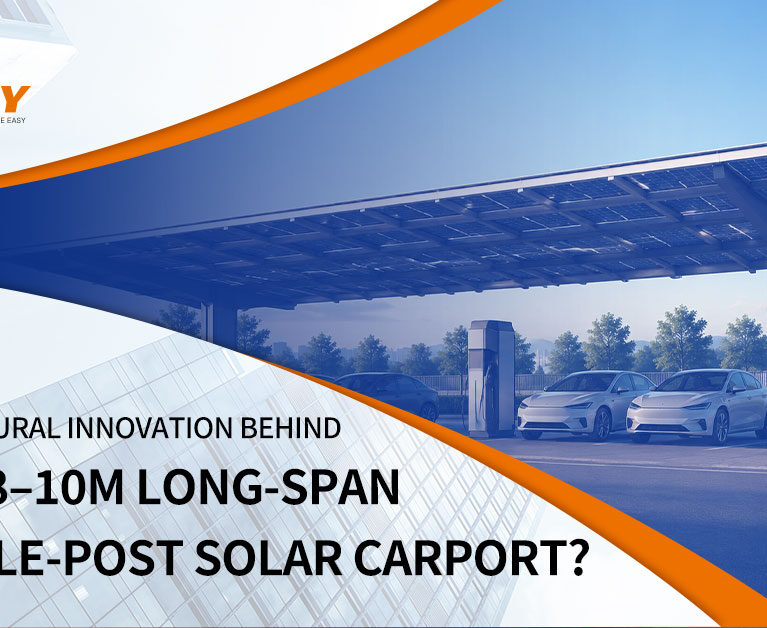
Featuring long-span cantilever structures and BIPV drainage designs, with electrical cables concealed inside columns, SOEASY Smart Solar Carport combines structural safety with premium aesthetics, making it ideal for commercial properties and corporate headquarters.
Integrated Solar + Storage + EV Charging Capability
SOEASY Smart Solar Carport seamlessly integrates with smart EV chargers and energy storage systems, upgrading traditional parking spaces into valuable energy assets capable of peak shaving, energy management, and EV charging revenue generation.
Policy Incentives Are Declining While Compliance Requirements Are Increasing
For commercial property owners, investors, and EPC contractors, 2026 represents the ideal window to benefit from renewable energy incentives, secure tax advantages, and maximize green energy returns.
Contact the SOEASY professional team today and submit your parking facility information.
We will provide free policy evaluation, structural design support, and ROI analysis solutions to help you capture the next growth opportunity in the global solar carport market.