English

 Post by
 As the construction industry transitions toward green, low-carbon development, Building-Integrated Photovoltaics (BIPV) are becoming an essential component of modern architecture. Unlike conventional PV systems, BIPV modules serve dual purposes: generating electricity while functioning as building envelopes, shading devices, or roofing materials. This dual functionality places significantly higher demands on mounting structures. Different BIPV applications require different installation methods, load-bearing considerations, and structural designs. This article explores common BIPV applications and their corresponding mounting structure requirements.
BIPV mounting structures differ from conventional PV mounting systems in several critical ways. Structural support must accommodate the building’s load-bearing capacity while ensuring the modules remain secure. Building integration requires seamless visual and functional harmony with the surrounding architecture. Waterproof performance is essential because BIPV modules often serve as the primary weather barrier. Drainage design must prevent water accumulation that could damage both the modules and the building structure. Thermal expansion requires flexible connections that allow for movement between modules and the building frame. Long-term durability must match or exceed the building’s expected service life, typically 25 to 50 years.
Common BIPV Applications and Mounting Structure Requirements
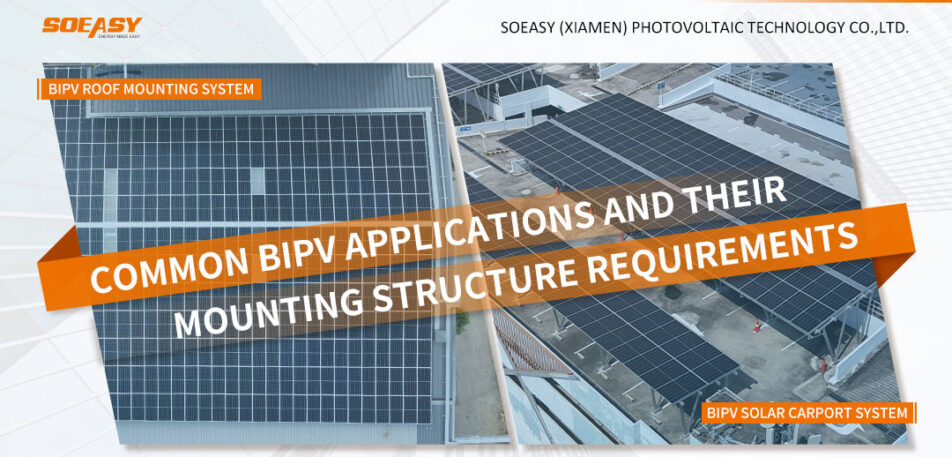
BIPV Roof Mounts
Typical Applications
- Commercial buildings
- Industrial facilities
- Public buildings such as schools, hospitals, and government offices
Mounting Structure Requirements
Roof-integrated BIPV systems replace conventional roofing materials with photovoltaic modules. The mounting structure must support PV modules as the primary roofing material while ensuring reliable waterproof performance between module joints. This requires precision-engineered sealing systems and overlapping module arrangements that prevent water ingress.
The structure must provide sufficient strength to withstand wind loads and snow loads over decades of exposure. In many regions, BIPV roof systems must meet the same wind uplift and snow load requirements as conventional roofs. The mounting design must also accommodate thermal expansion and contraction of both modules and support structures, as temperature variations can cause significant movement. Efficient drainage is essential to prevent water pooling that could penetrate the building envelope. The system must enable maintenance and module replacement without compromising the building’s weather protection.
BIPV Solar Carport Systems
Typical Applications
- Commercial parking lots
- Industrial parks
- Office buildings
- Shopping centers
- Public parking areas
Mounting Structure Requirements
BIPV solar carports demand high structural strength for large spans. Unlike roof systems, carports must support modules while providing clear space for vehicles below. The mounting structure must resist wind and snow loads while maintaining the required vehicle clearance, typically 2.5 to 5 meters depending on local regulations and vehicle types.
Traffic safety is a critical consideration. Columns must be positioned to avoid vehicle collision risks. Integrated drainage design prevents water dripping onto vehicles or creating slip hazards. Durable steel or aluminum structures with corrosion protection are essential for outdoor exposure, particularly in coastal or industrial environments.
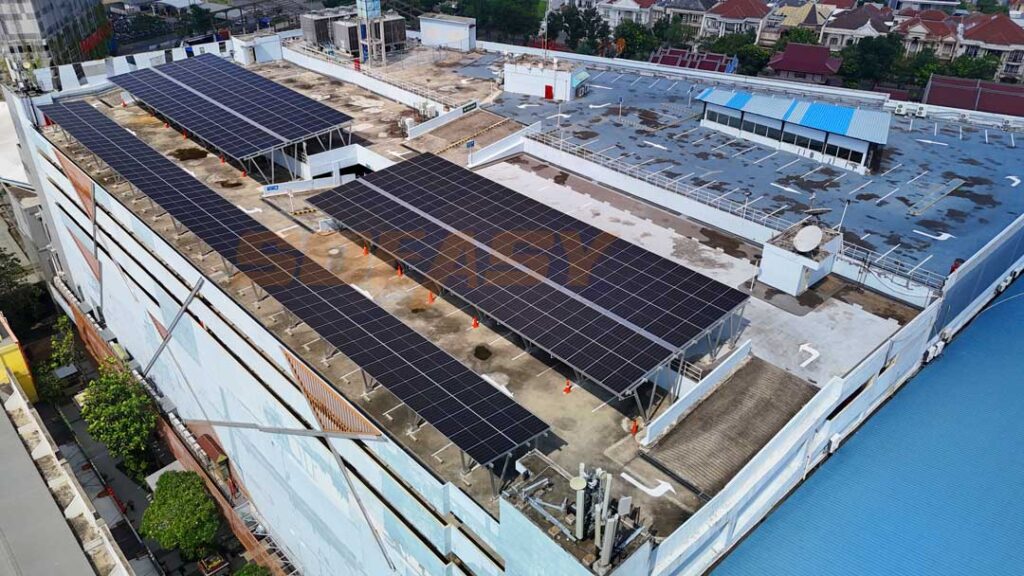
259kW CUSTOM BIPV SOLAR CARPORT PROJECT
Completed in March 2026, this 259 kW BIPV solar carport project was installed on the rooftop of a commercial complex in Indonesia. SoEasy Solar provided the customized mounting structure design and technical support, delivering a high-quality aluminum BIPV solar carport system that integrates clean energy generation with a functional, weather-protected parking space. To overcome the challenges of an uneven concrete rooftop, the mounting structure was engineered specifically for the site, ensuring reliable installation, effective waterproof integration, and long-term structural stability while maximizing the value of the available rooftop space.
Why Customized Mounting Structures Matter for BIPV Projects
Every BIPV project presents unique challenges. Roof geometry varies between flat, pitched, curved, and irregular shapes. Building height affects wind loads significantly. Local climate determines wind and snow design values. Structural layout influences load paths and connection points. Architectural requirements may dictate specific aesthetics, colors, or profile shapes.
Standardized products often cannot satisfy these diverse requirements. Customized mounting design delivers multiple benefits. It improves structural safety by addressing site-specific loads. It optimizes material utilization, reducing waste and cost. It shortens installation time through pre-designed, project-specific solutions. Most importantly, it lowers overall project cost by eliminating field modifications and rework.
For inquiries about custom BIPV mounting designs, contact the SoEasy Solar team for expert assistance.
Frequently Asked Questions: BIPV Mounting Structures
What is the difference between BIPV and conventional rooftop PV?
BIPV modules replace conventional roofing materials and serve as the primary weather barrier, while conventional PV is mounted on top of existing roofing.
What waterproofing standards apply to roof-integrated BIPV?
BIPV roof systems must meet the same waterproofing standards as conventional roofing materials for the building type.
Can BIPV be installed on existing buildings?
Yes, but the existing structure must be evaluated for additional load capacity and compatibility with BIPV modules.
What materials are best for BIPV mounting structures?
Zn-Al-Mg coated steel, and aluminum alloys with appropriate corrosion protection are all suitable depending on the environment.
Does SoEasy Solar provide BIPV mounting solutions?
Yes. We offer customized BIPV mounting structures, roof mounting solutions, solar carport structures, and structural design optimization services.
How SoEasy Solar Supports BIPV Projects
SoEasy Solar provides comprehensive BIPV mounting solutions tailored to each project’s unique requirements. Our offerings include customized BIPV mounting structures, roof mounting solutions for various roof types, solar carport structures for commercial and public applications, and structural design optimization services that balance safety, cost, and installation efficiency.
Our mounting solutions are compatible with major inverter brands and leading module manufacturers, ensuring seamless integration across the PV system. With over 10 GW of solar mounting capacity delivered across 100+ countries, SoEasy Solar brings proven expertise to every BIPV project.
The growth of BIPV depends not only on high-efficiency photovoltaic modules but also on reliable mounting structures. Different applications—from metal roofs and flat roofs to solar carports and shading structures—each demand careful consideration of structural safety, waterproofing, durability, and installation efficiency.
As a professional solar mounting structure manufacturer, SoEasy Solar is committed to providing high-quality, customized BIPV mounting solutions. Our products deliver stable, reliable structural support for building-integrated photovoltaic projects worldwide. Whether you need roof-integrated systems, solar carports, or custom architectural solutions, we help you achieve safe, efficient, and aesthetically integrated BIPV installations.