English

 Post by
 The Critical Role of L-Foot Supports in Rooftop PV Systems
When designing a rooftop photovoltaic system, much attention is given to solar modules, inverters, and overall energy yield. However, one of the most overlooked yet structurally critical components is the L-Foot support.
The L-Foot is the essential interface between the roof structure and the PV mounting rails. It directly carries the weight of the modules and rails while transmitting dynamic loads—such as wind uplift, snow pressure, and thermal expansion forces—into the roof substrate. In other words, the L-Foot is where the entire solar array meets the building.
Choosing the wrong L-Foot—whether in terms of material, strength, or compatibility—can lead to loose modules, damaged roofing membranes, corrosion-induced failures, or even catastrophic system collapse during extreme weather. Conversely, a properly selected L-Foot ensures safety, long-term stability, and minimal maintenance over the system’s 25+ year lifespan.
This article provides a comprehensive guide to evaluating, selecting, and installing L-Foot supports for rooftop PV systems, covering roof types, load requirements, material selection, corrosion resistance, and best practices for installation and maintenance.
Understanding L-Foot Supports
1. Definition and Function
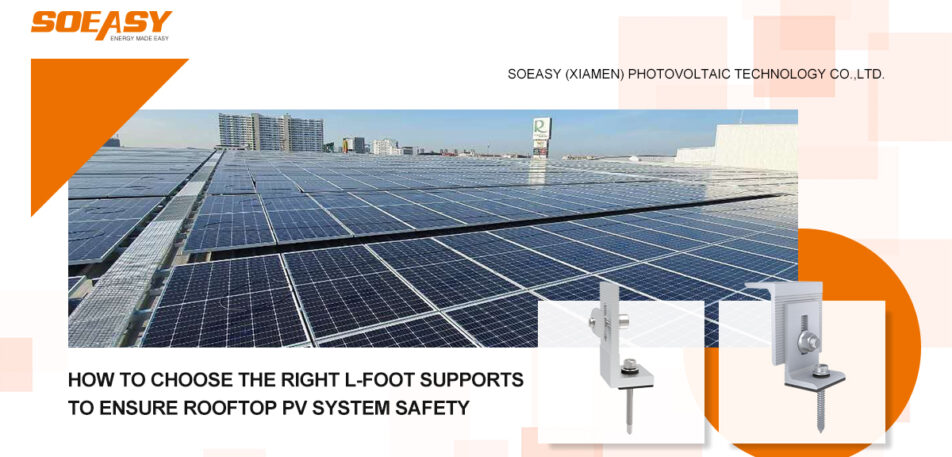
An L-Foot (also known as an L-bracket, L-foot mount, or roof attachment bracket) is a right‑angled metal component used to secure PV mounting rails to a rooftop. Its name comes from its characteristic “L” shape, with one leg attached to the roof surface (via fasteners, adhesives, or clamps) and the other leg supporting the rail.
Primary functions of an L-Foot include:
- Fixed rail positioning: Maintaining precise spacing and alignment for the mounting rails that hold solar modules.
- Load distribution: Spreading point loads from the PV array across a larger area of the roof structure, preventing localized overstress and roof damage.
- Structural support: Bearing the combined weight of modules, rails, and accessories, plus live loads such as snow, wind, and maintenance personnel.
- Wind uplift resistance: In many regions, uplift from high winds imposes greater forces than gravity loads. L-Feet must be securely anchored to resist these upward forces.
2. Common Materials
The material of the L-Foot directly determines its strength, corrosion resistance, weight, and cost. The three most common material choices are:
| Material | Key Properties | Advantages | Limitations |
|---|---|---|---|
| Aluminum Alloy (typically 6005-T5 or 6063-T6) | Lightweight, naturally forms protective oxide layer | Corrosion-resistant in most inland environments; easy to extrude into complex shapes; compatible with aluminum rails | Less strength than steel; can suffer galvanic corrosion if in direct contact with dissimilar metals |
| Stainless Steel (304 / 316) | High strength, excellent corrosion resistance | Ideal for coastal, industrial, or high‑humidity roofs; 316 grade resists chlorides exceptionally well | Expensive; heavier than aluminum; requires appropriate fasteners to avoid galling |
| Galvanized Steel | Low cost, high strength | Economical for budget‑sensitive projects; strong in compression and tension | Limited corrosion resistance in harsh environments; coating can be damaged during installation |
Expert recommendation: For most residential and commercial rooftop projects, aluminum L-Feet with proper anodization or powder coating offer the best balance of cost, weight, and durability. For coastal or high‑corrosion environments, upgrade to Zn-Al-Mg coated steel or stainless steel 316.
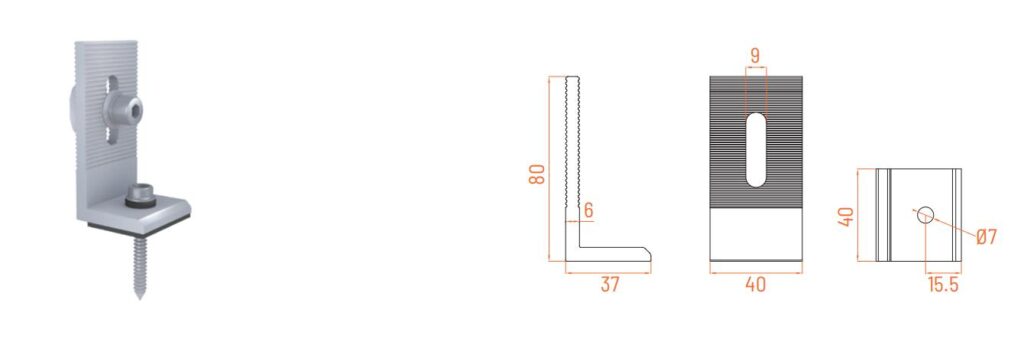
Factors to Consider When Choosing L-Foot Supports
Selecting the right L-Foot is not a one‑size‑fits‑all decision. Below are the five most important factors to evaluate.
1. Roof Type and Structure
Different roof types demand different L‑Foot designs and attachment methods.
- Tile roofs (clay, concrete, or slate):
Standard L‑Feet cannot be screwed directly through tiles without breaking them. Instead, use tile hooks or specially designed L‑Feet that attach to the underlying rafters after removing or cutting a tile. Some systems use adhesive‑bonded L‑Feet to avoid any tile penetration. - Metal roofs (standing seam or corrugated):
For standing seam roofs, clamp‑on L‑Feet attach to the vertical seam without penetrating the panel. For corrugated sheets, L‑Feets may be screwed through the ridges using EPDM‑sealed fasteners or attached with specialized brackets that match the profile. - Flat concrete or built‑up roofs:
L‑Feet are typically secured using concrete anchors, expansion bolts, or adhesive anchors. Ballasted systems may use weighted trays instead of penetration, but L‑Feets still serve as rail attachments. - Wood shingle or composite roofs:
L‑Feets can be lag‑bolted directly into rafters, with proper flashing and sealant to prevent leaks.
2. Load Requirements
Every L‑Foot must be sized and spaced according to the actual loads it will experience. Key loads include:
- Dead load: Weight of modules, rails, and the L‑Feet themselves.
- Live load: Snow accumulation, ice, and maintenance personnel.
- Wind load: Uplift and lateral forces, which often dominate in coastal or open areas.
- Seismic load: In earthquake‑prone regions, L‑Feet must resist horizontal accelerations.
How to determine required L‑Foot strength:
- Consult local building codes (e.g., ASCE 7 in the US, Eurocode 1 in Europe) for design wind speeds and snow loads.
- Calculate the tributary area per L‑Foot (typically 1–2 modules per foot, depending on spacing).
- Multiply by safety factors (usually 1.5–2.0 for rooftop solar attachments).
- Choose an L‑Foot with a certified load rating that exceeds these calculated forces.
Example: In a 150 mph wind zone, a single L‑Foot may need to resist over 500 lbs of uplift force. A flimsy stamped metal bracket will fail; a heavy‑gauge stainless or reinforced aluminum L‑Foot is required.
3. Corrosion Resistance
Roof environments vary dramatically, and corrosion is the #1 cause of long‑term L‑Foot failure.
- Inland / rural: Standard anodized aluminum or galvanized steel is often sufficient.
- Coastal (within 1 km of salt water): Salt spray is highly corrosive. Use stainless steel 316, Zn-Al-Mg coated steel, or aluminum with heavy anodization (20+ μm) plus a powder topcoat.
- Industrial / agricultural: Chemical fumes or fertilizers can accelerate corrosion. Stainless steel or Zn-Al-Mg is recommended.
- High‑humidity / marine: Same as coastal – avoid bare galvanized steel.
Note on galvanic corrosion: Never directly mate aluminum L‑Feet with stainless steel rails or copper flashing without an isolating barrier (e.g., nylon washer or polymer pad). The potential difference can cause rapid aluminum pitting.
4. Installation Considerations
An L‑Foot that is difficult to install increases labor costs and the risk of errors.
- Ease of adjustment: Can the L‑Foot accommodate slight variations in roof flatness? Adjustable L‑Feet with slotted holes or telescoping sections save time on uneven roofs.
- Roof penetration management: Does the design include EPDM washers, sealant channels, or flashing to prevent water intrusion? Every penetration is a potential leak point.
- Tool compatibility: Are standard wrenches, sockets, or hex keys used? Proprietary fasteners can complicate installation and future maintenance.
- Compatibility with rails: The L‑Foot’s rail‑attachment interface (e.g., T‑slot, bolt‑through hole, or clamp) must match your chosen rail system.
5. Compatibility with PV Modules and Rails
Even a strong L‑Foot is useless if it doesn’t align with the rest of the system.
- Module dimensions: Larger, heavier modules (e.g., 210mm cell‑based, >35 kg) require more L‑Feet per rail or higher‑load‑rated brackets.
- Rail profile: Common rail types include “hat” channels, “C” sections, and closed‑slot extruded aluminum. The L‑Foot must provide a compatible interface.
- Array layout: Portrait vs. landscape orientation changes load distribution and rail spacing, which affects L‑Foot quantity and placement.
Types of L-Foot Supports
Based on the above factors, L‑Feet can be categorized into three primary types.
1. Standard L-Foot
- Description: A simple right‑angle bracket with pre‑drilled holes on both legs.
- Best for: Flat roofs, simple pitched roofs with even surfaces, and projects where no height or angle adjustment is needed.
- Advantages: Lowest cost; widely available; quick installation.
- Limitations: No adjustability; requires precise rafter or anchor positioning.
2. Adjustable L-Foot
- Description: Features slotted mounting holes, telescoping sections, or a pivoting joint to allow height (±10–30 mm) or tilt (±5–15°) adjustment.
- Best for: Uneven substrates, older roofs with sagging, or systems requiring precise module alignment (e.g., architectural aesthetics).
- Advantages: Compensates for construction tolerances; reduces shimming and rework.
- Limitations: Higher cost; moving parts may require periodic re‑torquing.
3. Corrosion‑Resistant L-Foot
- Description: Manufactured from stainless steel 316, Zn-Al-Mg coated steel, or aluminum with marine‑grade anodization + powder coating.
- Best for: Coastal rooftops, high‑humidity regions, industrial zones with chemical exposure, and agricultural buildings (e.g., poultry farms with ammonia).
- Advantages: 25+ year service life; minimal maintenance; resists pitting and crevice corrosion.
- Limitations: Premium pricing; may require special fasteners to maintain corrosion protection.
Best Practices for Ensuring Rooftop PV System Safety
Choosing the right L‑Foot is only half the battle. Proper engineering, installation, and maintenance are equally critical.
1. Accurate Load Calculation
- Always perform (or have a structural engineer perform) load calculations based on local codes.
- Use the tributary area method: each L‑Foot supports half the distance to adjacent feet in each direction.
- Apply appropriate safety factors (ASCE 7 recommends 1.5 for roof attachments).
- Document calculations for permitting and inspection.
2. Proper Installation Techniques
- Match fasteners to substrate: Concrete anchors for concrete, lag bolts for wood rafters, toggle bolts for metal decking.
- Seal every penetration: Apply high‑quality polyurethane or silicone sealant under the L-Foot base and over the fastener head.
- Use proper torque: Over‑tightening strips threads or crushes roofing material; under‑tightening leads to loosening under vibration.
- Avoid damaging the roof membrane: For modified bitumen or TPO roofs, use protective pads or distribute load with larger base plates.
- Verify rail level: After installing L‑Feet, check that rail mounting planes are co‑planar; add shims if needed.
3. Periodic Maintenance and Inspection
Rooftop PV systems should be inspected at least annually and after major storms.
Inspection checklist for L‑Feet:
- Visual corrosion: Look for red rust (steel), white oxidation (aluminum), or pitting (stainless steel). Surface discoloration may be cosmetic, but deep pitting requires replacement.
- Tightness: Check a representative sample of bolts using a torque wrench. More than 10% loose indicates systemic issues.
- Sealant condition: Cracking, peeling, or missing sealant should be reapplied immediately.
- Roof waterproofing: Inside the building, inspect ceilings below array areas for water stains or leaks.
- Module movement: If modules can be rocked by hand, L‑Feet may be loose or roof deck has failed.
The Right L-Foot Choice Equals Safer Rooftop PV Systems
The L‑Foot is a small component with an outsized responsibility. A failure at this single point can compromise an entire rooftop array, leading to costly repairs, energy losses, and safety hazards.
By carefully considering roof type, load requirements, corrosion environment, installation practicality, and compatibility with the rest of the system, specifiers and installers can select L‑Feet that will perform reliably for 25 years or more.
At SOEASY Solar, we offer a comprehensive range of L‑Foot supports to meet diverse rooftop needs:
- Standard aluminum L‑Feet for cost‑effective residential and commercial installations.
- Adjustable L‑Feets for uneven substrates and precision alignment.
- Corrosion‑resistant models in stainless steel 316 and Zn-Al-Mg coated steel for coastal and harsh environments.
Every SOEASY L‑Foot is load‑tested, compatible with leading rail systems, and designed for simple, leak‑free installation.