English

 Post by
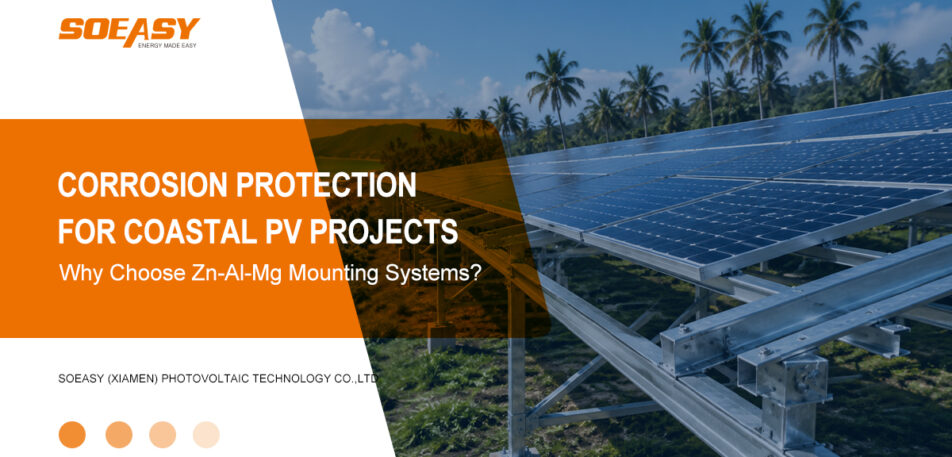
 As the global energy transition accelerates, photovoltaic (PV) installations are increasingly moving from inland areas to coastal regions. Coastal zones offer ample land and higher solar irradiance, making them ideal for both large-scale ground-mounted and distributed PV projects. However, these environments also present a critical challenge: corrosion.
High humidity, salt-laden winds, strong gusts, and significant temperature fluctuations collectively act as hidden threats to PV mounting systems. Many coastal projects begin to show corrosion-related issues within 3–5 years of operation, including rusting of structural surfaces, loosening of fasteners, and peeling of zinc coatings. In severe cases, such damage can compromise module safety and overall plant efficiency. Inadequate corrosion protection significantly increases maintenance costs and may force early replacement of mounting systems, resulting in substantial economic loss.
Therefore, corrosion-resistant design for PV mounting systems is not an accessory—it is one of the key factors determining a project’s lifecycle performance.
This article examines the corrosion mechanisms affecting PV mounting systems in coastal environments and explains why Zn-Al-Mg (zinc-aluminum-magnesium) alloy mounting systems are becoming the preferred choice for coastal PV projects.
1. How Coastal Environments Affect PV Mounting Systems
To understand the need for higher corrosion standards, it is essential to know how coastal conditions attack metal structures.
1.1 Salt Spray Corrosion
Salt-laden air is the most destructive factor. Chloride ions (Cl⁻) carried by sea breezes deposit on mounting surfaces and can penetrate or damage protective oxide films. Ordinary galvanized steel or untreated structural steel experiences accelerated electrochemical corrosion, leading to pitting, stress corrosion cracking, and even perforation. Studies show that within 500 meters of the coastline, salt concentrations can be tens or even hundreds of times higher than inland areas, drastically reducing the lifespan of traditional protective coatings.
1.2 High Humidity
Coastal regions typically have average annual relative humidity above 70%, often exceeding 80%. Prolonged damp conditions form a continuous water film on metal surfaces, providing an ideal electrolyte for corrosion. Temperature fluctuations, day-night cycles, and seasonal changes promote condensation, accelerating oxidation. Bolts, welds, and structural gaps often retain moisture, becoming corrosion hotspots.
1.3 Temperature Variation and Wind Load
Coastal areas also experience large diurnal temperature swings and frequent strong wind events. Repeated thermal expansion and mechanical vibration can generate microcracks in protective coatings, or cause local delamination. Once the protective layer is compromised, corrosion spreads rapidly from the damaged area, gradually reducing structural capacity and threatening the safe operation of PV installations.
2. Introduction to Zn-Al-Mg Alloy Mounting Systems
Traditional corrosion protection methods have proven insufficient in high-salinity environments. Zn-Al-Mg alloy mounting systems were developed specifically to address these challenges.
2.1 Material Composition
Zn-Al-Mg mounts are not ordinary steel; they are coated with a special zinc-aluminum-magnesium alloy layer, typically composed of:
- Zinc (Zn): ~85–95%
- Aluminum (Al): ~3–11%
- Magnesium (Mg): ~1–3%
- Trace other elements
Coating thickness is usually 70–100 μm, with high-corrosion-grade applications exceeding 120 μm. For comparison, conventional hot-dip galvanized coatings are generally 45–85 μm.
2.2 Corrosion Protection Mechanism
The alloy’s corrosion resistance arises from the synergy of its three main elements:
- Zinc (Zn): Acts as a sacrificial anode. Even if the coating is locally damaged, zinc protects exposed steel via cathodic protection.
- Aluminum (Al): Forms a dense Al₂O₃ passive layer, blocking chloride ions and moisture, significantly enhancing overall corrosion resistance.
- Magnesium (Mg): Refines the coating’s microstructure and promotes the formation of stable corrosion products (e.g., ZnCl₂·4Zn(OH)₂). These products fill micro-pores and scratches, achieving a self-healing effect that protects small damaged areas from corrosion spread.
3. Advantages of Zn-Al-Mg Mounts for Coastal Projects
3.1 Superior Corrosion Resistance
In neutral salt spray tests, standard hot-dip galvanized steel begins to show red rust after 300–500 hours. Zn-Al-Mg alloy coatings resist over 1,000 hours, sometimes exceeding 2,000 hours, depending on magnesium content and coating thickness. This ensures that even under severe coastal conditions, the mounts remain rust-free, addressing the typical issues of corrosion at edges and welds.
3.2 Extended Service Life
Designed for a 25+ year PV plant lifecycle, Zn-Al-Mg mounts maintain structural stability and resist chloride ion attack. Actual coastal installations achieve 25 years or more without rust or perforation, sometimes reaching 30 years in moderate environments. This reduces component replacements and minimizes lifecycle maintenance costs.
3.3 Performance in Harsh Conditions
Besides salt corrosion, mounts must withstand typhoons and extreme wind loads. Zn-Al-Mg mounts combine high-strength steel substrates (S350GD, S420GD, S550GD) with dense alloy coatings, ensuring resistance to wind and mechanical stress. The coating adheres strongly, preventing cracking or peeling during punching, bending, or stamping.
3.4 Workability and Installation Convenience
The alloy coating is smooth and lubricated, facilitating cold bending, cutting, and punching with high dimensional accuracy. Low friction improves bolt fastening, and the mounts maintain excellent adaptability during on-site drilling or cutting, reducing construction difficulty and schedule.
4. Comparison with Other Corrosion-Resistant Materials
| Material Type | Corrosion Resistance | Initial Cost | Lifecycle Cost | Suitable Environment |
|---|---|---|---|---|
| Hot-Dip Galvanized Steel | Moderate | Low | Medium (requires maintenance) | Inland, low-salinity areas |
| Stainless Steel 304 | Good | High | Higher | Coastal areas, rural regions |
| Stainless Steel 316 | Excellent | Very High | Very High | High-corrosion coastal, chemical, offshore |
| Zn-Al-Mg Steel | Outstanding | Moderate | Low (long maintenance-free period) | High-salinity, high-humidity coastal environments |
Key Conclusion: While stainless steel offers excellent corrosion resistance, its high cost and difficult processing limit large-scale PV applications. Zn-Al-Mg mounts provide corrosion resistance comparable to or exceeding SS316 at a significantly lower cost, making them the most cost-effective solution for coastal PV projects.
5. Design and Construction Considerations
Even with Zn-Al-Mg mounts, proper design and installation are crucial.
5.1 Mount Foundations and Drainage
- Ensure reliable isolation between mount base and concrete or precast pile foundation to prevent soil moisture and salt contact.
- Design drainage paths for horizontal members and grooves to prevent water accumulation.
5.2 Bolts and Fasteners
- Use fasteners with corrosion protection matching the mounts (e.g., Dacromet-coated, hot-dip galvanized, or SS316).
- Avoid hammering the coating during installation. Any scratches must be repaired with zinc-rich primer or cold galvanizing spray.
5.3 Inspection and Maintenance
- Conduct annual inspections focusing on welds, cut edges, bolts, and contact surfaces.
- Minor scratches can be cleaned and touch-up coated. While the Zn-Al-Mg layer self-heals, deep damage still requires manual repair.
6. Why Zn-Al-Mg Mounts Are Ideal for Coastal PV Projects
- Superior corrosion resistance: Outperforms traditional galvanized steel in high-salinity, high-humidity conditions.
- Extended service life, lower maintenance costs: 25+ years maintenance-free, reducing replacement and repair costs.
- Reliable structural performance: High-strength substrates with dense coatings withstand typhoons, humidity, and temperature variations.
- Proven workability and installation: Compatible with standard PV mounting manufacturing and construction processes, facilitating efficient project deployment.
SoEasy Solar has years of experience in PV mounting systems. Our Zn-Al-Mg alloy mounts combine high-quality coated steel, optimized profile design, and reliable connections, providing full support for coastal PV projects—from material selection to structural design and installation guidance.
If you are planning a coastal PV project and aim for 25+ years of reliable operation while controlling costs, contact the our team for professional corrosion protection solutions and technical support.
SoEasy Solar — Providing a Solid Support for Every Watt of Solar Power.