English

 Post by
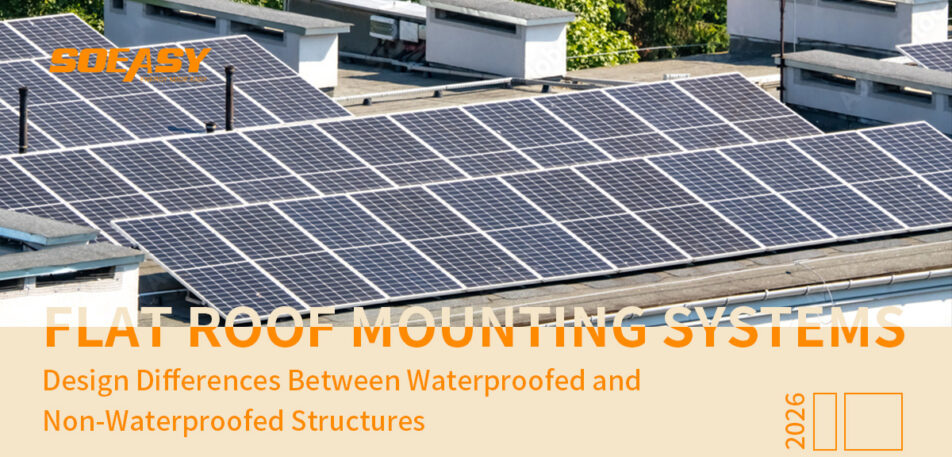
 When designing a flat roof solar mounting system, one critical factor often determines the entire structural approach: Does the roof include a waterproof layer?
Although flat roofs may appear structurally similar, installation strategies differ significantly depending on the roof composition. Therefore, understanding these structural differences is essential for EPCs, developers, and distributors who aim to ensure both safety and long-term performance.
In this article, we will analyze the structural logic, design considerations, and practical advantages of mounting systems for:
- Flat roofs with waterproof layers
- Flat roofs without waterproof layers
Why Roof Structure Matters in Solar Mounting Design
Flat roofs are commonly found in commercial and industrial buildings. However, their internal structure varies widely. Some roofs incorporate a dedicated waterproof membrane, while others rely on reinforced concrete for water resistance.
Because the mounting method directly interacts with the roof surface, the structural composition determines:
- Fixation strategy
- Waterproof integrity control
- Load transfer method
- Long-term maintenance risk
As a result, selecting the wrong installation solution can compromise roof durability and system safety.
Flat Roofs With Waterproof Layers
Structural Characteristics
Roofs with waterproof layers typically consist of:
- Reinforced concrete base
- Insulation layer (in some cases)
- Waterproof membrane (bitumen, TPO, PVC, etc.)
Since the waterproof membrane protects the building from leakage, preserving its integrity becomes the primary engineering concern.
Key Installation Challenge: Protecting the Waterproof Layer
Penetrating the membrane without proper treatment can cause leakage and long-term structural damage. Therefore, mounting systems must either:
- Minimize penetrations, or
- Ensure reliable sealing solutions
For this reason, two mainstream approaches are widely adopted.
Solution 1: Ballasted Mounting System (Non-Penetrating)
A ballasted system uses concrete blocks to secure the structure without roof penetration.
Advantages
- No damage to the waterproof layer
- Reduced leakage risk
- Faster installation process
However, this approach increases roof load. Consequently, structural load verification is mandatory before deployment.
Ballasted systems are particularly suitable for roofs with sufficient load-bearing capacity and strict waterproof protection requirements.
Solution 2: Penetrating Mounting with Sealing Treatment
In some projects, structural conditions or wind loads require mechanical anchoring into the concrete slab.
In such cases:
- Penetration points must bypass insulation layers
- Chemical anchors or expansion bolts are used
- Professional waterproof sealing must be applied
Although this method improves wind resistance, strict construction standards are essential to maintain roof integrity.
Flat Roofs Without Waterproof Layers
Structural Characteristics
Flat roofs without dedicated waterproof membranes typically rely on:
- Reinforced concrete slabs
- Structural slope design for drainage
Because there is no independent membrane layer, the installation logic changes significantly.
Key Installation Focus: Structural Anchorage
Since waterproof membrane protection is not a concern, installers can directly anchor into the concrete slab.
This allows:
- Stronger mechanical fixation
- Higher wind resistance performance
- Lower ballast dependency
As a result, these roofs are often more suitable for mechanically fixed systems.
Recommended Mounting Approach
For non-membrane flat roofs, penetrating mounting systems are generally preferred.
Key benefits include:
- Direct structural load transfer
- Optimized material usage
- Reduced system weight
- Improved long-term stability
Nevertheless, structural calculations remain essential to verify load distribution and anchoring capacity.
Engineering Comparison: With vs. Without Waterproof Layer
| Aspect | With Waterproof Layer | Without Waterproof Layer |
|---|---|---|
| Waterproof Risk | High if penetrated | Lower structural concern |
| Recommended Solution | Ballasted or sealed penetration | Direct mechanical anchoring |
| Load Consideration | Higher ballast weight | Lower overall system weight |
| Installation Complexity | Moderate to high | Relatively straightforward |
| Maintenance Risk | Membrane monitoring required | Structural inspection focus |
Clearly, roof composition directly influences system design strategy.
Wind Load and Structural Verification
Regardless of roof type, wind load remains a decisive factor in flat roof solar projects.
For example:
- High-wind regions may require additional anchoring
- Coastal environments demand corrosion-resistant materials
- Large rooftop arrays require detailed structural calculation reports
Therefore, professional engineering validation is not optional—it is fundamental.
How to Select the Right Flat Roof Mounting Solution
When evaluating a project, consider the following:
- Roof structural drawings
- Waterproof layer condition
- Load-bearing capacity
- Local wind and snow load requirements
- Long-term maintenance expectations
By analyzing these variables together, EPCs can choose a solution that balances safety, cost efficiency, and installation speed.
Conclusion: Structure Determines Strategy
In flat roof solar projects, there is no universal solution.
If the roof includes a waterproof layer, protecting membrane integrity becomes the primary objective. Conversely, if no waterproof layer exists, structural anchoring and load optimization take priority.
Ultimately, the correct mounting system depends on structural analysis, engineering validation, and climate considerations.
By selecting a design that aligns with roof composition, project stakeholders can ensure:
- Long-term waterproof reliability
- Structural safety compliance
- Optimized installation efficiency
- Reduced lifecycle risk
In distributed photovoltaic projects, professional differentiation begins with structural understanding.