English

 Post by
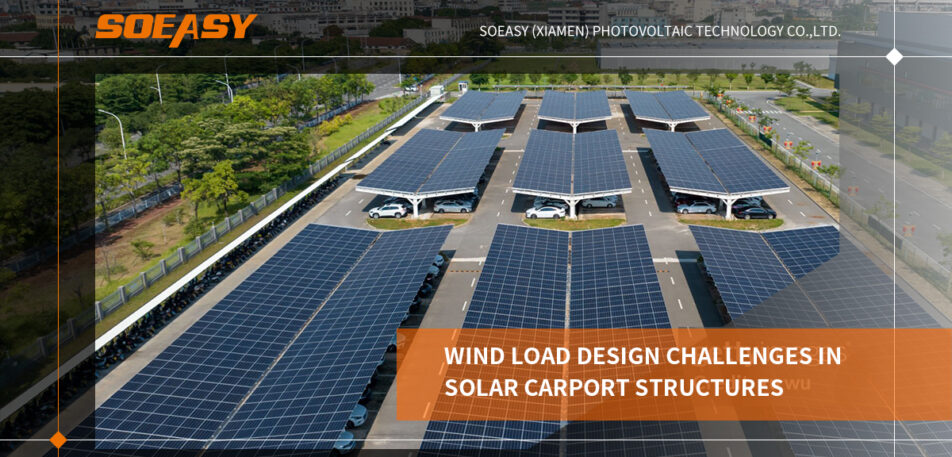
 As solar applications continue to diversify, solar carports have become an increasingly popular solution across industrial parks, commercial facilities, and residential developments. By combining power generation with parking functionality, they make efficient use of unused space while providing shade and weather protection for vehicles.
However, from a structural engineering perspective, solar carports present significantly greater wind load challenges than conventional ground-mounted solar systems.
This complexity stems from their dual identity. A solar carport is both a building-like canopy and a supporting mounting structure. That hybrid nature fundamentally changes how wind forces act on the system.
As a result, wind load often becomes the governing factor in solar carport structural design. Any underestimation during the design phase can lead to structural damage, overturning, or severe economic loss under extreme weather conditions.
Why Wind Load Design Is More Complex for Solar Carports
Before examining calculation challenges, it is essential to understand the unique structural characteristics that distinguish solar carports from other PV structures.
1. Open Structure and Wind Channel Effect
Unlike enclosed buildings, most solar carports lack side walls. Wind flows freely through the structure and acts simultaneously on both the upper and lower surfaces of the PV modules.
When airflow passes over the canopy:
- Negative pressure (suction) forms on the top surface.
- Positive or negative pressure develops underneath due to airflow penetration.
This bidirectional pressure effect increases total wind load compared to enclosed roofs at similar heights.
Therefore, engineers must evaluate not only horizontal wind pressure but also vertical uplift forces.
2. Elevated Structural Center of Gravity
Ground-mounted systems sit close to the ground, which limits overturning moments. In contrast, solar carports require clearance heights of approximately 2.5 meters or more.
As structural height increases, overturning moment increases proportionally. The column bases must resist significantly larger bending moments, and overall structural stability becomes more sensitive to wind loads.
3. Large Spans and Cantilever Designs
To maximize parking efficiency, many carports adopt large-span or cantilever configurations:
- Single-column cantilever carports
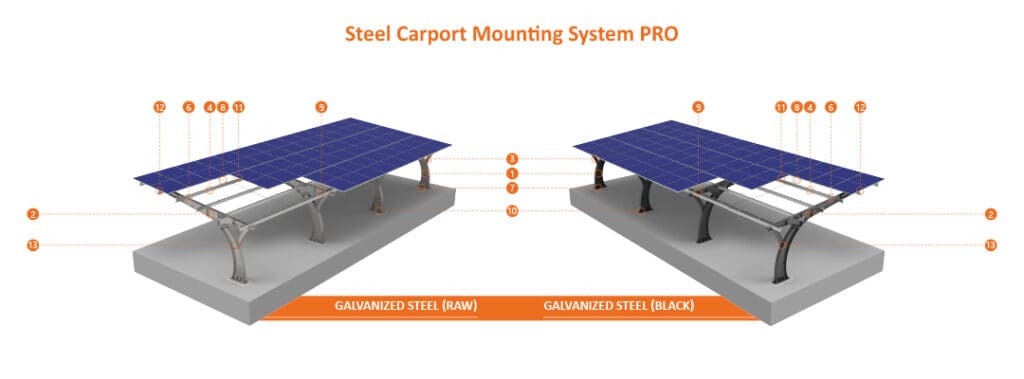
- Double-column symmetric carports
- Multi-row continuous arrays
While these designs improve space utilization, they introduce:
- Concentrated bending and torsional stresses
- Increased deformation under wind loads
- Higher demand on connection rigidity
Consequently, wind load effects become amplified at beam-column joints.
Key Wind Load Calculation Challenges
Understanding structural behavior is only the first step. During detailed engineering analysis, several critical challenges emerge.
1. Non-Uniform Wind Pressure Distribution
Wind pressure across a solar carport surface is never uniform.
Edge zones, leading edges, and corners experience significantly higher pressure coefficients. In multi-row layouts, upstream rows create shielding and vortex effects that alter downstream wind pressures.
Therefore, localized failure may occur if edge amplification effects are ignored.
Accurate zoning and coefficient selection are essential for safe design.
2. Uplift Force and Overturning Control
In many wind events, uplift force poses a greater threat than horizontal push.
When airflow accelerates over the canopy surface, strong suction develops. In typhoon-prone regions, uplift forces can exceed the self-weight of the structure.
As uplift combines with horizontal wind force, overturning moment increases dramatically. Engineers must:
- Calculate uplift precisely
- Verify anchor bolt tensile capacity
- Design foundations with adequate pull-out resistance
Without proper uplift control, entire structures may detach from their foundations.
3. Torsional and Lateral Stability Issues
For single-sided cantilever systems, wind load often acts eccentrically relative to the structural axis. This eccentricity generates torsion.
If torsional stiffness is insufficient, excessive twisting may occur. Additionally, weak longitudinal bracing can lead to lateral instability under crosswind conditions.
Thus, stability design must consider bending, shear, and torsion simultaneously.
Wind Design Difficulties in Different Carport Types
Different structural configurations present different wind control priorities.
Single-Column Cantilever Carports
This configuration offers maximum parking clearance but introduces the highest structural demand.
Primary challenge: torsional resistance.
All wind-induced bending and torsion transfer through a single column. The beam-column connection must function as a rigid joint with sufficient rotational stiffness.
Double-Column Symmetric Carports
This is the most widely used structural form.
Primary challenge: concentrated foundation forces.
Although load sharing improves stability, each column still transfers substantial vertical uplift and horizontal shear to the foundation.
Accurate foundation design becomes critical.
Multi-Row Continuous Carports
Large parking areas often use continuous arrays.
Primary challenge: array wind interference effects.
Upstream rows generate vortices that influence downstream pressure distribution. Middle rows behave differently from edge rows.
Simple single-unit calculations become insufficient. Group effects must be evaluated.
Foundation Design Under Wind Load
Ultimately, wind load transfers into the foundation system. Therefore, foundation engineering plays a decisive role.
Uplift Resistance as the Core Issue
Whether using spread footings or pile foundations, uplift verification is essential.
Possible strategies include:
- Increasing embedment depth
- Enlarging foundation weight
- Using bored piles or screw piles
- Improving soil friction mobilization
Coupled Effect of Wind and Soil Bearing Capacity
Wind generates eccentric loading on foundations. One side may experience increased compression, while the other side may partially lift.
Engineers must verify:
- Bearing capacity under eccentric loading
- Settlement limits
- Tilting resistance
In coastal or high-wind regions, deeper foundations may be required to reach stable bearing strata.
Code and Standard Challenges
Solar carports are relatively new structural systems. Design standards vary internationally.
For example:
- GB 50009
- ASCE 7
- Eurocode 1
These standards differ in:
- Shape coefficients
- Exposure categories
- Gust factors
- Wind pressure formulas
Selecting appropriate parameters requires strong familiarity with both code intent and site conditions.
In some cases, direct application of standard coefficients may lead to overconservative or unsafe results.
Balancing safety and economy becomes a major design consideration.
Common Engineering Mistakes
In practice, wind-related failures often result from avoidable errors:
- Underestimating open-structure wind effects
- Ignoring connection strength and bolt capacity
- Failing to consider extreme historical wind data
- Neglecting dynamic wind vibration
Connections frequently fail before main structural members. Therefore, node design must receive equal attention.
Engineering Strategies to Address Wind Load Challenges
A systematic design approach can significantly enhance wind resistance.
1. Optimize Structural System
- Add transverse bracing
- Strengthen rigid beam-column connections
- Use space trusses for long spans
Improved stiffness reduces deformation and stress concentration.
2. Strengthen Uplift Resistance
- Select appropriate foundation types
- Increase embedment depth
- Use high-strength anchor bolts
- Enhance shear key detailing
These measures improve overall stability.
3. Apply CFD Simulation for Critical Projects
For complex or high-wind projects, Computational Fluid Dynamics (CFD) simulation provides more refined wind pressure distribution data.
CFD helps:
- Identify peak pressure zones
- Optimize reinforcement locally
- Reduce unnecessary material use
As a result, projects achieve both safety and cost efficiency.
Wind Load Is the Governing Factor in Solar Carport Design
In conclusion, solar carports combine architectural openness, elevated height, and large-span configurations. These characteristics significantly increase wind load complexity compared to ground-mounted systems.
Wind load design is not merely a calculation step. It defines the structural reliability, durability, and economic performance of the entire project.
From structural layout and connection detailing to foundation uplift verification, every stage must prioritize wind effects.
Only through accurate analysis, proper code application, and advanced simulation tools can engineers deliver solar carport structures that are safe, reliable, and economically optimized.
In high-wind regions especially, wind load control is not optional — it is the core of responsible engineering design.