English

 Post by
 As the global solar market continues to expand, coastal regions have become key areas for both distributed and utility-scale PV installations. From Southeast Asia’s coastlines to Mediterranean villas and industrial zones along China’s eastern seaboard, these locations offer abundant solar resources and available land.
However, coastal environments introduce unique challenges:
- High salt spray (chloride exposure)
- High humidity and condensation cycles
- Strong UV radiation
- Wind-driven corrosive particles
In such conditions, standard materials may show visible corrosion within just a few years. More importantly, corrosion directly impacts:
- Structural safety – reduced load-bearing capacity of fasteners
- Electrical performance – degraded grounding continuity
- Long-term cost – increased maintenance, replacement, and downtime
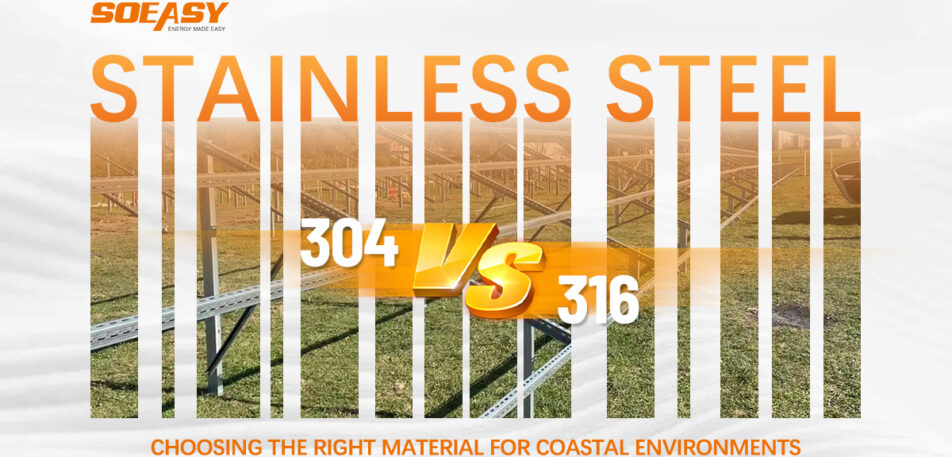
In solar mounting systems, stainless steel fasteners and connectors are the first line of defense against corrosion. Among available materials, stainless steel 304 and 316 are the most commonly used.
This guide explains their differences, performance in coastal environments, and how to select the right material for your project.
What Are Stainless Steel 304 and 316?
Stainless Steel 304
Stainless steel 304 is the most widely used austenitic stainless steel, often referred to as “general-purpose stainless steel.”
Key Composition
- Chromium (Cr): 18–20%
- Nickel (Ni): 8–10.5%
- Carbon (C): ≤0.08%
Performance Characteristics
- Good corrosion resistance in most environments
- Excellent formability and weldability
- Non-magnetic or weakly magnetic
Typical Applications
- General industrial fasteners
- Building components
- Food processing equipment
Stainless Steel 316
Stainless steel 316 is an upgraded version of 304, enhanced by the addition of molybdenum (Mo).
Key Composition
- Chromium (Cr): 16–18%
- Nickel (Ni): 10–14%
- Molybdenum (Mo): 2–3%
- Carbon (C): ≤0.08%
Why Molybdenum Matters
The addition of Mo significantly improves:
- Resistance to chloride-induced pitting corrosion
- Resistance to crevice corrosion
- Stability of the passive protective layer
Performance Characteristics
- Superior corrosion resistance in marine environments
- Better high-temperature performance
- Slightly lower machinability than 304
Typical Applications
- Marine engineering
- Chemical processing
- Coastal construction
- Desalination systems
Key Differences Between 304 and 316
1. Corrosion Resistance (Core Difference)
- 304 → sensitive to chloride environments
- 316 → significantly improved resistance due to molybdenum
In coastal environments, 316 can offer 3–5× higher corrosion resistance than 304.
2. Mechanical Properties
Both materials have similar:
- Tensile strength
- Yield strength
- Ductility
Selection should focus on durability, not strength.
3. Cost Difference
- 316 costs 30–50% more than 304
- Higher cost due to increased Ni and Mo content
However, lifecycle cost may favor 316 in harsh environments.
Why Coastal Environments Are More Corrosive
1. Chloride-Induced Corrosion
Salt spray contains chloride ions (Cl⁻), which:
- Break down protective oxide layers
- Initiate localized pitting corrosion
- Accelerate material degradation
2. High Humidity
- Promotes electrochemical corrosion
- Extends surface wetness duration
3. Wind and Salt Transport
- Salt particles can travel kilometers inland
- Corrosion risk extends far beyond the coastline
Applications in Solar Mounting Systems
Typical Components
| Component | Recommended Material |
|---|---|
| Fasteners (bolts, nuts, washers) | Coastal → 316 |
| Grounding components | Coastal → 316 |
| Rail connectors | 304 / 316 depending on environment |
| Structural parts | Based on corrosion level |
Why Fasteners Require Higher Protection
Fasteners are critical because:
- Small size but critical structural role
- High stress concentration
- Difficult to inspect and replace
- First point of failure in corrosive environments
Fastener corrosion can lead to system failure.
When to Choose 304 vs 316
Use 304 When:
- Inland areas (>20 km from coast)
- Low humidity environments
- Cost-sensitive projects
- Non-critical components
Use 316 When:
- Coastal areas (<20 km from sea)
- High humidity or salt exposure
- Critical structural components
- Projects requiring long-term reliability
Distance-Based Recommendation
| Distance from Coast | Recommendation |
|---|---|
| 0–2 km | Use 316 for all critical parts |
| 2–5 km | 316 strongly recommended |
| 5–20 km | Evaluate conditions |
| >20 km | 304 generally sufficient |
Common Material Selection Mistakes
- Choosing materials based only on cost
- Using 304 fasteners with 316 structures
- Ignoring environmental corrosion levels
- Overlooking lifecycle costs
Design Strategies for Coastal Durability
- Use 316 for critical components
- Apply surface treatments (passivation, coatings)
- Avoid galvanic corrosion between metals
- Optimize drainage and ventilation
- Minimize water accumulation and crevices
Lifecycle Cost Perspective
Although 316 has a higher initial cost:
- Lower maintenance costs
- Reduced failure risks
- Longer service life
In coastal environments, 316 often results in lower total cost of ownership (TCO).
Choosing the Right Material for Long-Term Reliability
There is no absolute “better” material—only the right choice for the environment:
- Inland projects → 304 is cost-effective and sufficient
- Coastal projects → 316 ensures durability and safety
Key Principles
- Select materials based on corrosion level
- Ensure critical components match or exceed structural material grade
- Consider full lifecycle cost, not just initial price
- Combine proper material selection with smart design strategies
In coastal PV projects, choosing 316 is not over-engineering—it is a risk management decision.
Why Choose SOEASY
At SOEASY, we understand that material selection is critical to the long-term performance of solar mounting systems—especially in demanding environments like coastal regions.
- Flexible Material Options (304 & 316)
We offer both 304 and 316 stainless steel solutions, allowing you to match material performance with environmental conditions and project requirements. - Expert Material Selection Support
Our engineering team provides practical recommendations based on corrosion level, site conditions, and project lifespan goals. - Comprehensive Anti-Corrosion Solutions
From fasteners to structural components, our systems are designed with integrated corrosion protection in mind. - Standardized and Custom Designs
Whether for typical installations or complex environments, we deliver solutions that balance reliability, cost, and performance. - Lifecycle-Oriented Engineering
We focus on long-term durability, helping reduce maintenance risks and overall project costs over 25+ years.