English

 Post by
 As commercial and industrial buildings increasingly adopt rooftop solar power, the flat roof PV mounting system has become one of the most popular solutions for efficient and large-scale solar installations. Compared with other types of roofs, flat concrete rooftops offer stronger structural capacity and wider usable areas.
However, designing a flat roof solar mounting system is far from simple. Engineers and system providers must carefully balance structural safety, waterproofing, wind resistance, and power generation efficiency. The following key design considerations outline what makes a durable and high-performance system for concrete flat roofs.
1. Roof Structure and Load Assessment
Roof Structure Features
Concrete flat roofs generally have a higher load-bearing capacity compared with metal or tile roofs. Still, it is essential to assess the roof slab thickness, reinforcement structure, and allowable load limits before installation.
The design should also account for the composition of the roof layers—such as slope leveling, waterproof membranes, and insulation layers—to avoid compromising their function during construction.
Static and Dynamic Load Distribution
A well-engineered PV system distributes loads evenly across the rooftop surface.
- Static loads include the weight of solar panels, mounting structures, and ballast blocks.
- Dynamic loads come from environmental factors such as wind uplift and snow accumulation.
Proper load analysis ensures the system’s stability without exceeding the roof’s structural limits, protecting both the solar investment and the building integrity.
2. Wind Resistance and Waterproofing Optimization
Wind Resistance Design
Flat roof systems are especially vulnerable to high wind forces due to their open exposure. To ensure long-term reliability, advanced design methods such as CFD simulation and wind tunnel testing are recommended to validate system stability.
Special reinforcement is often required at roof edges and corners, where wind uplift is strongest. Adding extra ballast blocks or anchor points can prevent displacement or uplift during strong winds.
Waterproof Layer Protection
Maintaining the waterproof integrity of the concrete roof is critical. For ballasted mounting systems, EPDM rubber pads or protective mats should be placed beneath ballast blocks to prevent abrasion.
For penetrative systems, the use of waterproof caps, stainless-steel bolts, and high-quality sealants ensures long-term sealing around anchor points.
Drainage and Ventilation Design
A proper drainage layout prevents water pooling, which can cause corrosion or algae growth around the system base.
Additionally, maintaining airflow beneath the solar panels improves heat dissipation, helping modules operate at lower temperatures and achieve higher power efficiency.
3. Installation and O&M Efficiency
Modular and Pre-Assembled Design
Modern solar racking systems are evolving toward factory pre-assembled designs, allowing for rapid on-site installation. This modular approach reduces labor time, minimizes installation errors, and ensures consistent quality across projects.
Construction Safety and Maintenance Pathways
Designing safe and convenient maintenance access is vital.
Leaving inspection walkways between panel rows enables technicians to conduct regular cleaning, cable checks, and maintenance work safely without disassembling components.
Lifecycle Cost Optimization
A well-designed flat roof mounting system should deliver low maintenance needs and long service life. Using corrosion-resistant materials and simplifying structural design reduces future repair costs and improves the long-term return on investment (ROI).
4. Mounting Method Selection
Ballasted Mounting System
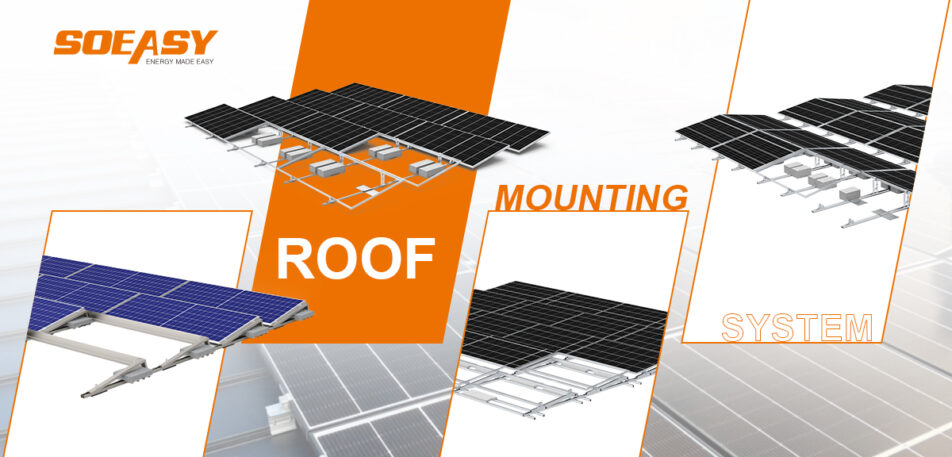
Among all flat roof solutions, the ballasted mounting system is the most widely used for concrete rooftops. By relying on weighted ballast blocks instead of mechanical anchoring, it provides a non-penetrative installation method that preserves the integrity of the roof’s waterproof layer. To ensure long-term stability, the design must carefully calculate ballast weight distribution, incorporate anti-slip devices, and use wind deflectors to resist uplift in high-wind conditions. This approach is particularly suitable for buildings where drilling or chemical anchoring is not permitted, combining both protection and performance in one solution.
Triangular Bracket Mounting System
The triangular bracket system is another popular option, offering fixed or adjustable tilt angles to capture optimal solar irradiance. Its geometric stability ensures excellent structural strength while maintaining a lightweight and modular design. The system can be flexibly adapted to either ballasted or penetrative bases, making it a versatile solution for projects seeking both efficiency and precision in array alignment.
Adjustable Front and Rear Leg Design
For rooftops with uneven surfaces or specific tilt requirements, adjustable front and rear leg designs provide exceptional flexibility during installation. Installers can fine-tune the inclination of solar panels on-site to achieve the desired tilt angle, thereby maximizing solar exposure and energy generation. This adaptability not only enhances installation accuracy but also improves the overall performance and reliability of the PV system over its lifetime.
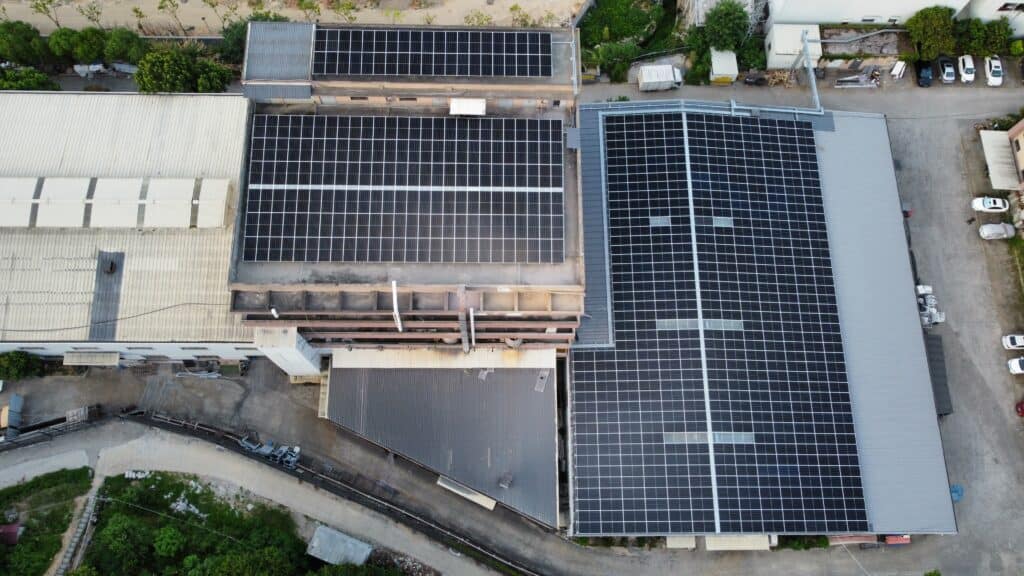
Designing a reliable flat roof solar mounting system requires a deep understanding of roof structure, load conditions, environmental forces, and installation practicality. Each design decision—from ballast weight to drainage planning—directly affects both system performance and building safety.
As a professional solar mounting system manufacturer, SOEASY Solar continuously refines its product design through structural optimization, material innovation, and real-world engineering experience.
Our solutions deliver safe, efficient, and easy-to-install mounting systems that ensure long-term stability and maximum energy generation on concrete flat roofs worldwide.
More rooftop solar projects, pls visit: SOEASY Solar – Roof PV Projects