English

 Post by
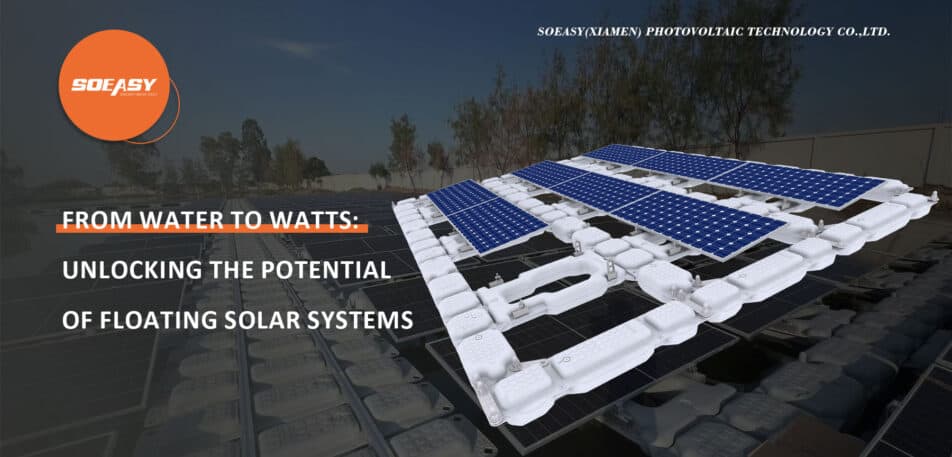
 As the global transition to clean energy accelerates, floating photovoltaic (FPV) systems are emerging as one of the most innovative solutions in the solar industry. By mounting solar panels on buoyant platforms supported by pontoons, FPV systems harness the power of water surfaces—such as reservoirs, lakes, and ponds—to generate clean electricity.
This technology transforms underutilized water areas into green energy assets, achieving both energy generation and environmental protection.
At SOEASY Solar, we specialize in the research, innovation, and manufacturing of advanced solar mounting systems. In this article, we’ll explore the applications and advantages of floating solar systems and how they are reshaping the future of sustainable energy.
Applications of Floating Solar Systems
1. Mining Subsidence Areas and Abandoned Pits
Ecological restoration and reuse: Floating solar can transform abandoned mining pits into renewable energy hubs. These inland static water bodies provide stable surfaces with no navigation or fishing conflicts, ensuring high operational efficiency.
2. Hydropower Reservoirs and Dynamic Water Bodies
Hydropower synergy: FPV systems can be deployed in hydropower balancing reservoirs to optimize water level management and electricity production without disrupting existing hydroelectric infrastructure.
3. Industrial Water Areas
Green power for industrial use: Floating PV systems can supply clean electricity for chemical plants and wastewater treatment facilities while reducing water evaporation losses.
4. Island Microgrids (Coastal and Brackish Water)
Reliable island energy: Ideal for islands and remote regions far from mainland grids, floating solar provides sustainable power and reduces dependence on diesel or fuel-based generation.
5. Agricultural Ponds and Irrigation Reservoirs
Supporting water-saving agriculture: Covering irrigation ponds with FPV systems helps reduce 30%–50% of water evaporation and supports smart agriculture—such as solar-powered irrigation and greenhouse operations.
6. Pumped-Storage Power Stations
Enhancing energy storage capacity: Floating PV on pumped-storage reservoirs enables daytime power generation and nighttime water storage, balancing grid load and increasing renewable energy penetration.
7. Urban Landscape Water Bodies
Aesthetic and functional design: Small-scale FPV systems in urban lakes or artificial canals can generate clean energy while enhancing city landscapes. Low-profile and visually subtle designs minimize visual impact.
8. Fishery-Solar Integration
Dual-use water resources: Combining floating solar with aquaculture improves land efficiency. The solar panels provide shade, reducing water temperature and fish stress, while optimized mounting structures ensure sufficient space for fish farming operations.

Advantages of Floating Solar Systems
1. Efficient Use of Idle Water Surfaces
Floating solar systems make use of non-productive water areas, saving valuable land resources—particularly in mountainous, coastal, or land-scarce regions. They can also be integrated with fisheries or hydropower stations, creating “solar + aquaculture” or “solar + hydro” hybrid systems.
2. Higher Power Generation Efficiency
Water provides a natural cooling effect, lowering solar module temperatures by 5–10°C and boosting generation efficiency by 5%–15% compared to ground-mounted systems. Additionally, water surfaces accumulate less dust, reducing cleaning frequency and maintaining high energy yield.
3. Reduced Water Evaporation and Improved Water Quality
FPV systems limit sunlight exposure to the water surface, which helps suppress algae growth and reduce nutrient enrichment. They can also cut water evaporation by 30%–50%, which is particularly valuable in arid regions.
4. Environmentally Friendly and Ecologically Compatible
Floating solar projects preserve land ecosystems by avoiding deforestation and earthworks. They also help mitigate the heat island effect, maintaining lower ambient temperatures compared to ground-mounted PV systems and supporting aquatic biodiversity.
5. Simplified Construction and Lower O&M Costs
Floating systems require no land leveling or piling, which lowers civil engineering costs. Their modular pontoons allow quick installation and scalability, while water environments reduce dust buildup—minimizing cleaning and maintenance costs.
Inspection can be performed via boat or drone, improving operational efficiency.
6. Strong Adaptability and Broad Applications
FPV systems are suitable for various water environments, including freshwater lakes, nearshore saltwater areas (with anti-corrosion protection), and industrial ponds. High-quality HDPE pontoons are UV-resistant, anti-aging, and can withstand wind, waves, and water level changes, ensuring long-term durability and system stability. Their flexible design allows scaling from small fishery-integrated setups to large centralized power plants.
7. Policy Support and Economic Benefits
Many countries and regions offer subsidies or tax incentives for floating solar projects, reducing initial investment costs.
With higher efficiency and lower maintenance expenses, FPV systems often achieve a lower Levelized Cost of Energy (LCOE) compared to some traditional ground-mounted projects.
SOEASY Floating Solar Systems – Aqua FPV
The SOEASY Aqua FPV System is built with food-grade HDPE material, ensuring environmental safety and long-lasting performance. It features leak-proof, hydrolysis-resistant, and anti-aging properties with strong resistance to UV exposure, photo-oxidation, and thermal aging.
Designed for a 25-year lifespan, the system boasts excellent wind and wave resistance, adapting easily to diverse aquatic environments. Every SOEASY floating solar solution undergoes comprehensive SGS testing and verification, guaranteeing high quality, safety, and reliability.