English


 Post by
Introduction: The Hidden Budget Killer in Latin American Solar Development
Latin America is experiencing an unprecedented solar boom. In Brazil, surging demand across the Free Energy Market (ACL) and Distributed Generation (DG) sectors is pushing developers to secure land fast before grid connection deadlines. Meanwhile, in Chile, high solar irradiation in the Atacama foothills and central valleys makes utility-scale PV highly profitable.
However, as flat, prime agricultural land becomes scarce and expensive, solar EPCs in Brazil and Chile face a massive engineering bottleneck: rolling hills, rocky slopes, and irregular terrain.
Traditional fixed-tilt ground mounts require extensive cut-and-fill earthworks (land grading) before pile driving can even begin. For a 10MW to 50MW project on uneven terrain, civil grading costs, topsoil erosion permits, and project delays can quickly destroy your Internal Rate of Return (IRR).
The solution isn’t reshaping the mountain—it’s adapting the racking. Here is how modern terrain-following, adjustable ground mounting systems are transforming hillside solar development across Latin America.
1. Why Traditional Ground Mounts Fail on Uneven & Sloping Terrain
When installing standard rigid ground-mount structures on undulating hills in Minas Gerais (Brazil) or the Andean foothills (Chile), EPCs typically run into three major roadblocks:
- Skyrocketing Civil Engineering Costs: Clearing and leveling undulating slopes adds weeks to the construction schedule and consumes up to 15%–25% of total Balance of System (BOS) budgets.
- Module Shading & Row Misalignment: Rigid purlins forced onto uneven ground create undulating array lines, leading to inter-row shading losses and mechanical torsional stress on glass-on-glass bifacial modules.
- Strict Environmental Permitting: In many Latin American municipalities, stripping natural vegetation and altering natural drainage contours triggers lengthy environmental impact assessments (EIA).
2. Engineering Breakthrough: The SOEASY Terra FLEX Sloping Ground Mount System
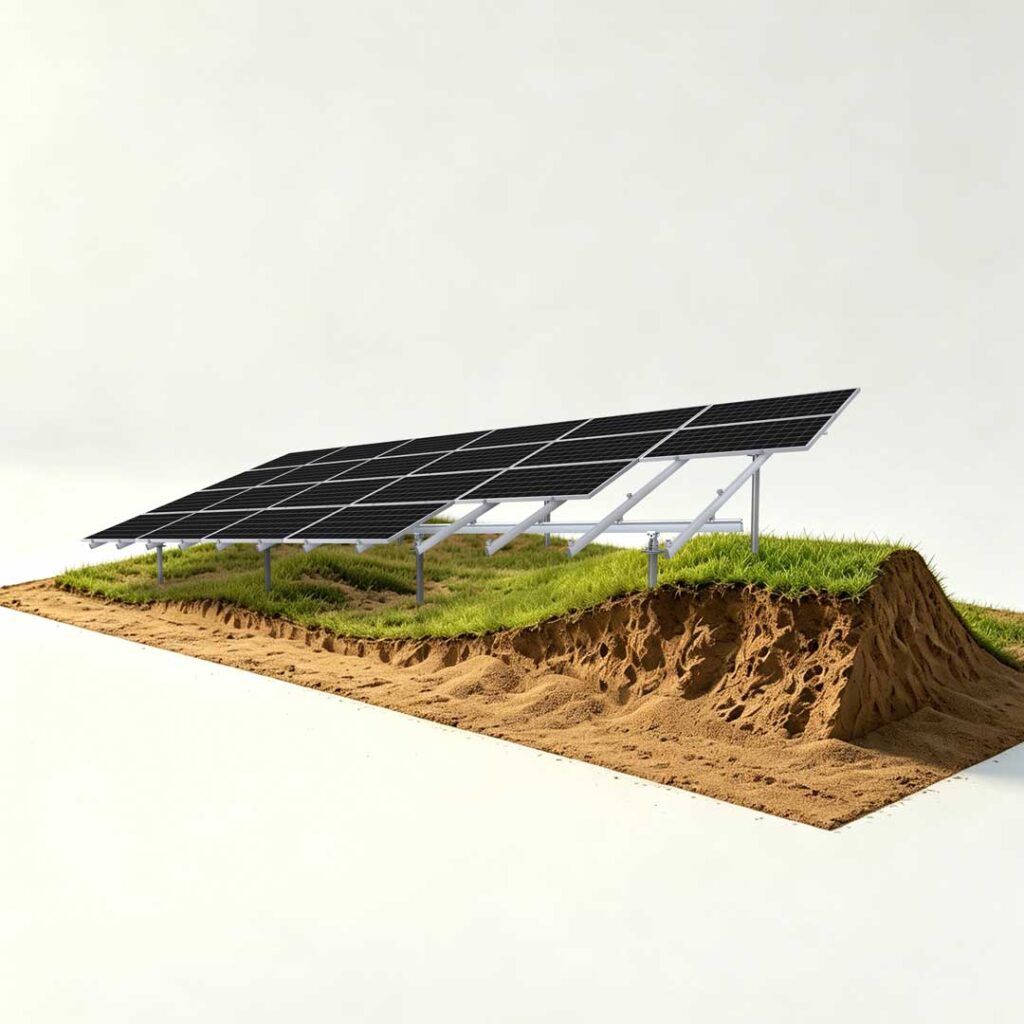
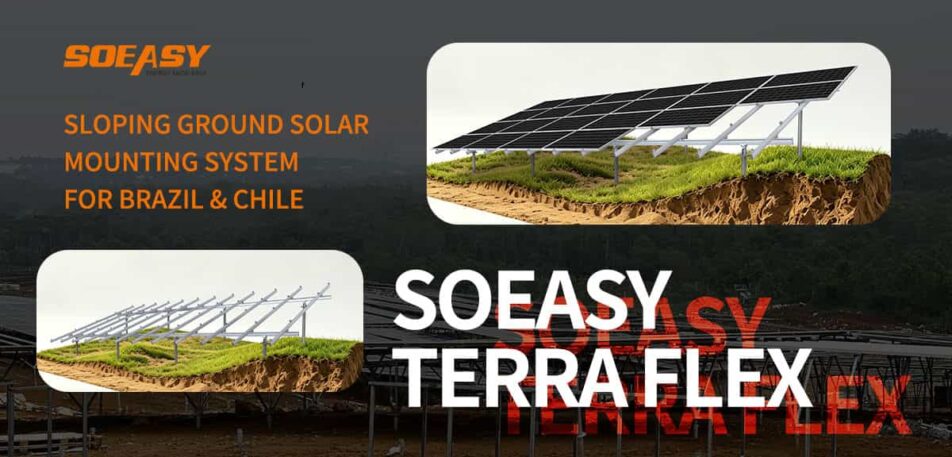
To solve complex topography without sacrificing structural integrity or installation speed, SOEASY engineered the Terra FLEX Sloping Ground Solar Mounting System.
Designed specifically for irregular landscapes, hillsides, and rolling plains, Terra FLEX allows solar arrays to follow natural ground contours seamlessly.
Key Technical Advantages for Latin American Projects:
- Multi-Directional Slope Adaptability (East-West & North-South): Terra FLEX features precision-engineered adjustable joints and telescopic post-to-beam connections. Installers can compensate for steep North-South inclines and rolling East-West terrain undulations directly on-site without custom cutting or welding.
- Zero Land Grading Required: By accommodating variable terrain angles and pile height tolerances, Terra FLEX eliminates the need for heavy bulldozing—preserving native soil stability and fast-tracking environmental approvals.
- High-Strength, Corrosion-Resistant Build: Manufactured from high-tensile anodized aluminum alloy paired with SUS304 stainless steel fasteners, the system delivers an exceptional strength-to-weight ratio. It withstands high wind uplift in coastal Chile and intense UV/humidity cycles in tropical Brazil, backed by a 10-year material and workmanship warranty and a 25+ year design lifespan.
- Optimized Layout for Maximum Energy Yield: Maintains uniform module tilt angles across irregular slopes, preventing inter-row shading and maximizing solar capture while leaving ample clearance for vegetation management and O&M.
3. Terrain Comparison: Rigid Racking vs. SOEASY Terra FLEX
| Engineering Factor | Traditional Rigid Ground Mount | SOEASY Terra FLEX Sloping System |
| Land Preparation | Requires extensive cut-and-fill grading | Follows natural terrain; minimal grading |
| Slope Tolerance | Limited (< 5° without major civil work) | High adaptability across steep & rolling slopes |
| On-Site Adjustment | Requires field cutting/drilling | Flexible pre-punched & adjustable joints |
| Foundation Compatibility | Sensitive to pile height deviations | Compatible with ground screws, driven piles & concrete |
| Environmental Impact | High soil disturbance & runoff risk | Low impact; preserves natural land contours |
4. Proven Track Record: Global Ground PV Projects in Complex Environments
When selecting a mounting partner for utility-scale or hilly terrain projects, bankability and field-proven engineering matter most. With over 10GW of global installed capacity, SOEASY has delivered ground-mount solutions across challenging mountain ridges, coastal zones, and massive utility sites:
- 1.25MW Mountainous Ground Solar Project – Western Bosnia and Herzegovina: Situated in rugged, rocky mountain terrain with steep elevation changes, this project required high structural rigidity against heavy wind and snow loads. SOEASY provided a customized terrain-adaptive ground mounting solution that minimized civil excavation and accelerated mechanical assembly.
- 568KW & 680KW Hillside Sloping Ground Projects – Serbia & Shizuoka, Japan: In land-constrained hilly regions where flat land was unavailable, EPCs deployed SOEASY Terra FLEX sloping structures to build directly along forest-edge hillsides—proving rapid deployment on steep gradients without soil erosion.
- 67MW Utility-Scale Ground PV Power Plant – Cambodia: Demonstrating SOEASY’s large-scale manufacturing and supply chain capacity, this 66.5MW utility project utilized over 201,600 modules in a 2P portrait configuration. Precision pre-punched components and modular designs ensured rapid, repeatable installation across massive acreage.
(Explore more utility and hillside installations on our Ground PV Projects Portfolio).
5. Fast-Tracking Q4 & 2027 Deployments in Brazil and Chile
For EPCs racing to meet grid-connection windows in Brazil or securing equipment for utility tenders in Chile, supply chain speed is just as critical as engineering design:
- Modular & Pre-Assembled Delivery: Key sub-assemblies are pre-assembled at the factory, slashing on-site installation labor hours and reducing reliance on specialized welding crews.
- Tailored Wind & Seismic Engineering: Structural calculations customized according to local wind load standards (e.g., ABNT NBR 6123 in Brazil and NCh432 / NCh2369 seismic/wind standards in Chile).
Frequently Asked Questions (FAQ) — Sloping Ground Solar Mounting
Q1: How much slope angle can the SOEASY Terra FLEX system handle?
Terra FLEX is engineered to accommodate significant North-South slopes (typically up to 20°–30° depending on soil and wind conditions) as well as rolling East-West terrain variations through adjustable post-to-beam brackets.
Q2: Which foundation type works best for rocky hillsides in Chile or clay soils in Brazil?
Terra FLEX is universally compatible with helical ground screws (ideal for rocky or uneven terrain without concrete curing delays), rammed C/H steel piles, and concrete ballasted foundations for hard rock strata.
Q3: Can Terra FLEX support large-format 600W–700W+ bifacial solar panels?
Yes. Our structural engineers calculate rail spans, purlin thickness, and clamp positions specifically for modern high-wattage, large-format bifacial modules to prevent micro-cracks under high wind loads.
Ready to Build on Challenging Terrain Without Blowing Your Civil Budget?
Don’t let hilly land stall your next solar project in Brazil, Chile, or across Latin America. Send us your topographical survey (CAD/KMZ) and module datasheet—our structural engineering team will provide a free customized layout, wind-load calculation, and competitive factory-direct quote within 48 hours.
Contact us to get your customized plan:sales@soeasyrobot.com
Whatsapp:+8618150110835