English

 Post by
 In the world of rooftop photovoltaic projects, time is money. Every extra day spent on installation translates directly into higher labor costs, delayed revenue generation, and increased exposure to weather-related risks. Among all the components of a rooftop PV system, rooftop hooks play an outsized role in determining overall construction speed.
Rooftop hooks are the critical interface between the roof structure and the PV mounting rails. They bear the weight of the entire solar array, resist wind uplift forces, and must be installed correctly to maintain roof waterproofing. Yet, despite their importance, hook installation is often a bottleneck that slows down entire projects.
The good news is that efficient rooftop hook installation is achievable—through smart component selection, pre-planning, optimized workflows, and the right tools. This article provides a comprehensive guide to shortening PV project construction time by choosing and installing rooftop hooks quickly without compromising safety or quality.
Understanding Rooftop Hooks
1. Definition and Function
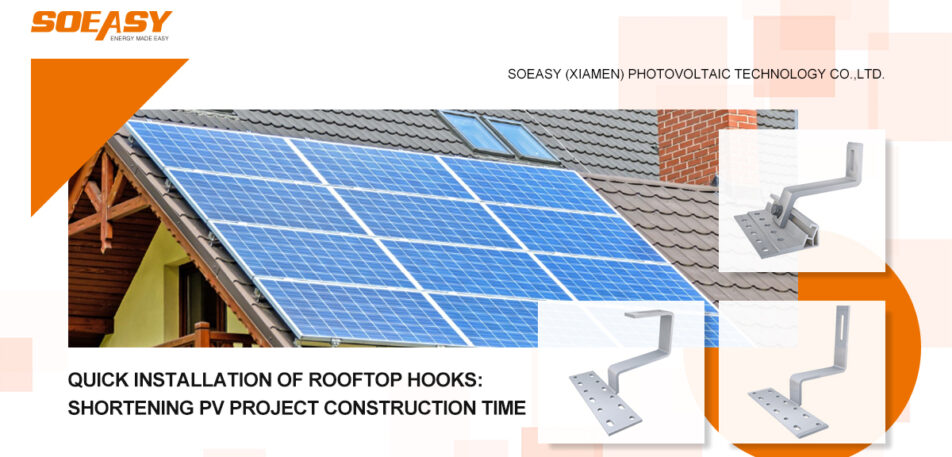
A rooftop hook (also known as a roof hook, tile hook, or roof anchor bracket) is a specialized mounting component designed to attach PV support rails to sloped roofs, particularly those covered with tiles, slates, or shingles. Unlike L-Feet that mount directly to the roof deck surface, hooks are typically tucked under or between roofing materials to preserve weatherproofing.
Primary functions of rooftop hooks:
- Structural support: Transferring the combined dead load (modules, rails, hooks) and live loads (snow, wind, maintenance) into the roof rafters or trusses.
- Waterproofing preservation: Designed to work with flashing or sealants to prevent leaks around the attachment point.
- Rail interface: Providing a secure connection point for the mounting rails that ultimately hold the solar modules.
- Adjustability: Accommodating variations in roof structure, tile thickness, and alignment requirements.
2. Types of Rooftop Hooks
Different roof types require different hook designs. Selecting the correct type is the first step toward fast, trouble-free installation.
| Hook Type | Best For | Key Features |
|---|---|---|
| Tile Roof Hooks | Clay, concrete, or slate tile roofs | Curved or angled profile that slides under tiles; often includes an adjustable upper section for rail attachment |
| Standing Seam Metal Roof Hooks | Metal roofs with raised vertical seams | Clamp-on design that attaches to the seam without penetrating the panel; no sealant required |
| Adjustable Hooks | Any roof with uneven substrate or varying tile thickness | Height and/or tilt adjustable (±20–50 mm); compensates for rafter irregularities |
| Flat Roof Hooks (rare) | Flat roofs with parapets | Typically used as part of a mini-railing system; less common than L-Feet for flat roofs |
Factors Affecting Installation Speed
Understanding what slows down hook installation is essential to improving it. Below are the four most significant factors.
1. Hook Design
The design of the hook itself is the single biggest determinant of installation speed.
- Pre-assembled hooks: Hooks that come with the rail attachment bolt, washer, and height adjustment mechanism already assembled reduce on-site handling. The installer simply positions the hook and tightens one or two fasteners.
- Modular design: Hooks with fewer total parts (e.g., integrated flashing, one-piece body) eliminate the need to assemble multiple components. Fewer parts mean fewer opportunities for lost hardware and fewer steps per hook.
- Adjustable angle/height: On roofs with variable tile thickness or rafter height variations, manually shimming or cutting hooks to fit consumes enormous time. Hooks with built-in adjustability (e.g., slotted holes, telescoping sections) allow the installer to dial in the correct position in seconds rather than minutes.
2. Roof Type and Condition
Not all roofs are created equal—and older roofs can be particularly time-consuming.
- Fresh, uniform tile roofs: Installers can work quickly using a consistent pattern. Tiles lift easily, and rafters are straight.
- Old or brittle tiles: Clay tiles from the 1970s or concrete tiles with weathering may crack or crumble when lifted. This forces installers to work more slowly, use specialized lifting tools, or replace broken tiles—all of which add time.
- Metal roofs: Standing seam clamps are generally fast, but corrugated metal roofs may require drilling through ridges and sealing each penetration, which is slower.
- Composite shingle roofs: Hooks that mount directly over shingles with lag bolts into rafters can be very fast—provided the installer can accurately locate rafters beneath the sheathing.
3. Pre-Planning and Layout
The most time wasted on a rooftop PV project is often not the physical installation but the time spent figuring out where to install.
- Unclear hook spacing: Without a pre-determined layout, installers must stop to measure and mark each hook location, recalculating as they go.
- Missing material staging: If hooks, bolts, sealant, and tools are scattered across the roof or ground, installers spend significant time walking, climbing, and searching.
- No rafter locating strategy: On wood-framed roofs, locating rafters through shingles or underlayment without a stud finder or pre-marking leads to missed fasteners and re-drilling.
4. Team Coordination and Workflow
Even with perfect hooks and a good plan, poor team coordination kills speed.
- Sequential vs. parallel work: If the entire crew waits for one person to finish marking before anyone starts fastening, throughput suffers. Parallel workflows (one team marking, one team installing hooks) are much faster.
- Material handoffs: Hooks and fasteners should be staged at the roof edge, not carried up one by one.
Benefits of Quick Rooftop Hook Installation
The advantages of faster hook installation extend far beyond the minutes saved on the roof.
1. Reduced Construction Time
Shorter hook installation directly compresses the overall project schedule. Since hook installation is often on the critical path (rails cannot be installed until hooks are in place), any acceleration here accelerates the entire project.
Real-world example: A 100 kW commercial tile roof project with 250 hooks. At 4 minutes per hook (typical for unoptimized installation), hook installation takes 16.7 labor-hours. With optimized techniques at 2 minutes per hook, the same work takes 8.3 hours—saving a full day of labor.
2. Lower Labor Costs
Labor is typically the largest variable cost in rooftop PV installation. Faster hook installation means fewer paid hours to complete the same scope. For installation companies operating on fixed-price contracts, this directly increases profit margins.
Additional savings: Reduced labor hours also mean lower workers’ compensation exposure, less overtime pay, and reduced need for temporary scaffolding or lift rentals.
3. Enhanced Safety
Paradoxically, rushing through installation unsystematically is dangerous, but efficient installation—with standardized tools, clear workflows, and pre-assembled components—is safer.
- Less time on the roof means less exposure to fall hazards, heat stress, and weather risks.
- Pre-assembled components reduce the number of small parts handled at height, lowering the risk of dropped objects.
- Clear team roles reduce confusion and the likelihood of accidental tool or material collisions.
4. Improved Project Predictability
When hook installation time is consistent and predictable, the entire project schedule becomes more reliable. This allows project managers to:
- Accurately schedule follow-on trades (electricians, module installers).
- Commit to firm completion dates for customers and financiers.
- Reduce costly “weather days” or idle crew time waiting for one slow phase to finish.
Choosing the Right Rooftop Hook for Fast Installation
Speed is not just about technique—it starts with selecting the right product. Not all hooks are designed for rapid installation.
1. Material and Durability
A fast installation is worthless if the hooks corrode and fail after five years. Material choice affects both speed (some materials are easier to work with) and long-term reliability.
- Stainless steel (304 or 316): Excellent corrosion resistance. 316 grade is essential for coastal sites. Stainless is strong but can gall (cold-weld) if fasteners are over-tightened. Use anti-seize or lubricated bolts.
- Zn-Al-Mg coated steel: Combines the strength of steel with corrosion resistance approaching stainless at a lower cost. The coating is smooth and doesn’t require post-installation touch-up. Highly recommended for coastal or high-humidity environments.
- Anodized aluminum: Lightweight and corrosion-resistant for inland projects. However, aluminum hooks should not be used with stainless steel rails without isolation washers (galvanic corrosion risk).
SOEASY recommendation: For fastest installation with long-term durability, choose Zn-Al-Mg coated steel hooks for most environments, and stainless steel 316 for coastal projects within 1 km of saltwater.
2. Compatibility with Roof Type
The fastest hook in the world is useless if it doesn’t fit your customer’s roof.
- Tile roofs: Choose hooks with a curved “tongue” that slides easily under tiles without lifting them excessively. Hooks with pre-attached flashing reduce sealant time.
- Metal standing seam: Select clamp-style hooks with a single bolt for tightening. No drilling, no sealant—just clamp and go.
- Corrugated metal: Use hooks with a pre-molded EPDM gasket on the base. The gasket seals the drilled hole without waiting for silicone to cure.
3. Pre-Assembled vs On-Site Assembly
| Feature | Pre-Assembled Hooks | On-Site Assembly Hooks |
|---|---|---|
| Installation speed | Fast (2–3 minutes per hook) | Slower (4–6 minutes per hook) |
| Risk of lost parts | Low | High |
| Flexibility | Limited to preset configurations | High—can adapt to unusual roofs |
| Best for | Standard residential/commercial projects | Complex, custom, or historic roofs |
SOEASY approach: We design our hooks for partial pre-assembly—the rail attachment bolt and washer come factory-installed, but the height adjustment remains free for field customization. This gives you the best of both worlds: speed and flexibility.
Efficient Rooftop Hook Installation as a Key to Faster PV Projects
Rooftop hook installation is often viewed as a simple, repetitive task—and that’s precisely why it offers such a large opportunity for efficiency gains. By focusing on this one component, project managers and installation crews can significantly reduce overall construction time, cut labor costs, improve safety, and deliver more predictable project outcomes.
The key strategies are clear:
- Choose the right hook for the roof type and environment—prioritize hooks with pre-assembly, adjustability, and corrosion-resistant materials like Zn-Al-Mg or stainless steel.
- Pre-plan the layout before anyone climbs the ladder—use templates, laser measures, and rafter-finding tools.
- Pre-assemble components on the ground to eliminate on-roof handling time.
- Use standardized, powered tools with correct torque settings.
- Organize the crew in parallel workflows—layout, installation, quality control.
At SOEASY Solar, we design our rooftop hooks with installation speed as a primary engineering requirement—without ever sacrificing safety or durability.
Our product range includes:
- Standing seam metal roof clamps with single-bolt tightening and protective rubber pads.
- Adjustable hooks for uneven substrates and variable tile thickness.
- Corrosion-resistant options for coastal, industrial, and agricultural rooftops.
Every SOEASY hook is load-tested, fully compatible with our rail systems, and backed by technical documentation that makes permitting and inspection straightforward.
Ready to speed up your next rooftop PV project?
Contact the SOEASY engineering team for product samples, load tables, and installation video guides. Let us show you how the right hooks—combined with the right techniques—can transform your construction timeline.