English

 Post by
 Introduction: Why Floating Solar Is Gaining Global Attention
Amid the global energy transition, solar power plant development is increasingly constrained by land availability. Agricultural land must be preserved, ecological zones cannot be occupied, and industrial land is costly.
Under these limitations, a previously overlooked resource is gaining attention: water surfaces.
Reservoirs, lakes, coal mining subsidence areas, wastewater treatment plants, and aquaculture ponds provide a new spatial carrier for solar power generation. Floating photovoltaic (Floating PV) systems have rapidly emerged in this context.
Key Advantages of Floating PV
- Zero land occupation: No use of valuable agricultural or construction land
- Resource integration: Compatible with hydropower, water infrastructure, and aquaculture
- Higher power generation: Water cooling effect improves efficiency by 3–8%
- Additional benefits: Reduces water evaporation and inhibits algae growth
However, transitioning solar systems from land to water is not a simple relocation. Ensuring structural stability and long-term reliability in dynamic water environments is the core engineering challenge.
This article explores the technical principles, environmental adaptability, material selection, and anchoring solutions of floating solar mounting systems.
What Is a Floating Solar Mounting System?
Definition
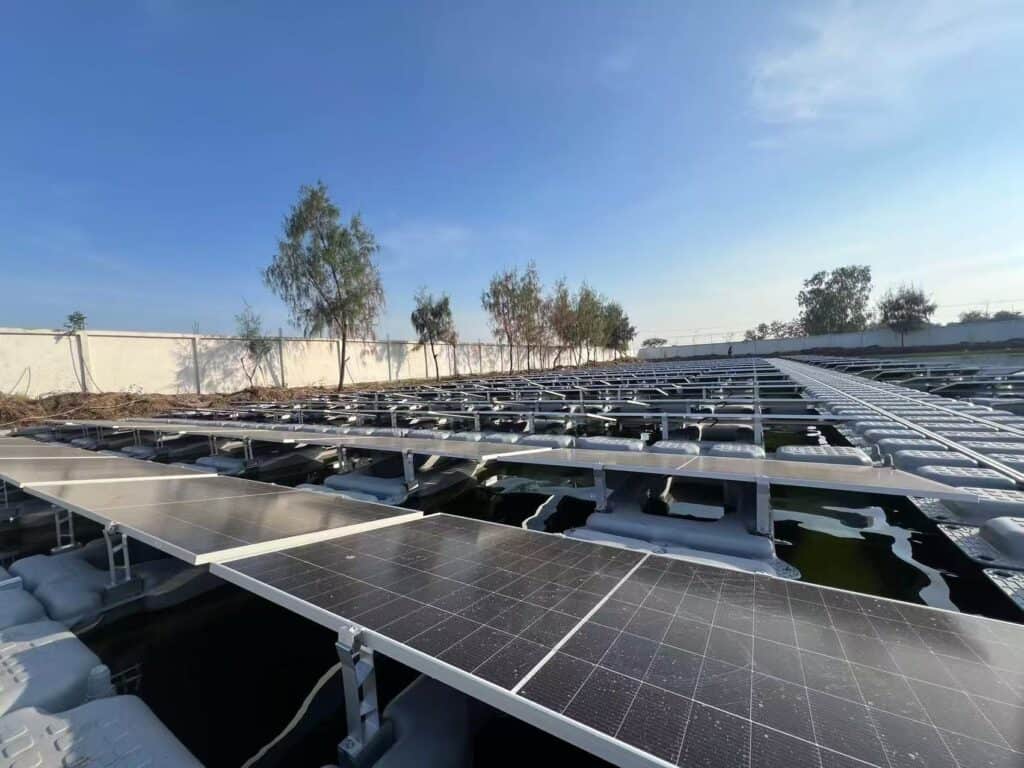
A floating solar system installs photovoltaic modules on buoyant structures that float on water, secured within a defined area using anchoring and mooring systems.
Core System Components
A complete floating PV system includes:
- Floating system: Provides buoyancy (HDPE floats, pontoons)
- Mounting structure: Supports modules at optimal tilt (aluminum alloy, galvanized steel)
- Anchoring & mooring system: Fixes the system in place
- Electrical system: Waterproof cables, floating junction boxes, inverter platforms
- Maintenance walkways: Floating access paths for operation and maintenance
Key Differences from Ground-Mounted Systems
| Aspect | Ground Mount | Floating System |
|---|---|---|
| Foundation | Fixed to ground | Floating, adapts to water level |
| Structural behavior | Rigid | Flexible |
| Load conditions | Wind, snow | Wind, waves, currents, biofouling |
| Environment | Soil corrosion | High humidity, water fluctuation |
| Installation | Land-based | Water-based |
Core difference: The foundation shifts from fixed ground to dynamic water, fundamentally changing load behavior and design logic.
Key Environmental Challenges in Reservoirs and Lakes
1. Water Level Fluctuation
- Reservoirs: 10–30 m annual variation
- Lakes: Typically 1–3 m variation
Impact:
- Mooring systems must adapt to changing levels
- Structural components must handle deformation stress
- Electrical cables require length allowances
2. Wind and Wave Loads
- Wind speeds over water are typically 20–30% higher
- Waves introduce cyclic fatigue loads
Impact:
- Increased structural fatigue
- Higher risk of connection loosening or failure
3. Corrosion and High Humidity
- Constant exposure to moisture accelerates degradation
- Even freshwater can cause long-term material deterioration
4. Biofouling
- Algae and microorganisms attach to surfaces
Impact:
- Increased weight
- Reduced buoyancy
- Higher maintenance requirements
5. Ice Loads (Cold Regions)
- Ice expansion and movement exert pressure on structures
- Floating systems must withstand freeze-thaw cycles
How Mounting Systems Adapt to Water Environments
Floating Structure Design
- Material: HDPE (UV-resistant, corrosion-resistant, recyclable)
- Modular design: Standardized units for scalability
- Buoyancy safety factor: ≥1.5
Flexible Structural Design
- Allows relative movement between modules
- Reduces stress concentration
- Uses hinged or elastic connections
Anchoring and Mooring Systems
Types include:
- Gravity anchors (soft soil)
- Pile anchors (hard soil)
- Screw anchors (shallow water)
Mooring options:
- Fixed mooring
- Elastic mooring
- Guide cable systems
Design considerations:
- Safety factor: 2.0–3.0
- Redundancy for critical points
Water Flow and Drainage Design
- Maintain spacing between floats
- Avoid enclosed cavities
- Streamline array edges to reduce resistance
Material Selection for Floating PV
Corrosion Resistance Overview
- HDPE: Best choice for floats
- Aluminum alloy (6005/6063): Preferred for structures
- Stainless steel 316: Recommended for corrosive environments
- Hot-dip galvanized steel: Limited suitability
Durability Requirements
- UV resistance (25-year lifespan)
- Hydrolysis resistance
- Temperature tolerance (-40°C to +80°C)
Electrochemical Corrosion Prevention
- Avoid dissimilar metal contact
- Use insulating materials
- Ensure compatible fastener grades
Stability and Safety Considerations
Wind Load Analysis
- Higher wind speeds and longer duration loads
- Design based on IEC standards
- CFD simulations recommended
Wave-Induced Dynamic Response
- Avoid resonance with wave frequency
- Use flexible connections to reduce stress
Load Distribution
- Ensure clear load transfer path
- Reinforce anchoring zones
Reservoir vs Lake Applications
| Aspect | Reservoir | Lake |
|---|---|---|
| Water level | Large variation | Small variation |
| Anchoring | Elastic mooring needed | Fixed often sufficient |
| Wind conditions | Terrain-dependent | Stronger waves |
| Water quality | Cleaner | Higher algae risk |
Installation and O&M Considerations
Installation Methods
- Shore assembly + water connection
- Barge-based installation
- Pre-assembled module deployment
Maintenance
- Float inspection (quarterly)
- Fastener checks (semi-annual)
- Anchoring inspection (semi-annual)
- Electrical checks (quarterly)
Core Advantages of Floating Solar
- Saves land resources
- Improves energy yield (3–8%)
- Reduces water evaporation
- Controls algae growth
- Integrates with existing infrastructure
Common Challenges and Misconceptions
- Underestimating water environment impact
- Ignoring anchoring system importance
- Applying ground-mount design logic
- Overlooking maintenance accessibility
Conclusion: Engineering Adaptability Is Key
Floating solar is not simply relocating ground systems onto water—it requires purpose-built engineering design.
Key Design Principles
- Water-first approach
- Flexible structural adaptation
- Redundant safety design
- Lifecycle optimization (25 years)
With annual growth exceeding 20%, floating PV is rapidly becoming a mainstream solution.
SOEASY Floating Solar Solutions
SOEASY provides comprehensive floating PV solutions:
- Integrated float and mounting systems
- Modular design for easy installation
- Customized anchoring solutions
- Full technical support from design to installation
- Proven applications across reservoirs, lakes, and wastewater facilities