English


 Post by
 Solar mounting systems are typically designed for a service life of 25 years. In real-world applications, however, their actual lifespan often varies significantly depending on environmental conditions. Laboratory-tested performance rarely reflects long-term behavior in outdoor environments.
Environmental factors continuously interact with mounting structures through cumulative and combined effects. Wind, temperature, humidity, and corrosive agents actively influence material degradation, structural fatigue, and connection reliability.
For example, the same mounting system may experience severe corrosion within 15 years in a coastal salt-spray environment, while operating reliably for more than 30 years in dry inland regions. This contrast highlights a fundamental reality: environmental conditions do not merely form a background—they actively participate in aging and failure processes. Understanding these mechanisms is essential for achieving full-lifecycle reliability in PV systems.
Core Elements That Determine Mounting System Lifespan
The actual lifespan of a solar mounting system results from several interrelated factors.
Structural service life reflects the system’s ability to maintain integrity under design loads. Material strength, section geometry, and connection design primarily determine this aspect.
Material durability focuses on performance degradation caused by corrosion, aging, and wear under environmental exposure.
Surface protection systems form the most critical barrier against environmental attack. Hot-dip galvanizing, anodizing, and powder coatings isolate base materials from corrosive agents and slow degradation. However, these protective layers also age over time, and their durability directly limits overall service life.
In practice, the weakest components often dictate system lifespan. Fasteners and connectors, despite their small size, frequently fail first due to complex stress states or insufficient protection. Corrosion of a single bolt can loosen an entire connection node and trigger a chain reaction.
Climate Effects on Solar Mounting System Longevity
Long-Term Impact of Wind Exposure
Wind affects mounting systems not only through extreme loads, but also through fatigue accumulation. Even moderate daily winds generate micro-vibrations that gradually reduce bolt preload. Studies show that in regions with average wind speeds of 6 m/s, connection loosening occurs three to five times faster than in low-wind environments.
Extreme wind events amplify this effect. Post-event investigations following Typhoon Lekima (2019) revealed that approximately 23% of mounting damage resulted not from direct wind pressure, but from fatigue damage accumulated over time and released under extreme conditions.
Cumulative Effects of Temperature Variation
Daily temperature cycles cause repeated thermal expansion and contraction. With a 30°C day–night temperature difference, a 10-meter aluminum profile expands and contracts by approximately 7 mm per cycle. These small but frequent movements gradually wear contact surfaces and reduce joint stiffness.
Temperature also alters material properties. At –20°C, steel exhibits reduced toughness and increased brittleness. At 60°C, aluminum alloy yield strength may decrease by more than 15%. Thermal cycling further accelerates aging of sealing materials, reducing waterproof performance.
Humidity and Water Exposure
In high-humidity environments (RH > 80%), continuous electrolyte films form on metal surfaces, accelerating electrochemical corrosion. Moisture can penetrate protective coatings through microscopic pores and attack the substrate.
Poor drainage creates localized water accumulation, often initiating corrosion at foundation contact points. In cold regions, freeze–thaw cycles worsen damage as trapped water expands during freezing. Proper drainage design—typically with slopes ≥3%—can extend mounting system lifespan by 15–20%.
Effects of Corrosive Environments
Coastal and High Salt-Spray Regions
Chloride ions in marine environments penetrate passive films and accelerate corrosion. Within 1 km of coastlines, steel corrosion rates can reach five to eight times those of inland areas. Even corrosion-resistant aluminum alloys may experience pitting or intergranular corrosion.
Effective coastal protection strategies include:
- Hot-dip galvanizing thickness ≥85 μm with increased pure zinc content
- Heavy-duty anodizing for aluminum alloys
- Stainless steel or higher-grade materials at critical connections
- Corrosion inspections at intervals of two years or less
Industrial Pollution Environments
Industrial atmospheres contain SO₂ and NOx gases that form acidic precipitation (pH 4.0–5.0). Heavy-metal dust deposition can also create galvanic corrosion cells.
In such environments, coating chemical resistance and density become critical. Fluorocarbon and heavy-duty epoxy coatings, while more costly, significantly extend maintenance intervals. Designers should avoid standard electroplated fasteners and instead use stainless steel or Dacromet-treated components.
Desert and Arid Regions
Wind-blown sand containing hard quartz particles causes surface abrasion, gradually thinning protective layers and exposing base materials. Intense ultraviolet radiation—often exceeding 2000 kWh/m² annually—accelerates polymer coating degradation.
Dry–wet cycling also contributes to corrosion. Nighttime condensation followed by rapid daytime evaporation can prove more aggressive than constant humidity. Effective design measures include:
- Thicker, harder coatings for abrasion resistance
- UV-resistant coating systems
- Structural details that minimize sand accumulation
Geographic and Installation Environment Factors
Long-Term Terrain Effects
In mountainous areas, slope installations introduce asymmetric loads that may cause uneven foundation settlement over time. Proper foundation type and depth selection based on geotechnical surveys helps prevent long-term instability. Slopes exceeding 15° require additional evaluation of soil sliding risks.
Installation Height and Exposure Level
Rooftop installations at higher elevations typically experience wind load coefficients 20–30% greater than ground-mounted systems. Increased height also raises turbulence intensity, reducing fatigue life. In highly exposed environments, engineers should:
- Apply conservative wind load models
- Increase safety factors at critical nodes
- Consider second-order effects in slender members
Matching Materials to Environmental Conditions
Material performance varies significantly by environment.
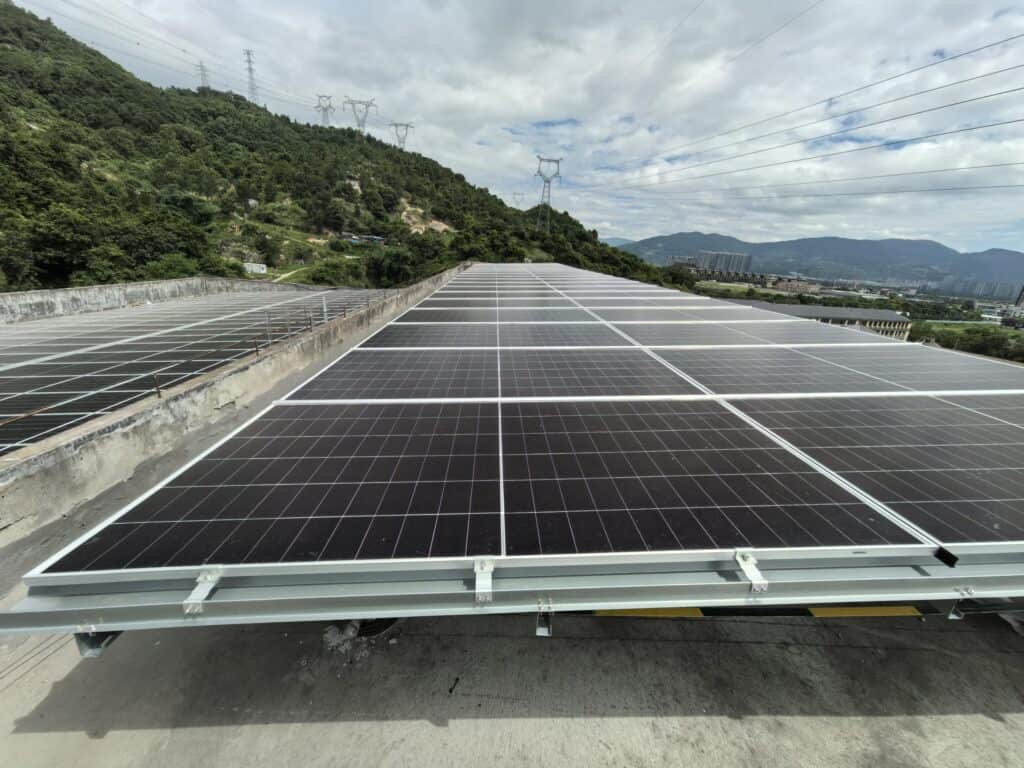
Galvanized steel structures offer excellent cost efficiency in dry inland regions, with zinc layers lasting over 25 years under low-corrosion conditions. In coastal or industrial zones, zinc consumption may reach 50 μm per decade, requiring planned mid-life maintenance.
Aluminum alloy mounting systems provide clear advantages in high-humidity and high-salinity environments. Anodized 6005-T6 aluminum can achieve a 30-year service life in C4 environments. However, alkaline soils (pH > 8.5) may still pose corrosion risks.
Surface treatment selection should align with corrosion category:
- C1–C2 (low): standard galvanizing or anodizing
- C3–C4 (medium–high): thick galvanizing, dual anodizing, or composite coatings
- C5 (very high): galvanized + coating systems, stainless steel, or special alloys
Fasteners often limit system lifespan. Designers should avoid direct contact between dissimilar metals and use insulating washers, uniform materials, or sufficient separation distances (≥50 mm) to reduce galvanic corrosion.
Environment-Adaptive Design Strategies
Targeted Design Principles
Effective mounting design begins with detailed environmental assessment. Engineers should compile at least 10 years of meteorological data, corrosion maps, and geotechnical reports to form a comprehensive environmental profile.
Reinforcement of Critical Zones
- Corrosion-prone areas: ground-level zones, water-contact points, and shaded areas require higher protection grades
- Stress concentration zones: optimized detailing reduces stress amplification
- Drainage-critical locations: designs must eliminate water accumulation and include auxiliary drainage where necessary
Balancing Safety and Cost
Lifecycle cost analysis often shows that a 10–15% increase in initial investment can eliminate two to three major maintenance interventions. Tiered protection strategies—applying higher protection only where necessary—achieve optimal cost-performance balance.
Maintenance as a Lifespan Extension Tool
Inspection Focus and Methods
A three-level inspection system is recommended:
- Monthly visual checks: corrosion, loosening, deformation
- Annual detailed inspections: coating thickness, bolt torque, foundation settlement
- Five-year deep assessments: NDT, corrosion potential measurement, material sampling
Optimal Timing of Maintenance Interventions
Protective repairs achieve the best results when zinc layer thickness falls to approximately 40% of its original value. At this stage, repair costs may reach only 30% of full replacement costs. Predictive maintenance based on monitoring data greatly improves efficiency.
Value of Early Intervention
Prompt treatment of localized corrosion prevents widespread degradation and avoids full system replacement. A maintenance culture emphasizing early detection offers the most economical path to lifespan extension.
Environmental-Driven Lifecycle Reliability Management
Environmental conditions should not constrain solar mounting design—they should define it. Truly reliable mounting systems result from coordinated decisions in materials, structure, protection, and maintenance based on local environmental characteristics.
As PV applications diversify, standardized solutions no longer suffice. Future mounting systems will emphasize environmental adaptability and full-lifecycle performance. Digital twins, big data–based aging prediction, and IoT-enabled monitoring are driving the transition from standardized products to intelligent engineering systems.
Only by integrating environmental factors into every phase—design, manufacturing, installation, and maintenance—can solar mounting systems truly achieve their intended service life and provide long-term structural reliability for photovoltaic power plants.